Everybody has heard of China’s top leader Xi Jinping, but what about the other 1.4 billion people there? They inhabit and shape the same globalised world as we do. Here are some of their stories that may give you a better feel of that society’s complex texture.
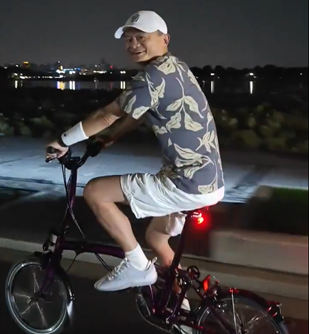
Jack Ma spotted by a fan cycling in Hangzhou. | Photo: 财经真相 on x.com (2025)
Jack Ma
(Born 1964) Jack Ma’s businesses are China’s answer to Amazon and Paypal. His Alibaba connects countless Chinese manufacturers to their customers across that country and abroad; AliPay handles half of China’s online payment, the predominant form of financial transactions in China. In late 2020, government agencies cracked down on Ma’s fintech company and forced its partial break-up. Ma disappeared from public life for two years before resurfacing with a much-subdued persona. Having built his empire from one of China’s first Internet-oriented companies in 1995 inspired by his visit to the US, Ma eventually grew too confident and powerful for the government’s comfort.
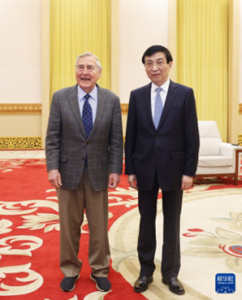
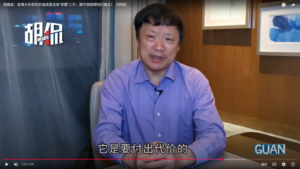
Wang Huning with the visiting US scholar Graham Allison. | Photo: China Ministry of Foreign Affairs
Wang Huning
(b.1955) Wang is directly in charge of China’s governmental reforms and policies on Taiwan today, having served as the Communist Party’s top theoretician since 1995, across three generations of senior leadership. The young scholar had gained prominence in the early 1990s, partly due to his book America against America, in which Wang recounted his six-month study tour in the US, reflecting on the governance of a modern society without dismissing the American system. Wang’s political instincts and competence carved out a path unique among Chinese scholars, while his intellectual background is a crucial asset for a Chinese leadership navigating foreign policy challenges today.
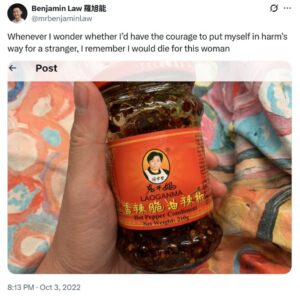
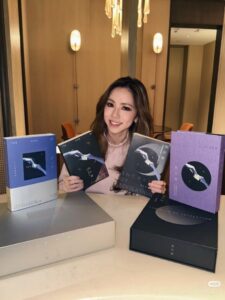
Photo: Benjamin Law on x.com
Tao Huabi
(b.1947) China’s most famous condiment maker, synonymous with her globe-trotting brand Lao Gan Ma, is an archetypal “self-made billionaire”. An illiterate, widowed mother by the age of 26, Tao started her one-person shop in one of China’s poorest provincial capitals. As her chili sauce became a local sensation and business boomed alongside the city, Tao set up a small factory in 1996. Within a decade, Tao’s company became a national success story under her personable yet efficient management and reputation of being quality-obsessed to a fault. Tao prides herself as an honest businessperson who always pays her fair share of taxes.
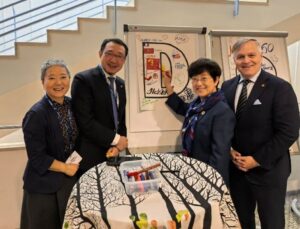
Prof. Jie Qiao (second from right) on a visit to Helsinki for an international conference. | Photo: Peking University
Jie Qiao
(b.1964) Amidst the rapidly deteriorating China-US relations in 2020 occasioned by COVID-19, Jie Qiao’s induction as a Chinese obstetrician into the American Academy of Arts & Sciences offered a rare glimpse of hope. It came just after Qiao had led one of the medical delegations from across the country to treat patients in the COVID epicentre, Wuhan, becoming part of China’s media story about national unity and government competence against the crisis. Since her appointment as Peking University’s executive vice president, the first woman in that role, Qiao remains a prolific researcher and a highly renowned clinician.