

From pilot to powerhouse: expanding WA’s sustainable bond market
Now a staple of global finance, GSS bonds offer a powerful mechanism to fund pressing environmental and social initiatives that lie outside traditional government budgets.
During a Senate inquiry into the Carbon Credit “Integrity and Transparency” Bill, my colleagues and I presented evidence showing that most of Australia’s 400+ “forest regeneration” (or “human induced regeneration, HIR) carbon offset projects are not regenerating native forests, and there is no prospect they will.
By Megan Evans
Fri 13 Nov 2026 10.20 AEDT
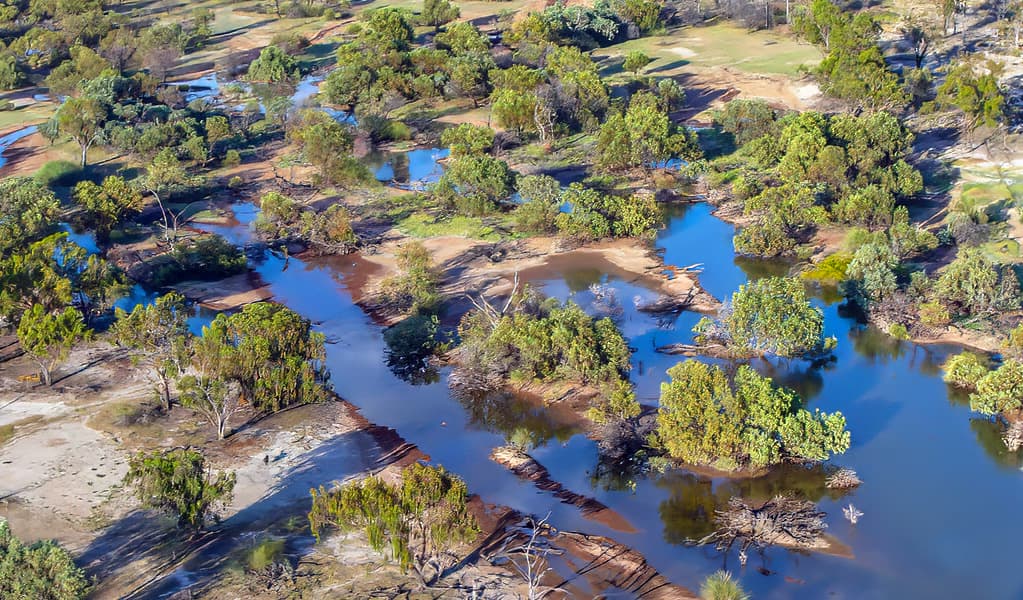
Brindingabba National Park, 175km from Bourke. Brindingabba contains a forest regeneration (HIR) carbon project. Photo: Joshua Smith, © DCCEEW


Now a staple of global finance, GSS bonds offer a powerful mechanism to fund pressing environmental and social initiatives that lie outside traditional government budgets.
Australia risks falling short of its global pledge to protect 30 per cent of the country’s land by 2030, with a new national review warning the biggest challenge isn’t just how much land is safeguarded, but whether it includes the ecosystems and species most at risk.
During a Senate inquiry into the Carbon Credit “Integrity and Transparency” Bill, my colleagues and I presented evidence showing that most of Australia’s 400+ “forest regeneration” (or “human induced regeneration, HIR) carbon offset projects are not regenerating native forests, and there is no prospect they will.
This is because the projects are mostly located in the “Outback”: semi-arid and arid landscapes that have never been comprehensively cleared and already contained mature vegetation (mostly shrubland and open woodland) when the projects started.
When I describe this situation in public talks, the audience is often in wide-eyed shock or erupts in nervous laughter at the absurdity of the situation. What do you mean that these projects are being issued tens of millions of carbon credits as if forest is regenerating on top of existing vegetation?
And yet the resounding message from industry and government is that everything is fine.
Last Friday, Senator Nick McKim described the situation as “scandalous”:
…we’ve had evidence … that only 10% of HIR projects are on land that has been comprehensively cleared of forest before the project was registered. That means 90% of the projects simply don’t meet the eligibility test. If this is true, this is scandalous, this is scandalous that it’s been allowed to occur, and questions need to be answered.
In response, a representative from the Clean Energy Regulator made the claim:
Senator, the claim that there is a requirement for land clearing is not correct. What the legislation requires is that there’s been a demonstrated history of suppression, which suppresses the ability to attain forest cover. Other methods do expressly require cleared land, and when we administer, we administer to the law…that is established under each of those methods.
The Clean Energy Regulator has made similar claims previously, including that “there is no requirement in the HIR method, nor other legislation, for projects to be preceded by land clearing” and that there is “no cleared land rule in the HIR method”.
It is, however, very easy to fact check this claim.
The Explanatory Statement of the HIR method states that:
The Determination applies to projects in which land has been cleared of native vegetation and where regrowth has been suppressed for at least 10 years. [Emphasis added]
Pretty clear cut. In fact, the Explanatory Statement says the same thing in two other places, including in the section concerning the eligibility of land:
The activity must occur on areas of cleared land on which regrowth has been regularly suppressed but has the potential to grow if suppression activities ceased, or on cleared areas that abut existing vegetation. [Emphasis added]
Quality research, analysis, explainers and factchecks from experts you can trust.
So while the HIR method itself does not explicitly refer to “cleared land”, any ambiguity is cleared up by the Explanatory Statement, which is the official legal guide to its interpretation.
In fact, the federal Department had previously interpreted the HIR method as only applying to cleared land, as its 2014 Fact Sheet states:
The activity must occur on areas of cleared land on which regrowth has been regularly suppressed (but which has the potential to grow if suppression activities ceased), or on cleared areas alongside existing native vegetation. [Emphasis added]
Similarly, the Clean Energy Regulator’s guidance on the method, published on its website over 2013 and 2014 stated:
The determination applies to projects where land has been cleared of native vegetation and where regrowth has been suppressed for at least 10 years. [Emphasis added].
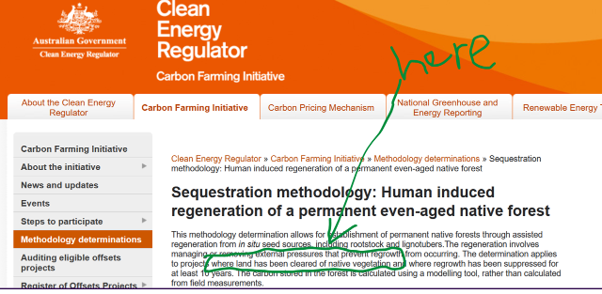
Screengrab of the Clean Energy Regulator website from 15th December 2014, available via Trove
Sometime around 2015, the Clean Energy Regulator seemingly forgot about the HIR method’s cleared land requirement, which also happens to be when project registrations exploded. Only 4 HIR projects were registered in 2013 and 2014, whereas 126 were registered in 2015.
It’s a shame that the Department’s HIR Fact Sheet and the old Clean Energy Regulator website have disappeared. Curiously, the current ACCU scheme’s project register includes a “Project Description” field in the downloadable spreadsheet and contains the following text for every HIR project:
This project establishes permanent native forests through assisted regeneration from in-situ seed sources (including rootstock and lignotubers) on land that was cleared of vegetation and where regrowth was suppressed for at least 10 years prior to the project having commenced.
This text also appears on the summary page for every HIR project, like this one for the Inverness Human-Induced Regeneration Project, which is located north of Bourke in NSW:
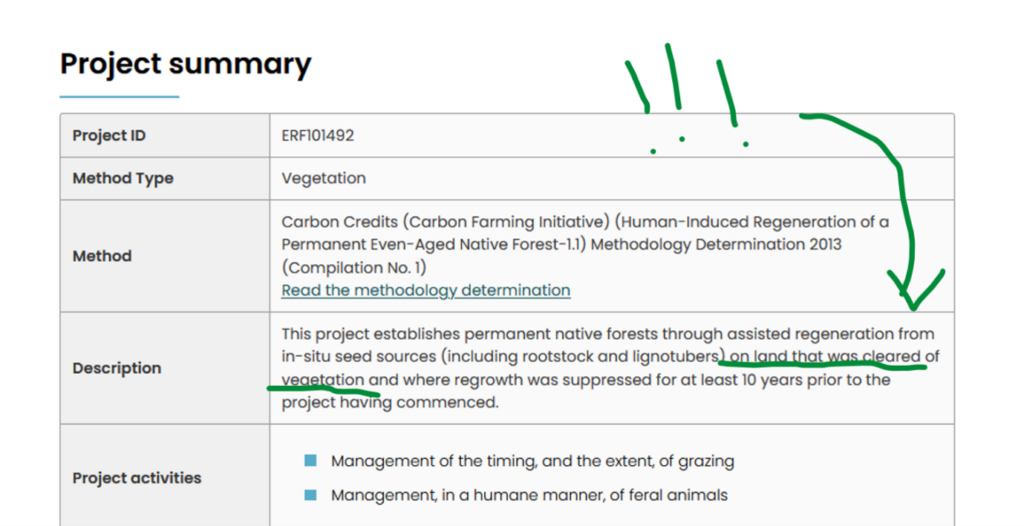
Caption: Screengrab from the Clean Energy Regulator website from 26th October 2026, via Internet Archive.
Curious indeed. Or perhaps a better word is “scandalous”.
Verdict: Not true