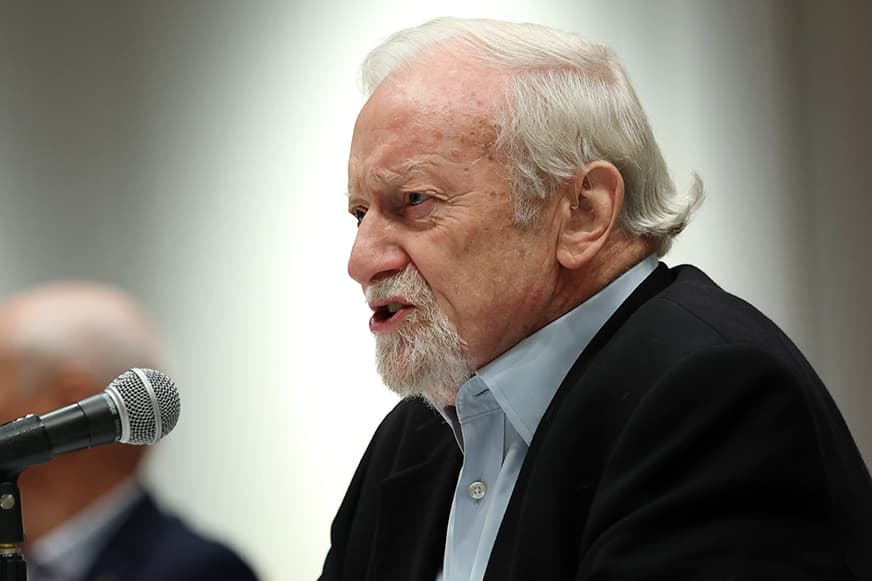
Former foreign minister Gareth Evans has described AUKUS as “one of the worst defence and foreign policy decisions” in Australia’s history, telling a public inquiry the submarine project may never be delivered and will “profoundly limit” the country’s freedom to make its own strategic decisions.
The former Hawke and Keating government minister delivered a scathing assessment of the $368 billion project at the independent inquiry into the trilateral security pact.
Under the deal, Australia’s first second-hand US Virginia-class nuclear submarines are due to be delivered in 2032.
However Mr Evans said there are “huge doubts” that will ever happen.
“There’s been, from the very beginning, zero certainty of the timely delivery of the eight promised AUKUS boats,” he said.
“The notion that these boats will be handed over to Australia on any other assumption that they’ll remain an absolute part of the US command is fanciful.”
Australia has already handed over A$2.7 billion to the US and A$863 million to the UK to boost their submarine-building capacity.
However, Mr Evans noted the US would still need to increase its annual build rate from 1.2 submarines to 2.3 to fulfil its own requirements and its promises to Australia.
He said there was even greater doubt about the second phase, arguing it required “even more heroic levels of optimism” for the UK to deliver an entirely new submarine design while grappling with workforce shortages, rising costs and delays.
Mr Evans cited former foreign minister Alexander Downer, who has described plans to build the submarines in Adelaide as a “fairytale” and a “mirage”.
To bridge the gap until the AUKUS submarines arrive, the Albanese Government is spending $11 billion to extend the life of the Collins-class fleet, which Mr Evans described as “already on geriatric life support”.
Mr Evans also argued the submarines were primarily designed to support US military operations against China.
“The only credible answer is for them to play the role which the United States manifestly wants them to play,” he said.
That role, he argued, would be “finding, tracking, attacking and destroying Chinese submarines seen as a nuclear threat to this US mainland”.
“With this role for the boats being the understood quid pro quo, the Morrison and Albanese governments could hardly have been left in any doubt as to what the United States thought it was getting from this deal,” he said, arguing Washington expected more than just Australia’s financial contributions.
Mr Evans criticised the belief that AUKUS amounted to “insurance premiums” for US security protection, warning that in the event of an “existential attack”, a future US administration would only retaliate if its own assets on Australian soil were threatened or attacked.
“The reality is that whatever the psychological comfort it might’ve offered us in days gone by AUKUS has never legally bound the United States to defend us,” he said.
“The notion that extended nuclear deterrence justifies our prostration … that the United States really would be prepared to sacrifice San Francisco for Sydney, let alone Miami for Melbourne, is and always has been a ludicrous delusion.”
While Australia benefits from intelligence co-operation and access to sophisticated technology, he warned it was sacrificing its independent decision-making.
“We should stop being so dewy eyed about what always has been and will be a very one-sided relationship and be very conscious of the risks involved in excessively entangling ourselves in what … may be again in the future, wrongheaded military decision-making in Washington.”
He cautioned Canberra against rushing to become involved in a possible war between China and the US over Taiwan, pointing out the increasing number of major US military installations on Australian soil would be “obvious targets” for China to attack.
“Australia is spending an eye-watering amount to build a capability to defend us from a military threat, which in fact is most likely to arise simply because we have that capability,” he said.
“This is not a fight that it would make any sense for Australia to join.”