A star Socceroo has delivered a powerful message to the world about multiculturalism, diversity and the contribution of refugees, ahead of Australia’s next game at the football World Cup.
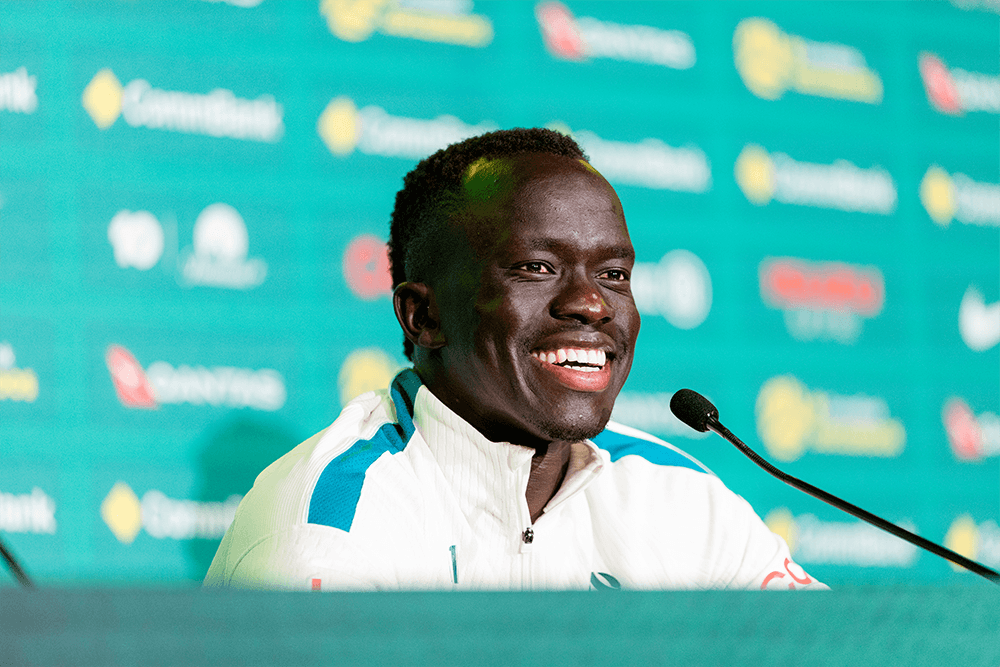
Adelaide-based winger Awer Mabil, one of four Socceroos who came to Australia as refugees before finding their way into the national soccer team, spoke to journalists in the build-up to the clash with co-hosts the USA on Saturday.
He was asked about the significance of the first week of the World Cup coinciding with International Refugee Week.
Mabil told his personal story of fleeing war-torn South Sudan when he was a small child.
He and his family spent years in a refugee camp in Kenya, where he learned to play football.
“I have a story of there was war in my country, so my parents flee my country, and then Australia took us in through a humanitarian visa,” he said.
“It’s Refugee Week. I would like to say to anybody that is misplaced all over the world that we are with you.”
“Everything is possible, so keep going.”
Mabil was asked about teammate Nestory Irankunda’s extraordinary opening goal of the team’s World Cup campaign against Turkiye on Sunday.
20-year-old Irankunda was born in a refugee camp in Tanzania, after his parents fled Burundi as the tiny east African nation descended into civil war in 2006.
His opening game heroics led to global coverage of his refugee background in news outlets all around the world – and an extraordinary outpouring of love in Australia.
“I think it was a moment to describe what Australia is, and Australia is very multicultural country, and that’s what makes it the best country in the world,” Mabil said.
“All the refugees. We all belong in this world”
Former Socceroo Craig Foster celebrated Mabil’s words on social media:
“Moving stuff from Awer Mabil. Telling his journey, and that of so many others, from displacement to the top of the world,” Foster wrote.
“Beautiful words about the history of Australian support for refugees, many of whom have been our greatest players.”“Australians come from everywhere, all with our own stories and journeys, united through the Socceroos. A message for the country, and very much needed.”
The Socceroos released a video on the eve of the tournament, celebrating the diversity in heritage of many members of the squad.
It was interpreted as a celebration of Australia’s multicultural society – “a reflection of modern Australia” – at a time when one of the event’s co-hosts was aggressively campaigning against immigration.
In the video, striker Mohamed Toure, who was also born in a refugee camp, tells of his “story before football”.
It’s a story of a family which spent 14 years in a camp in Guinea after fleeing Liberia when their homeland was being ravaged by ethnic violence in the 2000s.
Defender Milos Degenek explained how his family was forced to flee from Croatia to Serbia as the former Yugoslavia collapsed in the mid-1990s.
The players’ video message concludes with midfielder Jackson Irvine, saying “we are proud of where we come from and who we represent and proud to represent Australia.”
The Socceroos play the USA in Seattle on Saturday morning, Australian time, in a game which has become something of a grudge match, thanks to some colourful American commentary about the Australia team by members of the US media.