The Albanese government’s proposed new carbon credits method to help fund long-promised forest protection is facing possible defeat in the Senate, with the Coalition and crossbenchers joining forces to block the scheme.
Critics argue the proposal would allow fossil fuel companies to “greenwash” their emissions and help justify their continued expansion of coal and gas production.
Climate Change Minister Chris Bowen approved the Improved Native Forest Management (INFM) Method in June, carving out a significant exemption to the usual “additionality” requirements for state governments.
If approved by Parliament, the framework would become available to states and territories that still have active native forest logging industries, including Tasmania and Queensland.
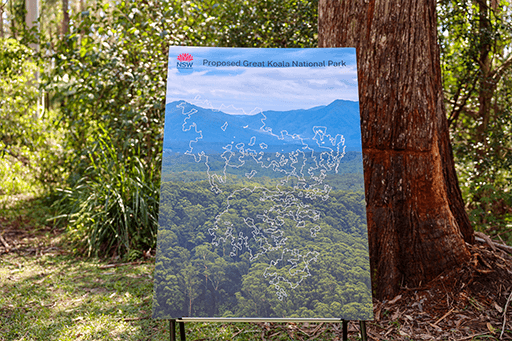
State and federal ALP governments have argued the new method could help fund the creation of the Great Koala National Park in New South Wales.
However, critics have pointed out that NSW Labor first committed to establishing the park in 2015 and reaffirmed the pledge before the March 2023 election.
The Minns Government then committed $80 million to its development, hailing it as the government’s most significant environmental commitment.
“The idea that you can generate carbon credits for something that was promised 11 years ago literally makes a mockery of the integrity claims around Australian carbon credits,” said the Australia Institute’s Co-CEO Dr Richard Denniss.
The principle of additionality is central to carbon offset schemes, requiring projects to deliver emissions reductions or carbon storage that that are additional to existing commitments, and would not have occurred without the financial incentive provided by carbon credits.
“The effect of this exemption is that a state government can generate Australian Carbon Credit Units (ACCUs) for stopping logging in publicly owned forest that it had already committed to protecting,” said Australia Institute advocate Louise Morris.
“This undermines the entire logic of so-called carbon offsets. It creates a mechanism for fossil fuel companies to purchase credits to keep polluting, while claiming forest protection and carbon abatement that was going to happen regardless.
“This is not an additionality assessment. It is a policy preference dressed up as one.”
The Coalition seized on similar concerns.
“If Labor’s policy is implemented, any state can monetise pre-existing forest closure commitments through the Australian Carbon Credit Unit (ACCU) scheme,” said Shadow Minister for Energy and Emissions Reduction Dan Tehan.
Environmental groups argued the proposal demonstrated that vested interests were being prioritised over conservation measures.
“What we’re worried about is that this tells us it’s the big end of town – the big polluters, the fossil fuel industry – that control parliament,” said Bob Brown Foundation campaigns director Jenny Weber.
“Australia Institute research has shown there is no shortage of carbon offsets boondoggles in Australia, but there is a shortage of the bravery required to confront the fossil fuel industry and their friends in the carbon offset industry,” added Dr Denniss.
There are also concerns that extend beyond the integrity of the carbon market, with Dr Denniss warning the proposal was fundamentally at odds with climate science.
“Climate science makes clear that the Australian Government needs to stop approving new gas and coal projects while simultaneously stopping the destruction of enormous amounts of our native forests,” he said.
“The science doesn’t say that it is okay for us to approve new gas and coal mines, as long as we save some trees at the same time.”
Independent MPs argued the proposal also raised broader questions about how governments valued environmental protection.
“The environment is inherently valuable. We shouldn’t be protecting important environmental places only if we can get carbon credits for them,” said Independent MP Andrew Wilkie.
“Why is it that the government has to monetise trees in order to create something that we absolutely need?” asked Member for Bradfield Nicolette Boele.
The Coalition has moved to disallow the proposed regulation, with Nationals leader Matt Canavan arguing it would incentivise governments to cease native timber harvesting rather than actively manage public forests.
“Labor’s new carbon credit approval will cause irreversible damage to Australia’s sustainable native forestry industry, sovereign timber supply capability, agricultural land and regional communities – locking up productive forest land for 100 years,” he said.
“The government’s obsessive pursuit of net zero is heading us towards net zero food security.”
The Australian Forest Products Association argued using carbon credits to shut down logging is unnecessary and harmful.
“This short-sighted decision risks undermining Australia’s sustainable multiple-use public production forests, which already deliver environmental, economic and climate benefits through active forest management,” Acting Deputy CEO Dominic Lane said.
“The only apparent beneficiary of this method is the NSW Government, which wants someone else to pay to fund their election commitment to develop the Great Koala National Park.”