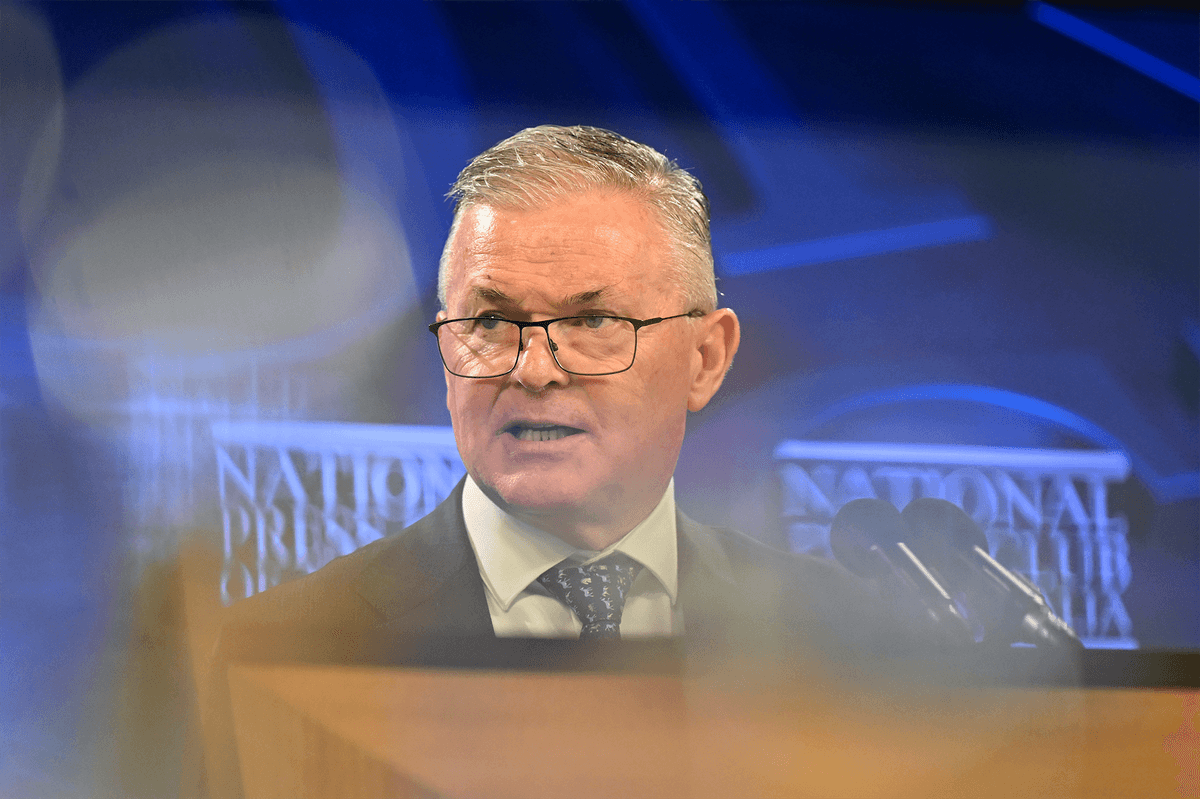
Santos CEO Kevin Gallagher has urged the Albanese government to rule out a tax on gas exports, warning the possibility remains on investors’ minds.
“I’d be misleading you if I said investors don’t ask about it, so I guess that means they’re concerned about it,” he told the National Press Club.
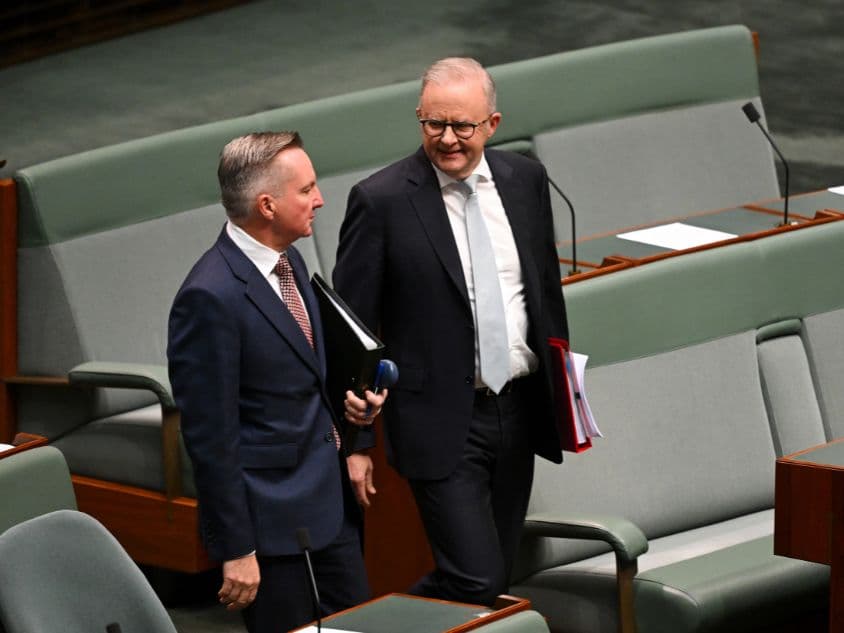
Prime Minister Anthony Albanese ruled out applying a gas export tax to existing contracts in the lead-up to the May budget, arguing it was the “worst possible time” to jeopardise key trading partners.
However, his choice of words sparked speculation that a future levy could still be imposed on new gas contracts and the spot market.
“Do I think it’s gone away? No, I don’t. I think the debate will be with us for a while,” said Mr Gallagher.
“I’d love to see them rule it out, but I don’t suspect they’ll ever rule anything out for the future.”
The long-serving CEO used his address to mount a broader case for Australia to increase gas development, saying conflicts in Ukraine and the Middle East had shown how heavily the world still relies on fossil fuels.
“It’s a common myth that when oil and gas prices spike, the world switches to renewables. It doesn’t. It switches to coal,” he said.
While he conceded there was a “legitimate and necessary” global push to reduce greenhouse gas emissions, Mr Gallagher argued that shouldn’t mean “abandoning” existing resource industries.
“Ours is an industry that needs no subsidies nor asks for them, yet some of our leaders are quick to say we’ve lost our social licence,” he said.
However, Tim Baxter, owner and founder of Naru Research, challenged that claim.
“Santos’s Moomba carbon capture and storage project has received a $15 million grant from the federal government plus federal carbon credits,” he said.
Mr Gallagher also argued more gas could help replace coal.
“I think gas’s biggest advantage from a climate perspective is that by putting more and more gas into the market, you’ll squeeze coal out by keeping prices competitive with coal,” he told the audience.
Get our newsletter
Quality research, analysis, explainers and factchecks from experts you can trust.
“If we prematurely withdraw supply of something the world still needs, we do not eliminate demand. We simply change who supplies it,” he said.
The Santos boss maintained that Australia’s LNG industry had stalled, with Asian buyers looking to the US and Canada to “hedge against the uncertain outlook they perceive” for Australian supply.
He also addressed accusations that Queensland’s LNG exporters were to blame for Australia’s east coast gas supply issues.
“It is not true that east coast gas supply issues were caused by Queensland’s LNG export industry, nor that there is an imminent supply or price crisis,” he said.
“Australia does not have a gas shortage,” he stated. “It just needs to get more gas out of the ground.”
However, Josh Runciman, lead analyst for Australian Gas at the Institute for Energy Economics and Financial Analysis, said the Santos-backed GLNG project told a different story.
“The Santos-backed GLNG project has siphoned more than 1000 petajoules of gas from the domestic market since 2017, equivalent to more than two years of domestic demand,” he said.
“That is despite the company originally assuring regulators the project would have no direct impact on our gas prices.”
Kyle Robertson, research director at Market Forces, also questioned Santos’ claims about Australia’s gas supply.
“Santos’ decisions to invest in huge new gas export projects have drained Australia’s domestic market and contributed to a near four-fold increase in gas prices,” he said.
Mr Gallagher also argued the Albanese government’s proposed 20 per cent domestic gas reservation scheme could be seen as “another form of tax”.
“A genuinely prospective gas reservation policy would be welcomed by the industry, so we know what the rules are before we invest,” he said.
Australia Institute polling found more than three in five Australians supported a 25 per cent tax on gas exports, with support particularly strong among One Nation and Greens voters.
The Canberra-based think tank estimates it would raise $17 billion each year, which it says could be spent on health, aged care or free childcare.