The NSW Government has committed to restricting the size of election posters but stopped short of committing to a proposed six-sign limit within 100 metres of polling booths ahead of the March 2027 state election.
By Tegan George
Thu 29 Oct 2026 10.16 AEDT
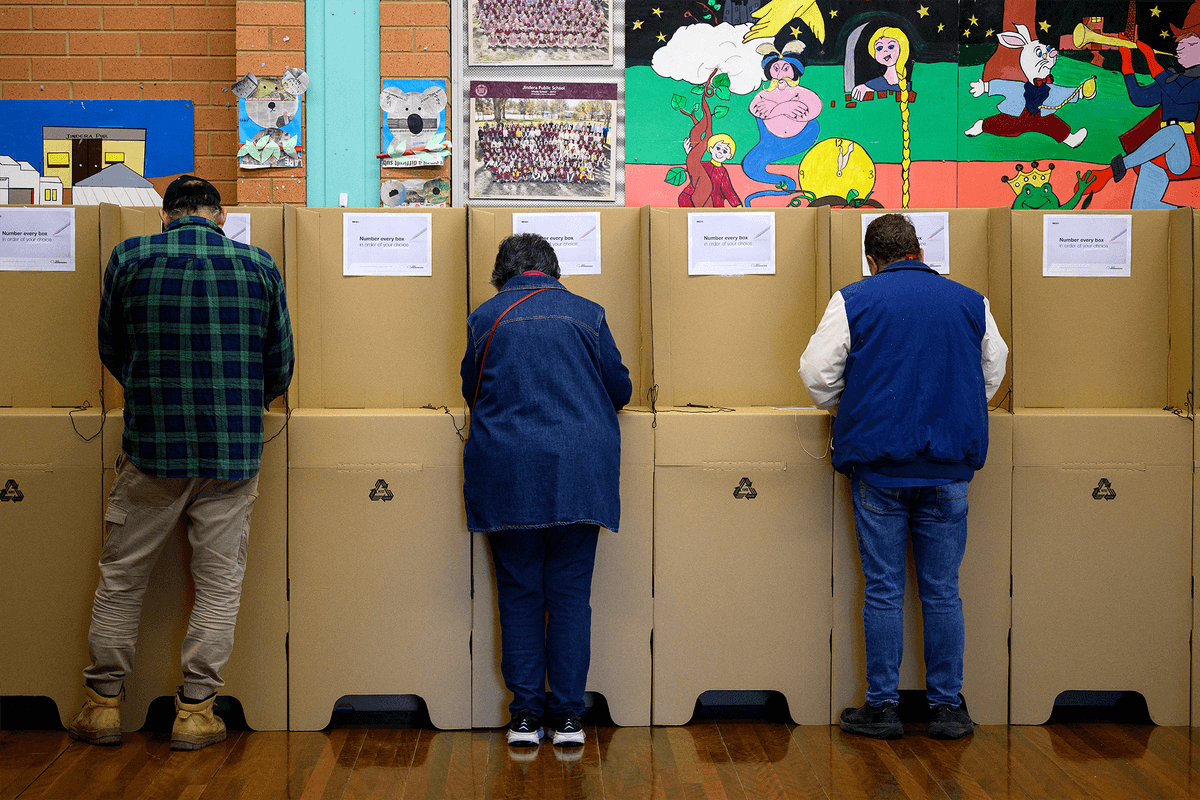
Photo: AAP Image/Bianca De Marchi


The NSW Government has committed to restricting the size of election posters but stopped short of committing to a proposed six-sign limit within 100 metres of polling booths ahead of the March 2027 state election.
Earlier this year, a parliamentary committee made 18 recommendations after an inquiry heard election signage had become an “arms race”, creating safety risks, visual clutter and an uneven playing field for candidates around polling places.
The Minns government has now tabled its response, accepting just one recommendation in full – limiting the maximum size of signs to 600mm x 900mm.
It adopted most other measures in principle including a proposal to establish a 100-metre restricted signage zone around voting booths, which it said it would consider implementing in future legislation following consultation with stakeholders.
Under current laws, election signage is restricted only within six metres of a polling place.
The NSW Electoral Commission warned that enforcing the wider zone would require substantial additional resources and asked that “any regulatory requirements of this kind should not be contemplated until after the 2027 election.”
“Some election sign proposals can be downright undemocratic, like the ACT’s ban on any signs or canvassing within 100 metres of polling booths,” said Bill Browne, the director of the Australia Institute’s Democracy and Accountability program.
“On the other hand, there’s an election ‘arms race’ where volunteers turn up in the middle of the night to block all available space with their own election signage.”
Mr Browne said the NSW committee had struck a balance between a “festival of democracy” and rationing limited space by proposing the six-sign limit.
Quality research, analysis, explainers and factchecks from experts you can trust.
However, he said he would like to see some provisions to protect non-registered third-party campaigners.
“Local community groups should be able to have a presence at polling booths without registering as third parties (with all the restrictions and reporting requirements that go with it),” he said.
However, he said broader electoral reform was needed.
“While they are at it, they could introduce truth in political advertising laws including restrictions on AI deepfakes, as demanded by over 31,000 NSW residents,” he said.
Pressure is growing for change in NSW following a grassroots campaign that saw 31,537 people sign a petition calling for truth in political advertising laws, similar to those already in place in South Australia and the ACT.
The petition closed in September and was the fourth-most popular electronic petition in NSW history.
Having exceeded the 20,000-signature threshold, the petition has now qualified for a debate in NSW Parliament.
“This year, tens of thousands of NSW residents told politicians that they want truth in politics laws before next year’s state election. Next month’s debate will be a chance for parliamentarians to make the case for these laws – or explain why they are not acting,” said Mr Browne.

