New South Wales voters appear to be heading to the polls next year without laws prohibiting misleading claims in political advertising. An e-petition, signed by more than 31,500 people, recently triggered parliamentary debate, but neither the Labor Government nor Coalition Opposition committed to introducing the proposed legislation.
By Tegan George
Thu 19 Nov 2026 15.33 AEDT
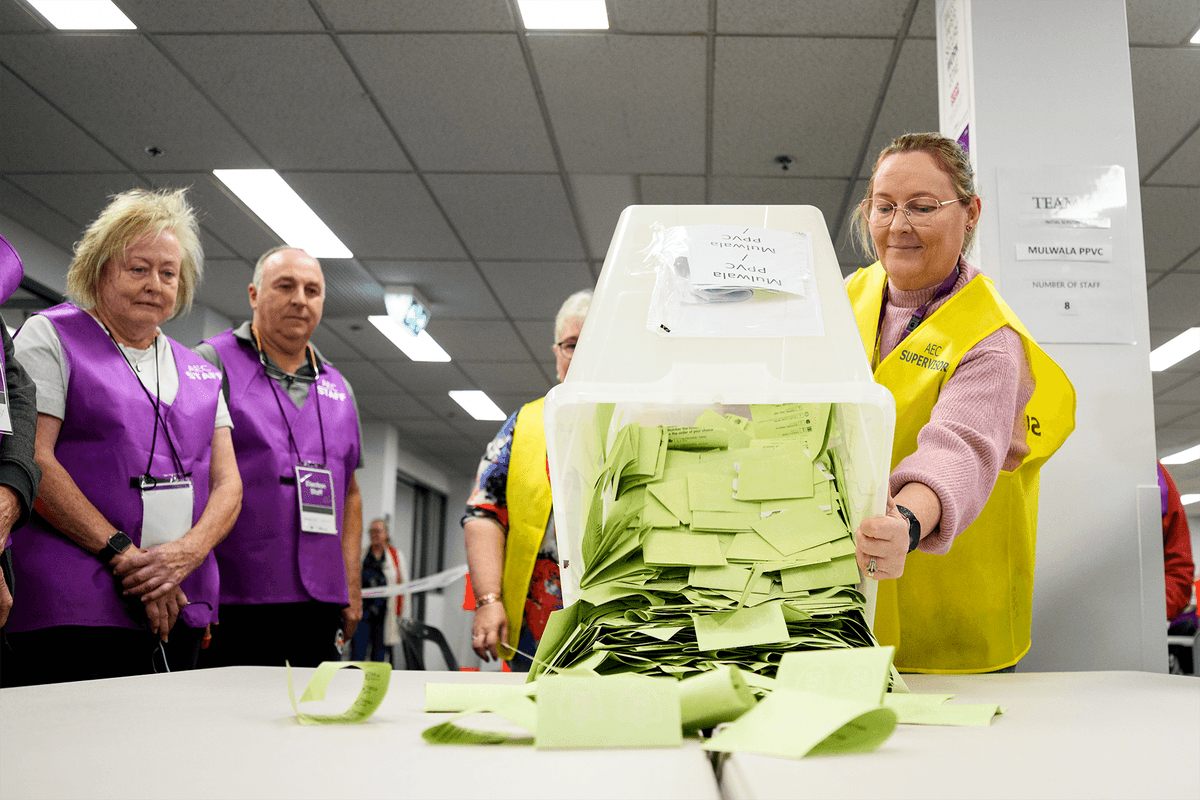
Photo: AAP Image/Bianca De Marchi


New South Wales voters appear to be heading to the polls next year without laws prohibiting misleading claims in political advertising.
An e-petition, signed by more than 31,500 people, recently triggered parliamentary debate, but neither the Labor Government nor Coalition Opposition committed to introducing the proposed legislation.
“For once, it was the people – not the politicians – who decided what Parliament debated, and they chose truth in political advertising laws,” said Bill Browne, Director of The Australia Institute’s Democracy & Accountability Program.
The petition, launched by concerned citizen Michelle Millner and supported by the Australia Institute, reached 31,537 signatures.
“Without laws around this, our democracy is broken,” Ms Millner said in June.
Under the proposed reforms, misleading factual claims in political advertising could be prohibited, including false suggestions a party will introduce a new tax or cut a government service.
Independent MP Jacqui Scruby, who sponsored the petition, described arguments against the reform as a “bit of a cop-out”, pointing to similar legislation operating in South Australia and the ACT.
“It really shows that we are not being brave,” she told the parliament.
Fellow independent MP Michael Regan backed the call, warning that the potential to create and spread convincing political misinformation had never been greater.
“Would it not be great to finish our parliamentary term with this one piece of legislation, united together and moving forward?” he said.
Labor Minister Jenny Aitchison acknowledged the issue, saying push polling – a campaign tactic that uses misleading questions disguised as opinion polling to influence voters – had been used against her in the 2023 election.
“People do not need a camera or a video to make the truth look different to what it actually is,” she said.
She also pointed to a 2024 parliamentary committee report that identified practical challenges with implementing the reforms.
“But that does not mean that we walk away,” she said.
She pointed to legislation introduced earlier this year banning certain AI-generated political deepfakes and requiring other digitally altered electoral material to be labelled.
Quality research, analysis, explainers and factchecks from experts you can trust.
Shadow Special Minister of State Tim James questioned who would determine whether political claims were false.
“Who will be the arbiter of the truth? Who could be the overarching judge of objectivity and fact?” he asked.
“Could the complaints process be weaponised against political opponents? A complaint lodged just before polling day could produce damaging headlines before anyone assesses its merits.”
However, supporters of the legislation say similar laws have been operating in South Australia for decades.
“South Australia has had working truth in political advertising laws for forty years, and they are popular, practical and constitutional,” said Mr Browne.
“And indeed, they have survived a challenge in the Supreme Court when measured against constitutional protections.”
Greens MP Kobi Shetty said the laws needed to extend to third-party campaigners.
“Industries such as the mining sector, as well as the gambling lobby and the tech billionaires—those with the deepest pockets—are able to flood our screens and social media feeds with ads that contain wild claims that are meant to create fear in voters and drive them to vote in a different way,” she said.
In June, Australia Institute polling showed almost nine in ten NSW residents supported truth in political advertising laws.
Independent MP Dr Joe McGirr said that the upcoming state election should “be a plebiscite on this issue for the community”.
Independent MP Alex Greenwich pointed to the risk from generative AI, saying “As AI use becomes more prominent, without intervention, misinformation and misrepresentation will become more entrenched in electioneering”.
In June, federal independent MP Zali Steggall launched a fresh push for truth in political advertising laws on a national scale, warning that artificial intelligence and deepfakes pose a growing threat to Australia’s democracy.
“Our electoral laws must keep pace,” she said.
NSW is set to go to the polls on 13 March 2027.

