Prime Minister Anthony Albanese is facing backlash after quoting inaccurate statistics from the gas lobby, while defending his decision not to impose a 25% tax on gas exports in the federal budget. Mr Albanese was interviewed on radio during a post-budget trip to Perth, during which he claimed that “gas companies paid $22 billion of tax last year”. The $22 billion figure is not an official estimate by the Australian Taxation Office (ATO), but a figure produced by a gas lobby group.
Fri 22 May 2026 01.00 AEST
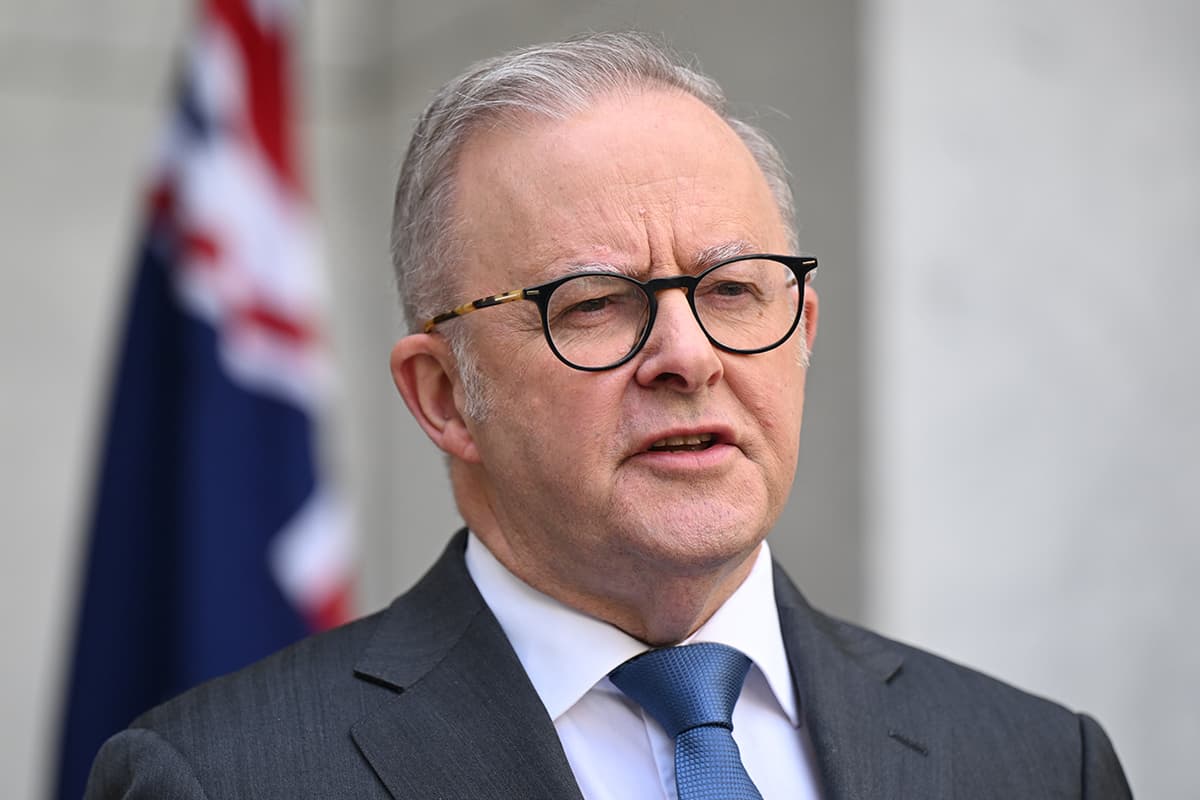
Photo: AAP Image/Lukas Coch


Prime Minister Anthony Albanese is facing backlash after quoting inaccurate statistics from the gas lobby, while defending his decision not to impose a 25% tax on gas exports in the federal budget.
Mr Albanese was interviewed on radio during a post-budget trip to Perth, during which he claimed that “gas companies paid $22 billion of tax last year”.
The $22 billion figure is not an official estimate by the Australian Taxation Office (ATO), but a figure produced by a gas lobby group.
The latest ATO figure is $10.2 billion in company tax in 2023-24 along with $1.4 billion in PRRT, payments that were boosted by high gas prices due to Russia’s invasion of Ukraine and the war in the Middle East.
Research by The Australia Institute shows that before the war in the Ukraine, the gas industry paid on average $2.6 billion in company tax each year, far less than income tax payments by professions such as nurses or teachers.
In the same radio interview, Prime Minister Albanese went on to claim the push for a gas export tax was “a social media campaign”.
Dr Richard Denniss, co-CEO of The Australia Institute, says that claim is disingenuous.
“Leaving aside the fact that many ordinary Australians express themselves through social media, what is most surprising about Mr Albanese’s comments is that he seems to be unaware that calls for an export tax came first from the Australian Council of Trade Unions,” he said.
“In addition to the ACTU, support for improving the taxation of gas comes from people as diverse as the Greens, David Pocock, Clive Palmer and Pauline Hanson.”
“It is clear that a large and growing number of back bench and cross bench MPs are fair dinkum about taxing gas exports.”
“Likewise, polling has shown that millions of ordinary Australians are fair dinkum about taxing gas. They’ve had enough of being constantly told to tighten their belts while multinational gas giants get a free ride.”
Dr Denniss also hit back at the Prime Minister’s suggestion that The Australia Institute’s support for the ACTU’s proposed 25% gas export tax was somehow not “fair dinkum”.
“I can assure the Prime Minister that The Australia Institute is fair dinkum in our calls for Australians to get a fair return for our gas,” he said.
“Mr Albanese’s government chooses to give gas away for free to the gas export companies, gas that could be taxed and raise more than $17 billion per year.”
The Australia Institute responded to the PM’s “fair dinkum” claim by taking out full page advertisements in newspapers around Australia, reminding readers that Australian nurses pay more tax than the gas industry pays and that a gas export tax would raise more than $17 billion a year.
“Fixing big problems doesn’t have to be complicated. Mr Albanese could tax gas exports and spend the money raised on repairing our schools, hospitals and roads, building public housing or supporting older Australians and those living with disabilities,” Dr Denniss said.
“Taxing gas exports is a no-brainer. It would raise more than $17 billion per year, divert gas away from export markets and to Australians, which would lower the price of gas here. “The only obstacle to this simple solution is finding the bravery to stand up to the gas giants.”
Many of the MPs pushing for a flat 25% gas export tax say they are doing so because of the abject failure of the Petroleum Resource Rent Tax.
In his petition for a gas export tax, Independent Senator for the ACT, David Pocock, says the PRRT is “supposed to ensure Australians get a fair return” for the nation’s natural resources.
“The Albanese Government made weak reforms in the last parliament with the support of the Greens, but the reforms are not delivering the billions of dollars they should have – money that should be funding hospitals, schools, disaster relief, and the transition to clean energy,” Senator Pocock’s petition states.
“This isn’t just a policy failure; it’s a national disgrace.
Australia Institute analysis of last week’s budget papers reveals the PRRT raises less revenue than the tobacco excise, despite estimates that more than half the tobacco sold in Australia is now bought tax-free on the black market.
“Australians are constantly hearing how more than half the tobacco sold in Australia is bought tax-free on the black market, which has led to a big drop in how much the government collects from tobacco excise. But, despite the flagrant tobacco tax evasion, the sale of cigarettes still contributes far more to the Commonwealth budget than the PRRT,” Dr Denniss said.
“While the government may be unable to crack down on the illegal tobacco industry, it is simply unwilling to crack down on the gas industry.”
The Prime Minister has been warned that while he may have kept the gas lobby happy for now by failing to introduce a gas export tax in the federal budget, the issue won’t go away.
Advertisement