It isn’t always easy to keep up with what’s happening in the US. “Shorter America” is a series where Dr Emma Shortis loops you in on what’s going on in America and shares news and analysis that you can trust.
By Emma Shortis
Fri 19 Jun 2026 01.00 AEST
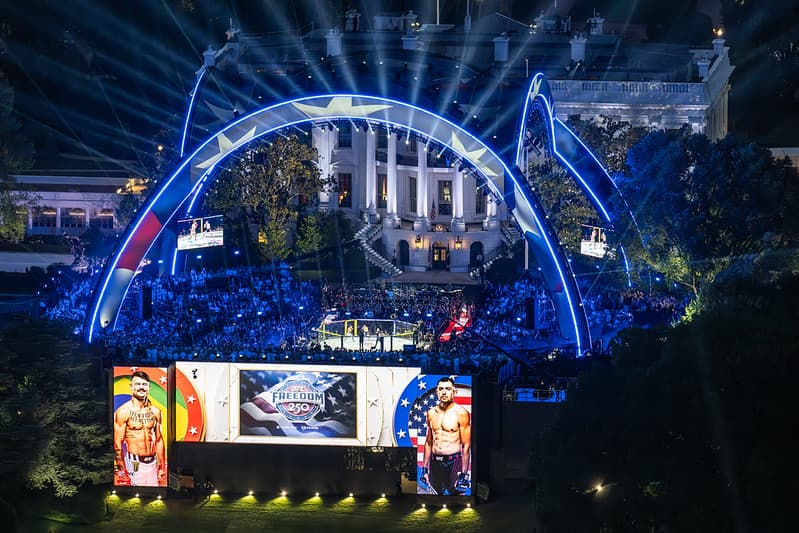
Photo: The White House/Flickr


Trump’s “peace” deal with Iran remains on very shaky ground. But the President isn’t worried – he is living his best life watching UFC fights on the South Lawn of the White House and looking forward to dinner with the French President at Versailles.
This week:
I don’t have the words to describe this, and there’s no point trying to find them. Ta-Nehisi Coates is the best writer of his generation. Possibly several generations. In Vanity Fair, he has an era-defining piece on “The Next Black President”.
In a special treat, one of the very few who might claim to be Coates’ peer also has a piece in the New York Times this week.
Here’s Shorter America favourite Tressie MacMillan Cottom on AI and democratic politics:
“I find centrism to be uninspired political messaging under the best of circumstances, but when the powerful are radically restructuring our politics, economy, relationships and environment, technocratic tinkering is political malpractice.”
Gee, I wonder who that might also apply to…
Last week, I put out a call for analysis of the link between American white supremacy and what’s happening in Belfast and the UK more broadly. Coates’ piece above provides the long historical context for the role of American empire in exporting and reinforcing white supremacy.
Closer to the ground, here’s Will Loyd in The New Statesman. And for some different takes on the role of Musk, I was struck by these two apparently contradictory pieces: Lee Hurley in Parker Molloy’s The Handbasket arguing that “Elon Musk alone isn’t responsible for Belfast’s racist pogrom”, and Le Monde/AFP with “Elon Musk’s role was ‘instrumental’ in the Belfast riots, researchers say”. Look deeper, though, and I think they’re compleimentary.
And on Musk, here’s a harrowing summary of his role in The Verge: “The world’s first trillionaire is a killer / Elon Musk’s empire of wealth is built on suffering”.
The other thing I haven’t been able to stop thinking about this week is the way Australia’s relationship with the United States, as it is currently constructed, reinforces the worst in both of our politics.
There is the obvious, official way in which the Australian government continues to double down on our “most important security ally”, refusing to approach that relationship from any point of progressive principle. And then there’s the way high-level former officials reinforce that – think former Treasurer-turned defence lobbyist Joe Hockey yukking it up with former Trump Chief of Staff Mick Mulvaney at the National Press Club in Canberra.
But we must add to that the way that Australian sports broadcasters jumped enthusiastically on board with Trump’s UFC “Freedom 250” at the White House, wholesale regurgitating his line during both AFL and NRL broadcasts that this was “the most historic sporting event of all time”.
What does that even mean? And what does it say that Australian commentators uncritically regurgitate and reinforce Trump’s agenda? In the absence of any real pushback, that’s what the relationship is. It is defined, now, by Trump’s version of America. As Monica Hesse wrote in The Washington Post this week, “I guess this is what we’re doing now.”
P.S. What I’m doing now is heading to Brussels and Berlin to talk about security with our European colleagues. Shorter America will be back in a fortnight x
Advertisement