A third top level recruitment process is under way for the National Anti-Corruption Commission – to appoint a new commissioner and deputy commissioner following the resignations in May of Paul Brereton and Nicole Rose, both two years short of their five-year terms.
The first two processes – in 2022 and 2023 – were characterised by secrecy. Even members of parliament’s NACC oversight committee, the PJC-NACC, were given little information on how the recruitment was conducted. The jobs were publicly advertised but then the shutters came down.
In acknowledgement of the profound public disappointment in the NACC’s performance to date, following Brereton’s resignation Attorney-General Michelle Rowland promised a more transparent recruitment process and a “reset” of the beleaguered organisation:
I’m engaging across the parliament to look at ensuring … that there is transparency of the merit-based process … [and] also realising there is an opportunity here to reset the Commission and to ensure there is public confidence in this very important institution. (Bold added.)
This investigation, based on documents released under Freedom of Information, shows that nothing of substance has changed. The secrecy that characterised the two earlier recruitment processes looks set to be repeated. The government appears just as intent on evading scrutiny and oversight of this crucial third recruitment process.
Despite having been repeatedly advised by integrity experts to establish a recruitment process at arms-length from government for the top NACC roles, the Albanese government has chosen to stick with the ‘merit and transparency’ guidelines that have been in place since 2008.
These guidelines were strongly criticised by Lynelle Briggs in her 2023 “Jobs for Mates” report.
Smoke and mirrors
The current attorney-general, Michelle Rowland, appears to have led members of the NACC oversight committee and respected integrity advocates to believe that the latest recruitment process is a marked improvement – because there will be an “eminent” independent person included on the government-controlled selection panel.
Yet we can reveal that the first recruitment process also featured an eminent independent member on the selection panel.
Not only was this information kept from the public, it was also withheld from the PJC-NACC.
“It’s extraordinary as a member of the Parliamentary Joint Committee on the NACC to be finding this out three years after the event and only through an FOI,” Greens Senator David Shoebridge told us.
Despite Rowland’s promises of increased transparency, the government has refused to disclose – even to members of the PJC-NACC, which is bound by confidentiality – the names of the people it has appointed to the selection panel.
Integrity expert, and former counsel assisting the NSW ICAC, Geoffrey Watson SC, told the committee he was “absolutely shocked” when advised the government would not be telling the committee who’s sitting on the selection panel.
I’m absolutely shocked. I did not know they’re not going to tell you who’s on the selection panel…
Even if there were good reasons not to make the identity of the people on the selection panel public, surely there are no good reasons whatsoever to keep it secret from this joint committee. I just would not be able to understand that. … This committee has got an incredibly important role. You’re representing all of us when you’re sitting there. … You should be given as much information as possible.
“Inappropriate and problematic” to reveal name
At the 26 June parliamentary hearing of the PJC-NACC, deputy secretary of the attorney general’s department Sarah Chidgey said the selection panel for the current recruitment would comprise three or four members, with the final number not decided.
While the panel would include an “eminent independent person”, Chidgey stated that it would be “inappropriate and problematic” for the person’s name to be made public, citing the potential for that person to be possibly influenced.
When deputy chair of the committee, Victorian independent MP Helen Haines, and Senator Shoebridge both responded that eminent people were very experienced in dealing with that, and insisted the name be made public, Chidgey said only that the department “may” consider releasing the eminent person’s name after the appointments had been made.
We asked AG Rowland as well as the PJC-NACC chair, Labor MP Kate Thwaites, whether the government would be telling the committee the names of the panellists. Neither responded.
We asked Senator Shoebridge shortly before publication whether the committee had been told the names. He said it had not been.
Attorney-general Dreyfus intervened in previous two NACC recruitment processes
Two recruitment processes were required to fill the positions of Commissioner and three deputy commissioners (DCs) because of an intervention by then attorney-general Mark Dreyfus.
The FOI documents show that Dreyfus initially directed that three permanent DCs be appointed, but after the selection panel had recommended three suitable candidates, Dreyfus changed course and instead hired two permanent DCs – Nicole Rose and Ben Gauntlett – and a temporary ‘acting’ DC – Jaala Hinchcliffe, former head of the Australian Commission for Law Enforcement Integrity.
An additional recruitment process was later required to hire a third permanent DC.
For both processes, the attorney-general’s department, led by secretary Katherine Jones, appointed a selection panel whose members decided on and interviewed a short-list of applicants, then recommended suitable candidates to the attorney-general.
The first recruitment process began in October 2022. Some 17 people applied for commissioner while 94 people applied for one of the three DC roles.
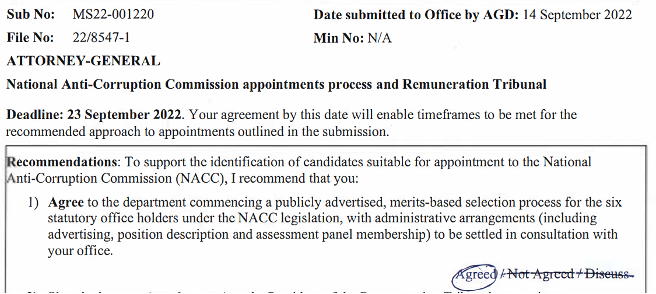
The six NACC office holder positions to be advertised were: Commissioner, three deputy commissioners, chief executive and Inspector.
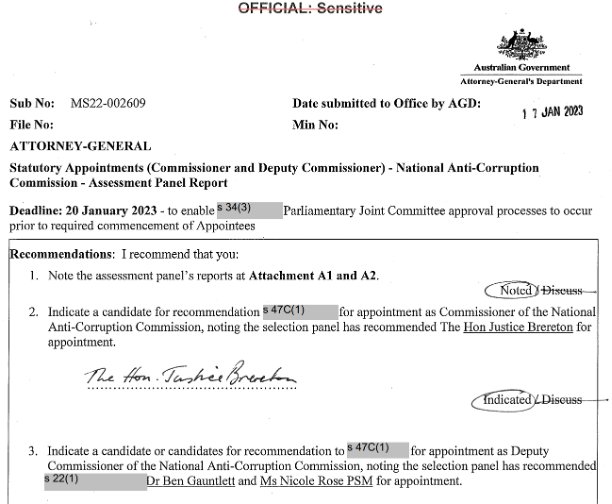
The selection panel recommended three people for appointment as permanent DCs.
The second process to hire a third permanent DC began in July 2023 and 50 people applied.
The first recruitment process had included an eminent independent member on the panel, but the second did not. We asked the Attorney-General’s Department the reason for the different approaches. It did not respond.
As has been reported, it was during this second process that Dreyfus tried to install then NSW Supreme Court Justice Stephen Rothman as the third DC. Rothman had been a Labor candidate for a Sydney seat in 1984, and contested Labor preselection for a different NSW seat in 2003; both unsuccessfully. He was widely known in NSW for his long-term party and union connections.
The PJC-NACC, which is tasked with vetting the attorney-general’s nominated candidates, raised objections to the nomination.
Led by its then chair, the late Labor senator Linda White, the committee believed Dreyfus and his department had given them insufficient information on Rothman, and failed to properly vet him. Senator Shoebridge said they were given “sanitised” documents. Rothman subsequently withdrew his candidacy.
Dreyfus then proposed Kylie Kilgour, who was approved as the NACC’s third permanent DC by the PJC-NACC in January 2024.
Revealed: the selection panels and conflicts of interest
We obtained via FOI the names of the seven people who sat on the two selection panels. Aside from the sole external person, all panellists were senior government officials.
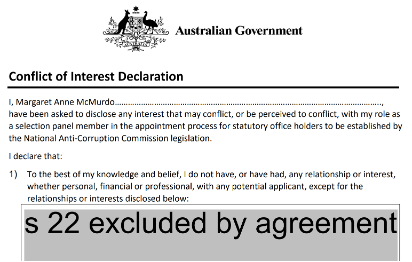
A separate set of documents, also obtained via FOI, revealed that four of those seven people – including the eminent independent person – declared actual or perceived conflicts of interest.
The first selection panel:
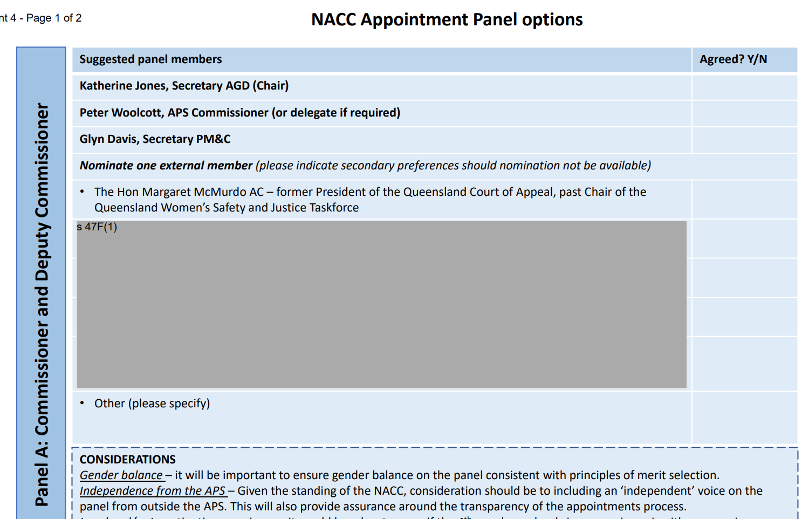
- Katherine Jones, panel chair, secretary of the AGD, prescribed by the guidelines
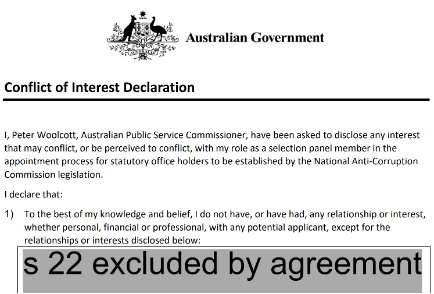
- Peter Woolcott, then Australian public service (APS) commissioner, also prescribed
- Glyn Davis, then secretary of Prime Minister Anthony Albanese’s department of prime minister and cabinet
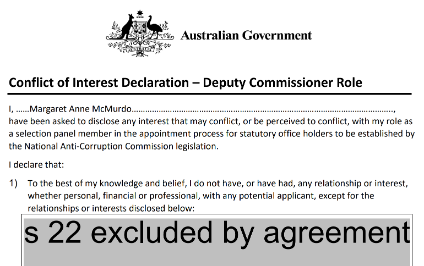
- The Hon Margaret McMurdo, a former president of the Queensland Court of Appeal.
The merit and transparency guidelines require the departmental secretary to be panel chair and the APS Commissioner to be included.
Jones, as departmental secretary, was responsible for appointing Davis and McMurdo.
The FOI documents show that deputy secretary Chidgey advised Jones on how to ensure ‘transparency’. She wrote:
“Independence from the APS: Given the standing of the NACC, consideration should be to [sic] including an ‘independent’ voice on the panel from outside the APS. This will also provide assurance around the transparency of the appointments process.”