ANZ has ruled out financing gas pipelines dedicated solely to new oil and gas projects, in a major win for climate activists who’ve spent the past five months campaigning against the bank’s potential involvement.
By Tegan George
Wed 11 Nov 2026 11.11 AEDT
Photos: Supplied/Rising Tide


ANZ has ruled out financing gas pipelines dedicated solely to new oil and gas projects, in a major win for climate activists who’ve spent the past five months campaigning against the bank’s potential involvement.
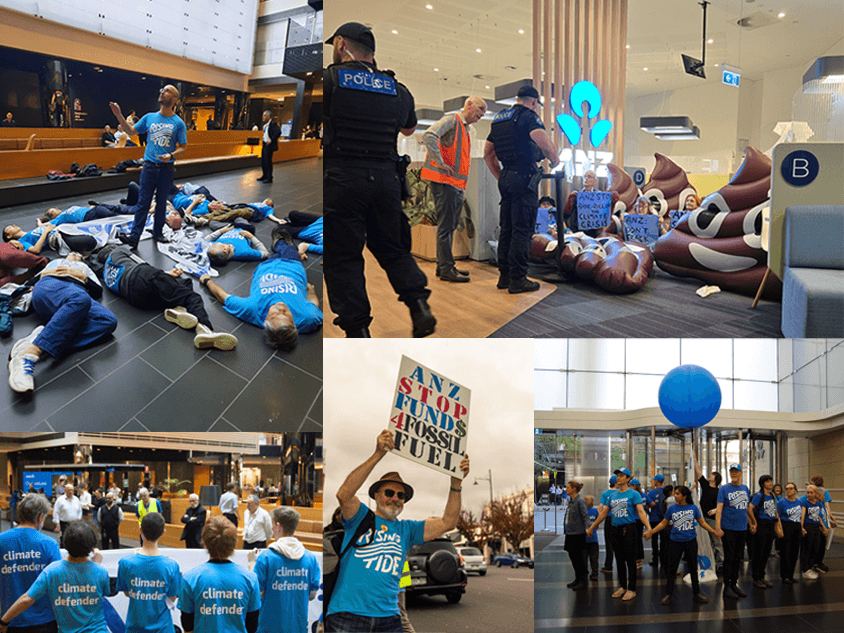
The announcement, contained in the bank’s 2026 annual report, follows more than 70 protest actions organised by Rising Tide across four states, including demonstrations inside ANZ branches, corporate offices and events attended by senior executives.
The group said ANZ was the last of Australia’s four major banks to adopt a policy that ruled out financing the proposed North to East Australia (NEA) pipeline, which would unlock large-scale gas production in the Northern Territory’s Beetaloo Sub‑basin.
“We will not directly finance new or expansion upstream oil and gas projects … or new midstream infrastructure dedicated solely to new upstream oil and gas projects (such as new transmission pipelines),” the bank stated.
Grassroots organisation Rising Tide claimed the announcement as a victory for community campaigning.
“Over the last five months, we have accomplished over 70 actions across the nation, calling upon ANZ to rule out the NEA pipeline,” said Rising Tide spokesperson Nick Willis.
“We have seen disco dinosaurs, giant poo emojis and even a marching band! Whilst we have used humour in our actions, there is a serious side. The funding of this massive gas pipeline is a serious threat to our climate and futures.”
Small business owner Allison Arnott said the issue compelled her to join protest action for the first time.
“It would unlock catastrophic fracking in the Beetaloo Basin and have devastating impacts on our climate and the cultural heritage and Country for traditional owners of the region,” she said.
“I realised that the only way to stop them was through people power.”
Fourteen people were arrested across three demonstrations in Brisbane, including six protesters who occupied an ANZ branch in the CBD equipped with giant inflatable ‘poo’ emojis.
Quality research, analysis, explainers and factchecks from experts you can trust.
Rising Tide said it was able to target its campaign effectively thanks to information provided by a confidential ANZ source.
“It has been scary to speak up, but the climate crisis is scarier,” said the source.
“In a company this size, our leadership team holds all of the power. There is no avenue for me as an employee to help change the company’s direction.”
Rising Tide said 19 staff members also completed a survey, with 95 per cent agreeing that ANZ should rule out funding the NEA pipeline.
It comes as New South Wales Police seek to block legal protections for the group’s planned protest in Newcastle, despite organisers insisting they have no intention of disrupting operations at the city’s coal port.
The group has been planning a community “Paddle for the Planet” event for this weekend to coincide with COP31 negotiations and said it submitted the required paperwork to police weeks ago.
Under NSW law, protest organisers can file a Form 1 Notice which, if the assembly is authorised, gives protesters legal protection against obstruction charges and police move-on orders.
“The Minns Labor Government is hell-bent on suppressing peaceful protest, and this is yet another attempt to silence dissent rather than actually take meaningful action on the climate crisis,” said event organiser Alexa Stuart.
The case, which is set to be heard in the Supreme Court in Sydney on Wednesday, also includes a bid by police to recover legal costs from Rising Tide if the application succeeds.
The Australia Institute’s co-CEO Dr Richard Denniss has previously argued that attempts to restrict protests demonstrates their effectiveness.
“Don’t feel for a minute that we as a community don’t have power. Please don’t think for a minute we can’t drive change. That is exactly what governments want people to think. If protests didn’t work, they wouldn’t try and ban them,” he said.

