“This is a war against Australians,” declared independent Senator David Pocock in a fiery Senate speech, minutes before the Defence Bill passed under a guillotine. The Defence Legislation Amendment (Accelerating Capability and Protecting Bases) Bill hands extraordinary executive power to the Defence Minister, foreign militaries and private companies. It has almost no merits review, toothless oversight, no red lines on international law, and harsh penalties for protestors and journalists.
Fri 20 Nov 2026 13.13 AEDT
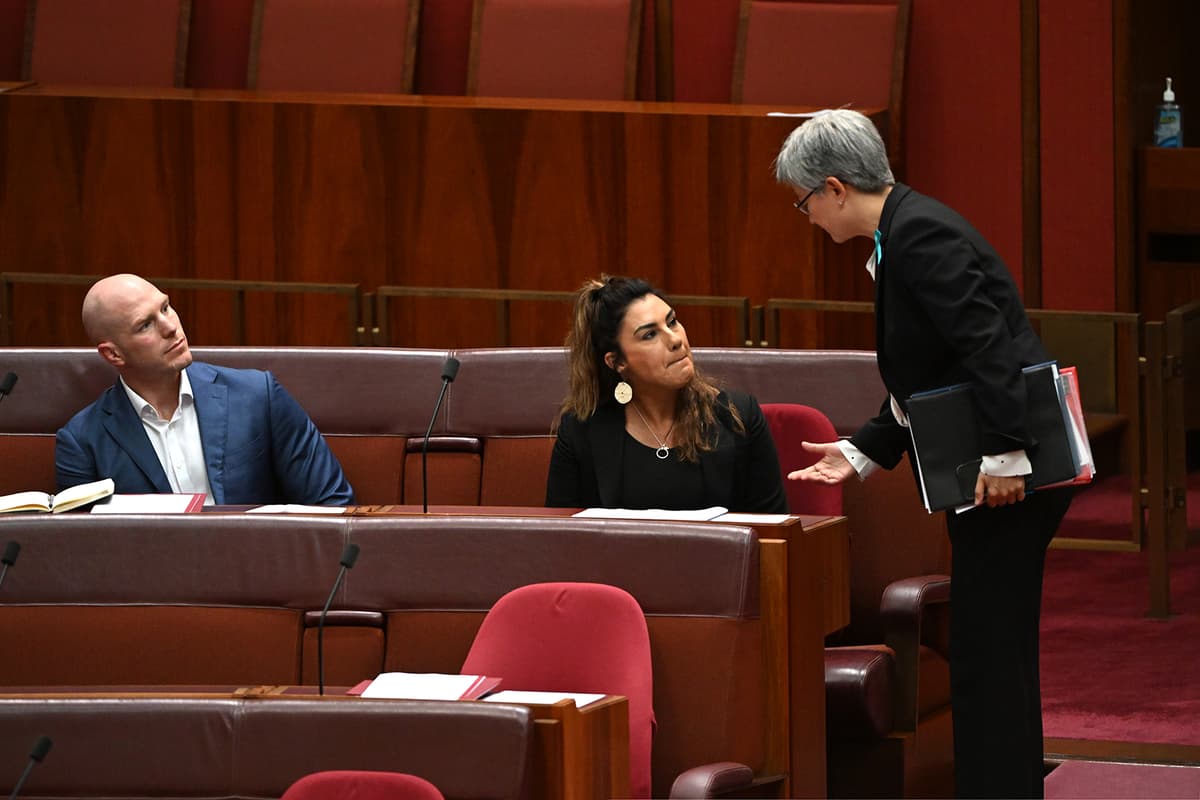
Photo: AAP Image/Mick Tsikas


“This is a war against Australians,” declared independent Senator David Pocock in a fiery Senate speech, minutes before the Defence Bill passed under a guillotine.
The Defence Legislation Amendment (Accelerating Capability and Protecting Bases) Bill hands extraordinary executive power to the Defence Minister, foreign militaries and private companies. It has almost no merits review, toothless oversight, no red lines on international law, and harsh penalties for protestors and journalists. The Minister or senior public servants can declare any Australian land, sea or airspace a ‘defence security zone’. That can be done not only for Australians’ safety, but to support a foreign military, and almost any corporate activity could be swept up. The Bill becomes law once the House of Representatives approves it when Parliament returns on 23 November.
“What kind of country are we creating?” Pocock asked. “Provisions of this bill are truly heinous. The bill hands the Defence Minister the power to decide where a defence zone is, who a defence official is, which laws defence officials don’t have to follow.”
He and independent Senator Lidia Thorpe sought a longer inquiry reporting in March 2027. Pocock said academics had made detailed submissions and offered evidence. The Parliamentary Joint Committee on Defence heard only from Defence, Home Affairs, the Defence Council of Australia AI Group, DroneShield and Leidos. “Well, unlucky for you, there is now a growing crossbench.”
Every voting crossbencher backed the call for a longer inquiry. Minutes later, the Bill slithered through with the support of Labor, the LNP, One Nation, and Senators Lambie and Babet. Nine voted against: mostly Greens, plus Senators Payman and Pocock. Senator Michaelia Cash called passing it “a matter of urgency” and welcomed the “collaborative and good-faith” process.
Thorpe said the Bill lets foreign armed forces and weapons manufacturers use Country, Stolen Land, for their purposes. She said it restricts citizens’ rights and permits direct breaches of Australia’s international legal obligations. It “fuels the war machine and genocides,” she said, calling for proper scrutiny, including by the Parliamentary Joint Committee on Human Rights.
Greens Senator David Shoebridge called the Bill “a massive power grab” with powers “which would even be troubling in wartime.”
“This is all so you can give some US personnel, some brigadier or major from the US, some trumped-up arrest powers over Australians,” he said. “It’s bloody treasonous what you’re doing,” he said.
Shoebridge cited the Maritime Union of Australia’s submission. The MUA wants express protection for lawful industrial action, union access, safety reporting and the right to stop unsafe work. It says opposing foreign military activity or nuclear cargo must not be treated as a security threat. The union stopped pig iron going to imperial Japan’s war in China, weapons bound for the Northern Territory for use against First Nations people, and weapons bound for the Dutch military in Indonesia. It has also stood with First Nations peoples against the nuclear industry. Its members now fear two years’ jail for blocking nuclear material at a port. “What are you fearing about Australians—that they’re going to come and protest, because they don’t like nuclear weapons being brought into the country? Well, that’s their right.”
Quality research, analysis, explainers and factchecks from experts you can trust.
The committee’s report ignored most of the hard questions. Nothing requires the Minister to consider the Genocide Convention, the Geneva Conventions, the Arms Trade Treaty or Article 36 of Additional Protocol I before making a declaration. Capability built for foreign countries is covered, on a lower “in connection with” test. Declarations can switch off state and territory criminal offences, the use of force outside Australia isn’t excluded, and land can be acquired overseas, including in occupied territory. On First Nations land rights, native title and heritage, the report offered only Woomera’s “legacy users.” It ignored the lack of a journalism or public interest defence to the photography, sketching and information offences. It also ignored US access to Australian facilities and zones over suburbs.
Where it engaged, its answers were thin. It noted that foreign officials cannot be given interception, hacking or Criminal Code powers, and that private companies get them only to “test those capabilities.” It “remains concerned” about the incidental collection of personal information, yet recommended no change.
Labor and LNP members expect the Minister to publish declarations “wherever possible.” Secret ones go only to the Inspector-General of the ADF. That satisfied the committee, though the IGADF lacks real independence, can have its reports redacted, has no enforcement power and must manage “with existing resources.”
The committee did secure more oversight for itself, which the Government accepted in watered-down form. It also secured a five-year independent review covering both capability declarations and zones, though the reviewer’s qualifications must satisfy the Minister.
The report’s underlying logic, borrowed from the Explanatory Memorandum, is that Australia’s defence objectives “increasingly depend upon close cooperation with allies, partners and other trusted foreign organisations.”
Now the question is whether the US Senate will pass its own controversial law, Benjamin Netanyahu has taken credit for, which seems to merge the US and Israeli miltiary industrial bases, sidestepping the need to ask for US aid. If it passes, we would then have a seamless industrial base with the US and Israel, and limited options to object.
At this stage, the only real form of change is convincing the government to improve its law or changing the Parliament at the next election.
Rita Jabri Markwell is a solicitor at Birchgrove legal, a policy strategist and former ministerial advisor. She writes a Substack which you can subscribe to here.

