In “Shorter America”, Dr Emma Shortis keeps you up-to-date on the United States with news and analysis that you can trust.
By Emma Shortis
Fri 20 Nov 2026 16.28 AEDT
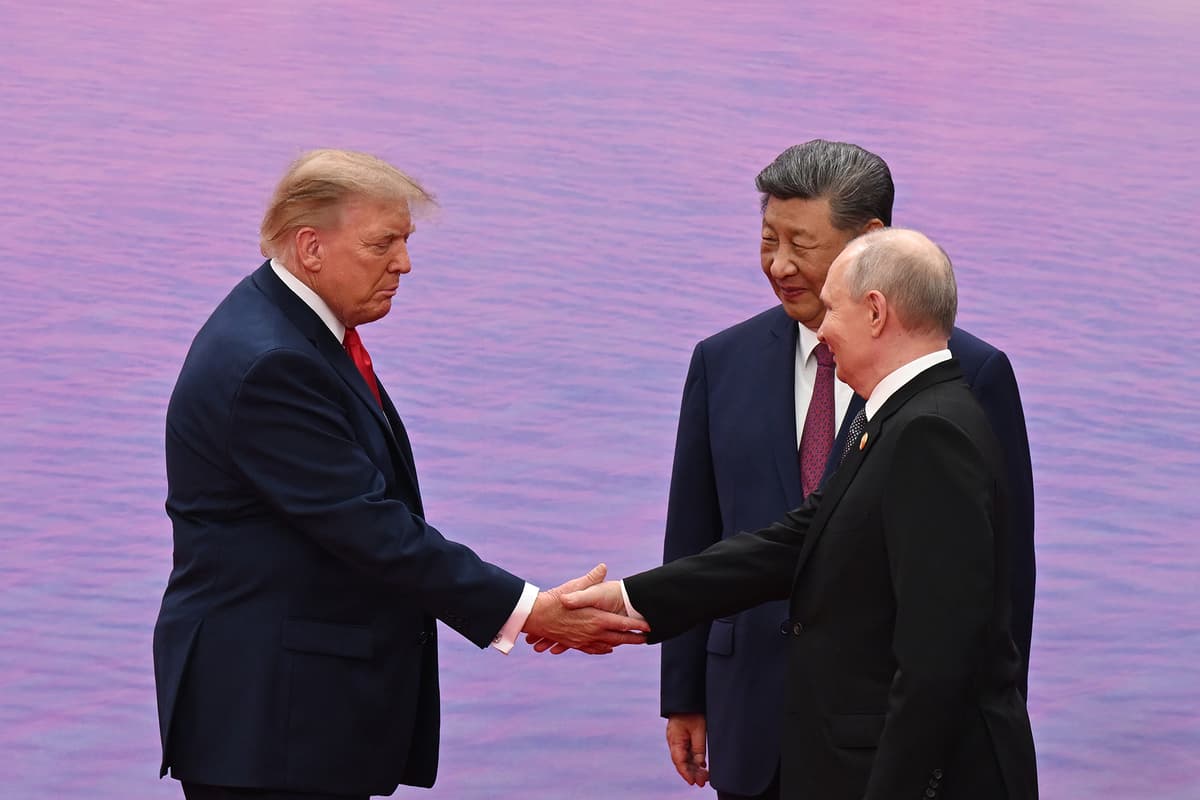
Photo: US President Donald Trump (left), and Russian President Vladimir Putin (right), shake hands in front of China's President Xi Jinping (centre) at the 33rd APEC Economic Leaders' Meeting and welcome banquet at the Shenzhen International Communication Centre in Shenzhen, China, Wednesday, November 18, 2026. (AAP Image/Lukas Coch)


Men, why? This week, Trump met with Putin and Xi. They sat around a table and took some photos. Xi was at the centre, asserting China’s dominance of the event. Putin was runner-up, making the most of a poor hand. And Trump was entirely out of his depth, performative rather than productive. Back home in the US, the battle for the soul of the Democratic Party continues. The Australian Government, meanwhile, continues to act as if everything’s the same.
The study of “international relations” prides itself on the development of complex theories of behaviour, power, and relationships. Those theories attempt to cut through the vast complexities of the world and our relationships; they also ascribe grand meaning to what happens in the world.
And then, men…well, men.
In the lead up to Trump’s big meeting with Xi Jinping and Vladimir Putin, there were many, many efforts to understand the encounter as “historic”. The BBC, ABC (Australia), NBC, take your pick – all described it that way. It was, after all, “unprecedented” for the leaders of those three countries to be in a room together. Some commentary even described the meeting as a “new Yalta” — the 1945 conference between Roosevelt, Churchill and Stalin.
Guys, please. As this Al Jazeera piece outlines, this meeting was not that.
It was three men sitting around a big table with a hole in the middle staring at each other and achieving a new status quo, though only one of them knew it. As this Margaret Hartmann piece outlines, for Americans, it was all pretty mortifying.
Quality research, analysis, explainers and factchecks from experts you can trust.
We know that when Trump feels cornered or weak, he tends to self-soothe with international summits where he knows he’ll be flattered and get some good photo ops.
While he was busy enjoying a lovely rendition of “YMCA” and a nap, the Democrats seem to be getting down to business. They’re having a substantive fight about the future of the party. As this piece in the New Republic outlines, while there’s a fair bit of handwringing about disunity – the fight over substance is actually a good thing.
It also means that, as we say in Australia, it’s on. Current Senate Minority Leader Chuck Schumer is fighting for the position of Senate Majority Leader in the next Congress – challenged by Maryland Senator Chris Van Hollen. If you’re interested in the numbers, I had a long chat with Chas Licciardello on PEP last week. The tl;dr is that it’s entirely possible Van Hollen will get the votes, and if he does, that would signal a substantive shift in the party – not least on Israel.
The Australian Government, meanwhile, appears blissfully unaware that anything significant is underway in American politics. It continues on as if subservience to Trump’s version of America is right and necessary. At APEC, the Prime Minister channeled Abbott’s shirt-front energy. “What do we want? End the war in Ukraine. When do we want it? Now.” Now that’s really telling Putin! No suggestion about how he might achieve that, say by engaging a UN-style peace monitoring group, but hey, who really cares, so long as you remind Putin that you are both ineffectual and have no ideas.
This week, the Labor Government also rushed through draconian changes to the Defence Act: explained in all their harrowing detail here by my colleague Amy Remeikis with Antoun Issa in Deepcut, and here by Rita Jabri Markwell.
The changes are being framed as necessary for the implementation of the Aukus submarine deal — that is, in service of the US alliance. But why? Relationships with our allies should never require the erosion of existing rights and freedoms. Our alliances should reinforce our shared interests in defending those rights. Americans just rejected Trump’s version of authoritarianism.
Why is the Australian Government embracing it? It’s embarrassing, dangerous and completely unnecessary.
Advertisement


