Tue 28 Apr 2026 12.31 AEST
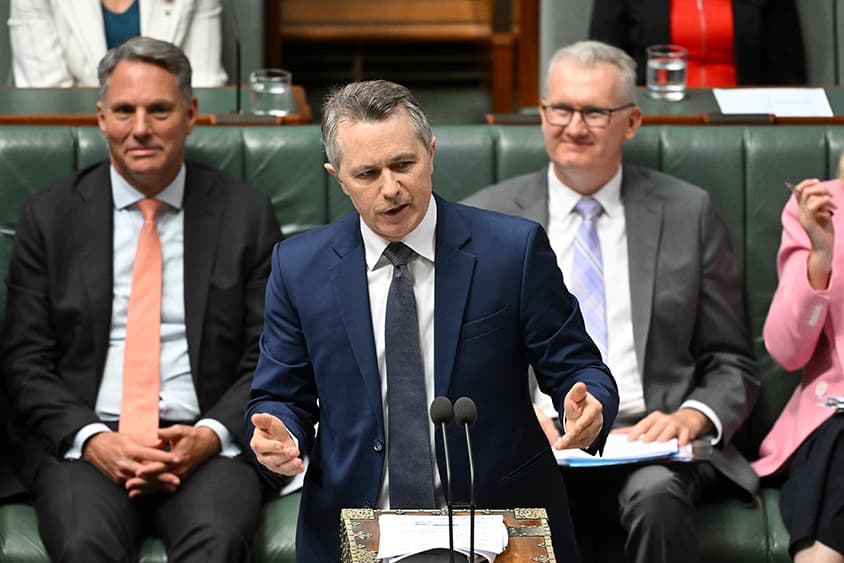
Photo: AAP Image/Lukas Coch


The Job Ready Graduates scheme stands out as one of the worst education policies in living memory. But six years on its still here, but it doesn’t need to be.
Three economists from the Australian National University have achieved in a few months what the Federal Government has struggled to do in six years — design a fix for the broken student‑contribution system known as Job‑Ready Graduates (JRG).
Bruce Chapman, Tim Higgins and Gaurav Khemka have produced a model that makes the system fairer for most students while remaining roughly budget neutral. Their goal was to create fairer HECS‑HELP repayments based on expected career earnings across 24 fields, assuming total funding to each discipline and institution would stay largely unchanged. Under their model, government costs even decrease slightly.
“The question we asked was how you could modify HECS prices so the amount charged to a student was related to expected future income,” Higgins explains.
The ANU proposal keeps four broad student‑contribution bands: $8,000, $10,000, $12,000 and $14,000.
This means a mathematics student’s annual fee would rise from about $4,738 in 2026 to $12,000, while a human‑welfare student’s fee would fall from $17,399 to $8,000.
“To achieve budget neutrality, any increase in HECS payments is offset by a matching reduction in the government contribution, so the total funding per discipline for each institution stays the same,” Higgins says.
As the May budget approaches — one framed around intergenerational equity — the JRG scheme appears likely to remain untouched, even as it burdens thousands of students, including the poorest, with unsustainable debt.
Education Minister Jason Clare has been steadily distancing himself from the issue.
First, reform was deferred until the Universities Accord was complete. Then responsibility was shifted to the new Australian Tertiary Education Commission (ATEC). Yet when ATEC’s enabling legislation passed in March, the body had no authority to set student‑contribution levels and could only advise on government funding.
JRG did not rate a mention in Clare’s address to the Universities Australia dinner in February.
“Of all the things in the Accord, I think this [ATEC] is the most important,” Clare said. “Not because of what it will do this year or next year, but because of what it has the potential to do in the next decade and the decade after that. You want real long‑term systemic reform? This is it.”
Perhaps — but it may be worth telling that to a generation of graduates carrying so much debt they can’t afford a home loan.
Julie Hare is an honorary senior fellow at the Melbourne Centre for the Study of Higher Education at The University of Melbourne.
She is a former education editor at The Australian Financial Review, and has over 20 years’ experience as a writer, journalist and editor, including as the higher education editor of The Australian.
This article was first published on Julie Hare’s substack, The Hare Report. Subscribe here.
Advertisement