
Let’s talk about the proposed ‘mental health round’ for the AFL. This is not the first time it’s been suggested – it was suggested last year, and multiple times before that – but I’m a Cats girl, and when Bailey Smith talks, we listen.

Mon 27 Apr 2026 12.03 AEST
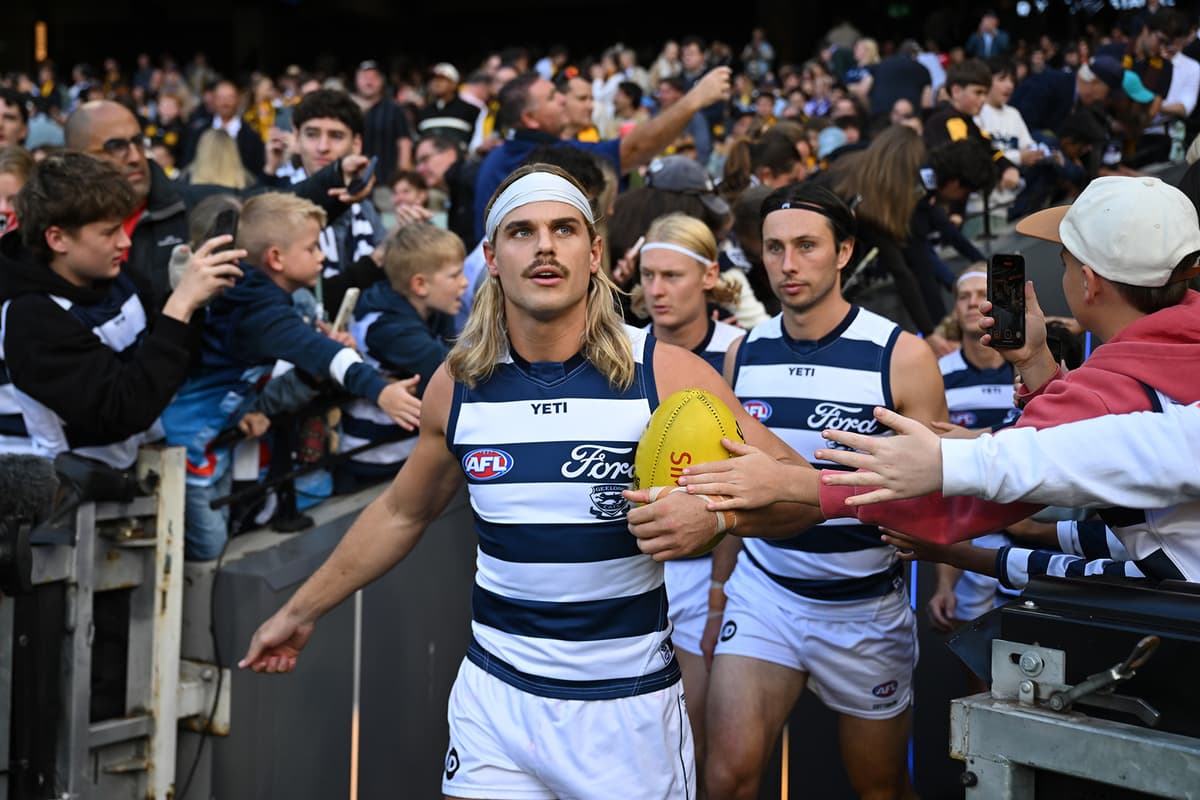
Photo: Bailey Smith walks up the players race (AAP Image/James Ross)
Let’s talk about the proposed ‘mental health round’ for the AFL. This is not the first time it’s been suggested – it was suggested last year, and multiple times before that – but I’m a Cats girl, and when Bailey Smith talks, we listen.
I think it’s a good idea (as do other AFL icons like Kevin Sheedy and Matthew Richardson). But I’m also nervous. The issue is that ‘awareness’ is the least pressing concern we have in mental health care.
Research shows people overwhelmingly know mental health conditions exist and that there are services available (Beyond Blue, Headspace, ReachOut, etc.) to support people experiencing them. The problem isn’t that people don’t know this is going on. We actually have that covered. Comparatively, quite a lot of funding gets pumped into mental health awareness campaigns and quite a lot of the new activity that starts up is also mental health awareness.
One in two Australians will experience a mental health condition in their lifetime, which means that even more than that number of people will also care for somebody who has a mental health condition in their lifetime. It’s estimated that almost a million of us provide unpaid, informal care to someone living with mental illness – an economic contribution of about $13.2 billion.
The problem isn’t that people don’t know that mental illness exists.
The problem is that there is not enough money in actual mental health care – particularly in complex mental health care.
There aren’t enough psychologists. There aren’t enough psychiatrists. The Medicare rebates are too small. There aren’t enough appointments, nurses or beds.
People are getting left behind. In fact, Australians can expect to wait an average of 77 days for an initial psychiatry appointment, which is an awfully long time for someone in crisis. They are not being treated the way they need to be by the healthcare industry.
The challenge to the AFL is to do something meaningful with all of that, which means not just putting a mental health organisation’s logo on the back of a guernsey or having a special mental health round away uniform, or getting someone from one of these organisations to get up at the start of a game to tell the crowd it’s okay if they feel bad … we already know.
What the AFL can do is tap into its powerfully enormous network. This is the largest sports viewership in the country – on broadcast numbers alone, it had a total reach in 2025 of 17.4 million viewers. It’s also led and administered by people with money, with industry connections and capital raising experience. Heck, Beyond Blue itself was founded by former Hawthorn Football Club President and State Premier, Jeff Kennett almost 30 years ago.
The AFL has the money. It has the connections. And now it also has the audience and the opportunity. This is about lobbying. It’s about fundraising. And it’s about meaningful media coverage that speaks to the problem and the solutions this country needs.
When Elijah Hollands had a horrible time against Collingwood, the resulting media coverage stoked the type of conversation you might expect: speculative, denigrating, vilifying and personal. It also brought about an inquiry from the AFL into the Carlton Football Club.
But what’s unusual about the Hollands case is not that he had a mental health episode working in an environment where it’s high pressure, where he’s a young man, where he’s one of the one in two Australians who will experience a mental health condition in his lifetime.
That’s not the unusual part. The unusual part is that he was almost immediately able to find a place in a facility that could help him. Most people can’t.
A bed in a private mental health hospital in Australia costs around $3000 a week, and if you can’t afford that (like most of us), you can cross your fingers for one of the approximately 7,080 public beds that exist across the entire country.
The situation with Elijah Hollands was not created by the fact that people his age don’t know what a mental health condition is. And it was certainly not because the Carlton Football Club hasn’t heard of mental health conditions. It was because of a systemic failure in this country to provide the care that people need when they experience a mental health condition. It’s in the underfunding of research, university study, government programs like the NDIS, community services and, you know, pretty much everything else. Actual mental health care – not stickers about it, but real appointments with healthcare professionals – has become almost impossibly rare, inaccessible and expensive.
If the AFL is going to have a mental health round – and I think it should – it needs to be in pursuit of something more meaningful than the work we have already done. We have stickers, billboards, radio ads, social campaigns and cupcakes. We have so much awareness. But if you call a helpline number and you need more than some words of reassurance, they cannot connect you to services if they don’t exist. So many of us have learnt that the hard way.
I want a mental health round, and I agree with Bailey Smith (not just because he’s one of our leading goalkickers). I want the AFL to bring change to mental health care, not just awareness. And I hope they rise to the challenge.
Dr Anna Spargo-Ryan is an award-winning writer. She is the author of three books, A Kind of Magic (2022), The Gulf (2017) and The Paper House (2016). Anna was the inaugural winner of the Horne Prize for her essay The Suicide Gene and holds a PhD in truth, memory and life writing.
Advertisement


For 46 years a little-known tax has drained capital set aside for Aboriginal people in the Northern Territory. Last year, it took $20.8 million from the endowment of the very body Parliament created to put that money under Aboriginal control.