Back in 2009 (which seems an entirely different world at this point) then US president Barack Obama delivered the commencement address to the Notre Dame graduating class.
There had been controversy in the lead-up – Notre Dame is a Catholic institution and Obama had been vocal in his pro-choice support.
He addressed the controversy in his speech, telling the class of ’09:
“The question then is how do we work through these conflicts? Is it possible for us to join hands in common effort? As citizens of a vibrant and varied democracy, how do we engage in vigorous debate? How does each of us remain firm in our principles, and fight for what we consider right, without, as Father John said, demonetising those with just as strongly held convictions on the other side?
And, of course, nowhere do these questions come up more powerfully than on the issue of abortion.
As I considered the controversy surrounding my visit here, I was reminded of an encounter I had during my senate campaign, one that I describe in a book I wrote called The Audacity of Hope. A few days after I won the Democratic nomination, I received an email from a doctor who told me that while he voted for me in the Illinois primary, he had a serious concern that might prevent him from voting for me in the general election. He described himself as a Christian who was strongly pro-life – but that was not what was preventing him potentially from voting for me.
What bothered the doctor was an entry that my campaign staff had posted on my website – an entry that said I would fight ‘right-wing ideologues who want to take away a woman’s right to choose’. The doctor said he had assumed I was a reasonable person, he supported my policy initiatives to help the poor and to lift up our educational system, but that if I truly believed that every pro-life individual was simply an ideologue who wanted to inflict suffering on women, then I was not very reasonable. He wrote, ‘I do not ask at this point that you oppose abortion, only that you speak about this issue in fair-minded words’. Fair-minded words.
After I read the doctor’s letter, I wrote back to him and I thanked him. And I didn’t change my underlying position, but I did tell my staff to change the words on my website. And I said a prayer that night that I might extend the same presumption of good faith to others that the doctor had extended to me. Because when we do that– when we open up our hearts and our minds to those who may not think precisely like we do or believe precisely what we believe – that’s when we discover at least the possibility of common ground.
That’s when we begin to say, ‘Maybe we won’t agree on abortion, but we can still agree that this heart-wrenching decision for any woman is not made casually, it has both moral and spiritual dimensions’.
Which all seems very reasonable, right? Very fair-minded? Very sensitive?
Except limiting abortion rights was part of the right-wing ideological project and it used liberal “fair-mindedness” to win, appointing conservative judges to the US Supreme Court, who struck down federal abortion protections, allowing the right-wing to do what it wanted in states it controls.
By not calling it what it was – part of the far-right agenda to control women’s autonomy and allowing the right to dictate the terms of the debate and what was “reasonable” – it was lost.
Now women are being prosecuted in the US for miscarriages and still births, suffering life-altering health traumas and dying preventable deaths.
If you don’t think that can happen in Australia, I applaud your optimism.
It is no coincidence that the anti-choice movement is growing in relevancy at the same time as the normalisation of One Nation into mainstream politics.
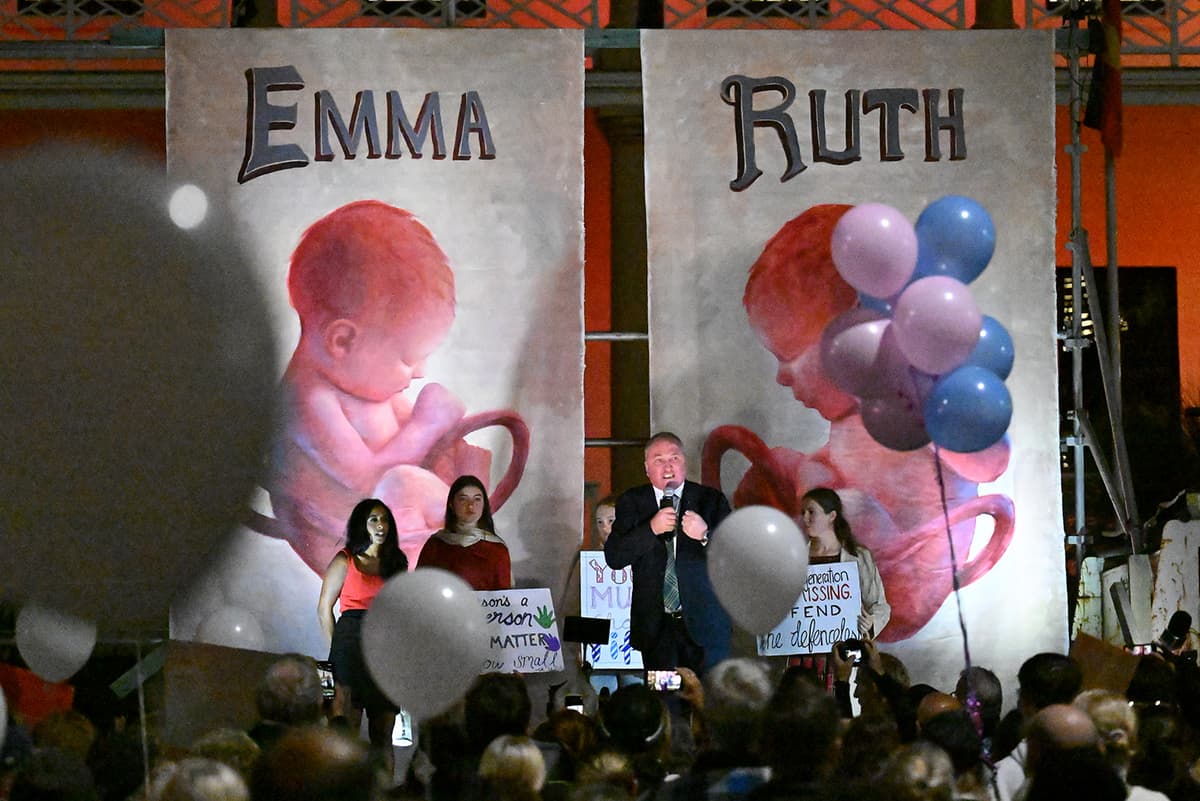
The most recent rally in NSW, purportedly around banning sex-selection abortions, which was headlined by Barnaby Joyce, is just another example of how intertwined far-right politics is with choice healthcare.
By framing a ban on sex-selection abortion as “reasonable”, anti-choice activists are progressing their cause into the areas where they think they need to win to ultimately succeed – the “reasonable centre”.
Because, of course, it sounds reasonable. But it is also not a problem. When the NSW parliament last looked at this issue in 2020, it reported that out of the nearly 16,000 reported terminations over the year, only three (or 0.02 per cent), indicated they were performed for the sole purpose of sex discrimination. (Another 10 were considered reporting errors as termination occurred before nine weeks, when no gender can be determined).
There is no evidence of widespread sex-selective abortion since then. But it all sounds so reasonable, it’s an easy gateway into starting the restriction of rights.
Joyce, who is one of the best political communicators in Australia, recognises this. It’s why he has abandoned the fire and fervour present in his anti-renewables preaching and adopted the Forrest Gump approach.
“I have a lot of flaws, we all do, but it does not make us bad people. We all recognise it, don’t make excuses for it and then move on to not repeat it,” he said in a recent social media post of him at a rally with illustrations of “Emma and Ruth” – allegedly aborted “twins” being used as movement’s new branding.
(The original post showing the “twins” used images of newborn sugar gliders. It now uses images of full-term babies attached to umbilical cords, which is just as disingenuous.)
“You can’t sex select as the reason for a termination. There has to be a line in this and, let’s be honest with each other, we all know that.”
At the rally, Joyce was embracing his new Gump-tion.
“I don’t know much about lots, but I know lots about politics. And the one thing politicians fear is losing their job. What I see before me here is about 1500 people who can hand out how-to-vote cards.”
Abortion is again an issue in NSW and South Australia. It was in Queensland at the last election.
It’s an issue that is primed for lies, mis and disinformation and those spreading them don’t care because they are ideological and have their eyes focused on the broader project. And despite polling showing most Australians support choice, they can sense a potential victory.
It shouldn’t matter why you have an abortion – the only concerns should be that it’s safe for the person choosing to have one. And accessible healthcare is safe healthcare.
Shifting the boundaries of what is “reasonable”, or “the line”, seems harmless but those pushing for it know that it’s the first step towards their ultimate goals. Sex selection has been chosen because it ties in with another of the far-right’s goals – an end to migration – with heavy emphasis on other “cultures” valuing one gender above another as part of the communication strategy.
And make no mistake, it is a strategy. Win one battle and you can start targeting healthcare providers harder, accusing them of allowing what has just been banned and then pushing for further bans to stop it entirely.
This isn’t a hypothetical situation. We have seen it play out. The only question is how far it gets before reasonable people catch on to just how orchestrated it all is.
Amy Remeikis is a contributing editor for The New Daily and chief political analyst for The Australia Institute
This article was first published on The New Daily.