We all know that visitors can be expensive. And in the regional security world, they can be very expensive. When Vanuatu’s Prime Minister Jotham Napat came calling a fortnight ago, it cost Australia half a billion dollars, albeit to be spent over a decade or more.
And what did Australia get in return? The right to be consulted as Vanuatu goes about exercising its sovereign independence in choosing the countries with which it is happy to do a deal. Anyone who thinks that China isn’t the mix doesn’t know much about deal-making in the Pacific.
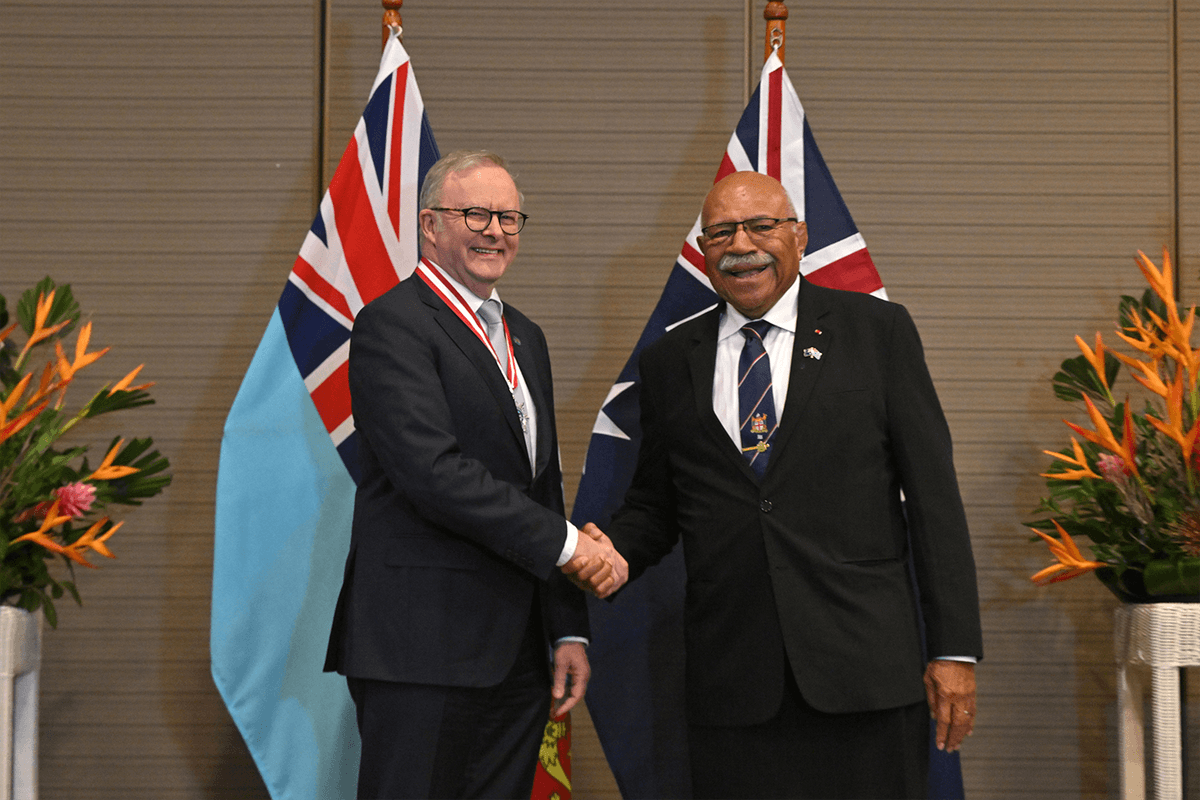
Going elsewhere to visit people, however, can be even more expensive. This week, Mr Albanese and Senator Wong went to Suva to visit the Fijian Prime Minister, Sitiveni Rabuka. As a tough guy who drives a hard bargain, Mr Rabuka has form. A gifted rugby player and top sportsman in his day, he’s one of the few who has led two coups and still managed to become a democratically elected Prime Minister. He gets results.
This time, Rabuka has excelled himself. On 6 July 2026 he landed a pair of treaties with Australia that expanded economic and social links between Australia and Fiji and delivered a significantly expanded defence and security relationship.
The Vuvale Union will improve the human security of Fijians, and will significantly enhance Australia’s reputation as a serious Pacific partner. It is a treaty entirely appropriate to the jittery times we live in: it focuses on communal and national well-being. Harmony and prosperity are the indispensable foundations of national security.
Rabuka has also landed a new security alliance – the Ocean of Peace Alliance – Fiji’s first and Australia’s fourth. This is a signal success for Rabuka: he gets a lot for very little, given his earlier negativity towards China’s interest in an enlarged security footprint in the Pacific.
For Australia, however, the visit to Fiji cost one billion dollars (over the next decade) without exactly delivering very much in return. While Australia might congratulate itself in constraining China’s aspirations, Rabuka was never going to agree to a Chinese military footprint in Fiji anyway.
What $1b did buy was a Members’ Stand view of China’s Pacific ballistic missile launch, which came within hours of the Treaties’ signing. Senator Wong’s response was immediate – China’s missile launch was “destabilising”. And if, by destabilising, Senator Wong was recognising that China was well and truly capable of test-firing a submarine-launched ballistic missile and was well and truly positioned at sea to do so, she’s right.
The deeper truth is that stability is not what’s at stake. China is big, and growing bigger. It is assertive, and becoming more so. It is comfortable with throwing its weight around in the Pacific, and is only too happy to demonstrate everyone else’s impotence. China is leveraging power disparity.
But Australia has much more to leverage. Armed coercion and military threats are a failure in statecraft, which happens to be Australia’s greatest asset. In Asia-Pacific regional terms, Australia has an extended set of tools in its statecraft kitbag. It wields great cultural assets extending from education, employment and other economic opportunities, to media, religion, sport, and tourism – as well as substantial family and community relationships through immigration.
These are what matter, and China is not well positioned to compete with Australia and New Zealand in the practice of soft and smart power. They give substance to Vuvale (family) in a way that patrol boats never can.
The day after signing the Fiji agreements, Albanese visited the Solomon Islands. As he stood at Honiara’s national sports stadium with Prime Minister Matthew Wale to celebrate the island nation’s Independence Day, the display of the flags of the nations with which the Solomon Islands has diplomatic relations – including China’s – was a signal that China is ever present. Wale reminded everyone that the Solomon Islands is a friend of China, while noting that China’s ballistic missile test was “not something a friend does”.
The Independence Day visit was not too expensive – Australia announced a new contribution of a mere $10 million or so on education support. But Albanese’s real target is likely to cost much more as he chases a Nakamal-style agreement with the Solomon Islands. He will need to bear two things in mind.
First, the Solomon Islands is looking for a much more comprehensive treaty than a bilateral agreement with Australia. Perhaps the Ocean of Peace Alliance provides a model, though a broadening of the scope of the treaty will not be cost-free in either diplomatic or financial terms.
And second, the Solomons, like PNG, Vanuatu and Fiji, will demand a quid pro quo to offset the risk of a reduced supply of Chinese cash and additional Chinese coercion. Cost really is the sting in the tail of security agreements.
So let’s hope that, as Albanese internalises the real meaning of Vuvale, he pays more attention to the dynamics of statecraft and sustained diplomacy in the Pacific. When the dollar payments cement prosperity, stability and well-being, they are worth every cent. When they’re simply the soft side of hard-talking but ultimately nugatory security deals, they invite China to do what it does best – display its own military power and everyone else’s comparative weakness.
As The Point noted last week, Australia’s Pacific diplomacy is a work in progress. We need to back our strengths and worry less about the fact that China is basically a one-trick pony that offsets coercion with cash.
Allan Behm is an advisor in the Australia Institute’s International and Security Affairs program.