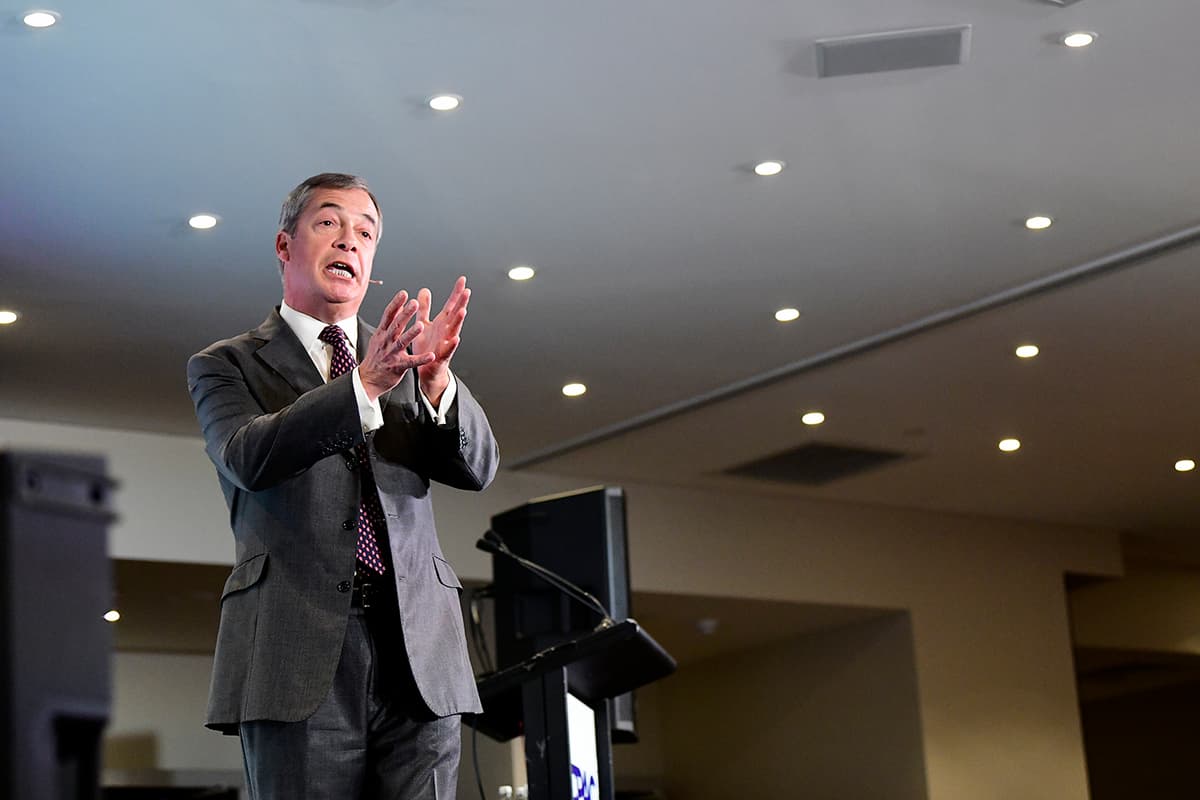
After unsuccessfully running for election to the UK House of Commons seven times, Brexit agitator and far-right politician Nigel Farage won the seaside county seat of Claxton in 2024 – only to quit two years later. Farage, who is being investigated by the British Parliament for millions of pounds in undeclared payments and gifts, resigned in order to re-contest the resulting by-election, claiming that only the people of Claxton, not the House of Commons, can judge him for allegedly breaking political donation rules.
Rather than dignify the stunt, mainstream parties – Labour, Conservatives, Liberal Democrats and Greens – have refused to run in the by-election. That leaves the field open for “Count Binface”, a space alien from the planet Sigma IX. His reason for visiting Earth is quite touching, if potty-mouthed:
“There’s only one planet in the entire cosmos using democracy – but you’ve gone and thrown away the fucking instruction book.”
Count Binface is a joke candidate with little prospect of success – although he does have the benefit of a mostly vacant field. Farage only won 46% of the vote in 2024, which leaves the tantalising possibility that, in the absence of serious candidates, Count Binface could unite the non-Farage vote and win the seat. While only the 76,000 voters in Clacton have a say, polling shows that across the country 33% of Brits would prefer the space alien to win the by-election, while just 21% say the same of Farage.
Nor does Count Binface have to win the seat to show up Farage. Already he has drawn attention to Farage’s alleged wrongdoing and his cynicism in forcing the wholly unnecessary by-election. Farage is both the butt of the joke and the straight man, taking seriously the threat from a man who claims to be “Leader of the Recyclons”.
Australians think of ourselves as laid-back larrikins, but the major parties have made it nigh impossible for an Australian equivalent to Count Binface to emerge.
In 2021, the Morrison Coalition Government and Labor Opposition agreed to restrict the names of political parties. ‘Frivolous’ party names are forbidden, which kills the Count Binface Party stone dead. That’s despite a long history in Australia of joke parties, like the Sun Ripened Warm Tomatoes Party, the Surprise Party and the Deadly Serious Party.
Even good faith, descriptive, party names are outlawed now if they use a word that appears in the name of another party. Australians saw fit to elect politicians from the Democratic Labour Party, Liberals for Forests and the Liberal Democrats when the major parties weren’t meeting their needs, but now one cannot even register the Anti-Socialist Party without permission from the Socialist Alliance.
Australia also places other barriers in the way of candidates. Count Binface needed the endorsement of 10 residents of Clacton to run in the by-election; an Australian independent would require 100.
In Australia, party candidates do not need any nominators (another advantage the incumbents have given themselves), but registering a party requires 1,500 members. That is prohibitive for parties focused on local or regional issues. In the UK, you only need two members: a treasurer and a returning officer.
While Australia’s po-faced rules and restrictions are at odds with our history as a thriving and playful democracy, in other ways this country has a much better electoral system than the United Kingdom.
The Australian Senate is democratically elected, while the UK equivalent – the House of Lords – until this year included lords who inherited their seats. To this day, lords are appointed by prime ministers or the Anglican Church rather than elected by the people.
Australian elections use full preferential voting, which means you cannot waste your vote and a candidate is only elected MP if they are preferred over the runner-up by a majority of voters.
By contrast, “first past the post” UK elections go to whichever candidate gets the single biggest pile of votes, even if it is well short of a majority. The effect is that likeminded parties end up splitting the vote, and candidates can win without being the preferred choice of the people.
Under preferential voting, Lord Buckethead could run in Clacton without eating Count Binface’s lunch, but in the UK to do so could hurt Count Binface’s chances of winning the seat.
Australia’s electoral system is among the best in the world, but we can still learn from other democracies.
In contrast to the UK’s more open system, Australia’s humourlessness and red tape when it comes to running for office only reduces democratic choice – and not just for joke candidates with serious messages.
Bill Browne is director of the Democracy and Accountability program at the Australia Institute.