

Shorter America This Week: Michigan Matters; Looking to Europe; Political Violence
In “Shorter America”, Dr Emma Shortis keeps you up-to-date on the United States with news and analysis that you can trust.
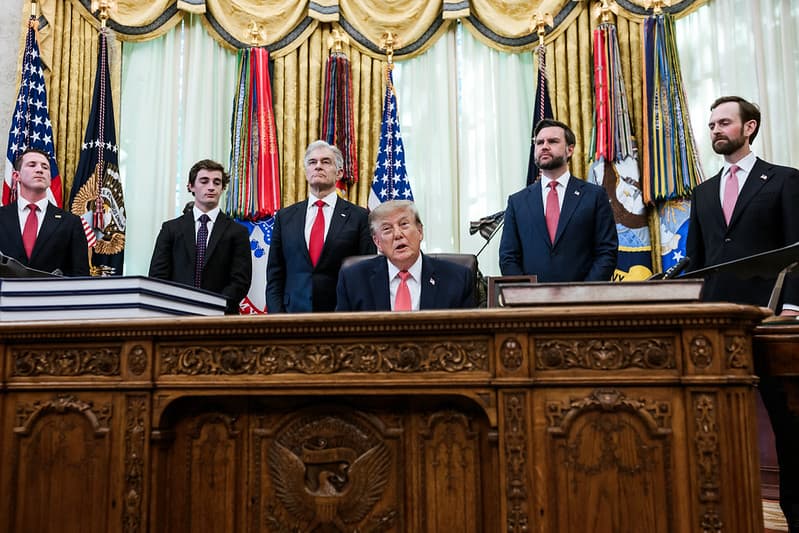
At a conference where harmony and light and a continually beaming Prime Minister came at the expense of any serious discussion of AUKUS (or gas exports tax or Middle East issues for that matter), cementing AUKUS into South Australia’s industrial fabric looks like a monument to the Defence Minister’s role as the AUKUS enforcer.

Tue 28 Jul 2026 10.54 AEST
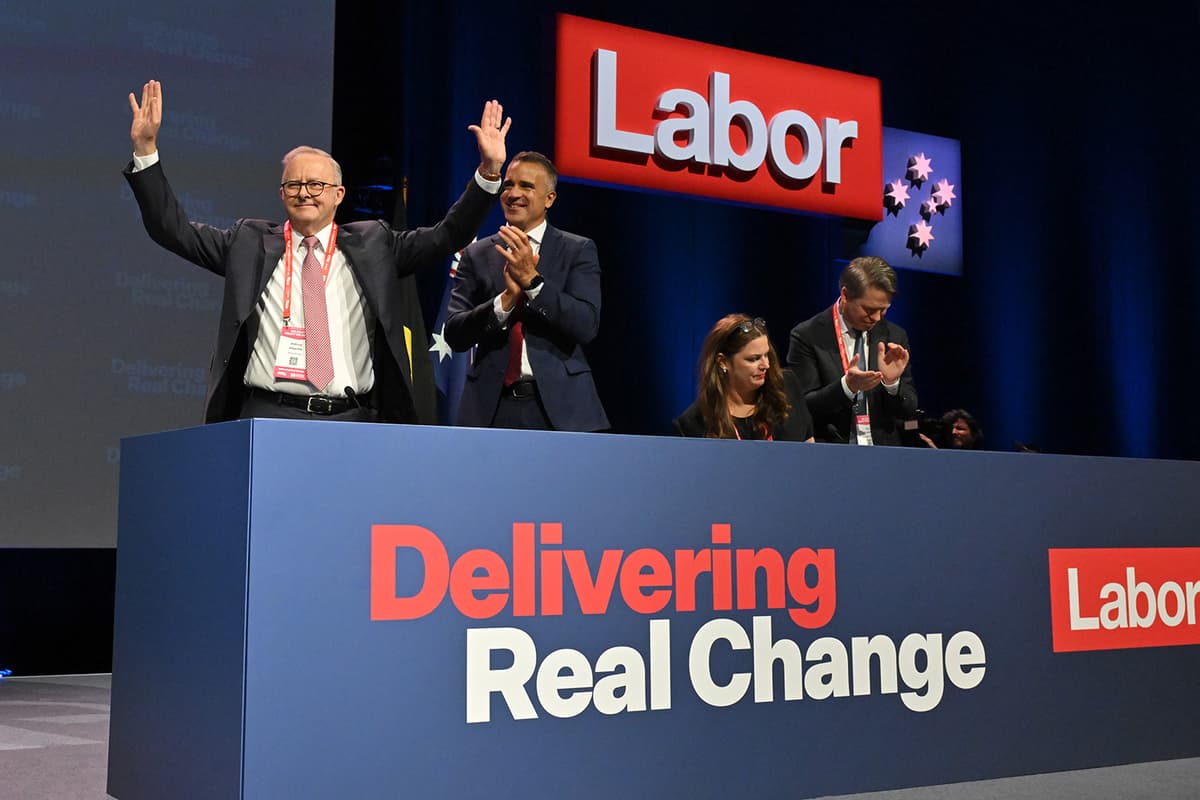
Photo: AAP Image/Mick Tsikas


The ALP National Conference seems an odd place to make yet another AUKUS infrastructure investment announcement.
At a conference where harmony and light and a continually beaming Prime Minister came at the expense of any serious discussion of AUKUS (or gas exports tax or Middle East issues for that matter), cementing AUKUS into South Australia’s industrial fabric looks like a monument to the Defence Minister’s role as the AUKUS enforcer.
Australia has a good record in naval shipbuilding. The ANZAC frigates and Collins-class submarines were initiatives of the Hawke government. And while both programs still have their naysayers, the fact is that governments could and did successfully direct the delivery of essential naval capability — Australian built and Australian operated — on time and at a reasonable cost.
But we have failed to maintain and build on our earlier successes. Changed political, strategic and technological conditions have complicated Australia’s national defence. At a time when multiple platform types, crewed and uncrewed, carrying out multiple roles looks like the way forward, we’re investing heavily in infrastructure support for boats that even the Pentagon now doubts can be delivered on time, if at all.
The entire AUKUS program was sprung on the Australian electorate without warning by the Morrison government. The Labor opposition ducked for cover, adopting the proposal without any analysis of its foundations or its consequences. So, we are now left with huge investments focused on a single capability, without any consideration of the suite of capabilities Australia needs for its defence, and where just one of those capabilities — submarines — fits in.
So, another $4.6 billion downpayment, in addition to the $3.9 billion announced earlier in the year, comes as a major boost to Adelaide’s claims to submarine construction bragging rights. In his short statement announcing the new funding target, the Defence Minister used the word “sovereign” five times: the AUKUS nuclear powered submarines will be built, maintained and sustained in Adelaide, and operated under the command and control of the Royal Australian Navy. “Sovereign capability” is one of those vague and meaningless phrases that now passes for a contemporary strategic policy.
AUKUS has become a real cornucopia: billions in construction investment; a Skills and Training Academy Campus (grandiloquent language for a kind of TAFE); over 10,000 new jobs in South Australia alone; and lasting benefits to the entire Australian economy. Moreover, the submarine construction investment in Adelaide is additional to the $12 billion promised to the Henderson precinct in Western Australia, rising to $25 billion over the decade.
Quite how the reallocation of jobs from the construction, manufacturing and mining industries to submarine construction is job creation is left unexplained. And quite how South Australia can meet the labour demand from its small population base, or how sustained national economic benefits result from a defence monopsony, also remains unexplained.
The nuclear submarines are looking like an antipodean version of castles in the air, an expensive version at that, just waiting to evanesce.
With AUKUS and all its associated investment — billions in opportunity costs and even more billions in a nuclear propulsion capability that may never eventuate — the government has created a big problem for itself. It has chosen submarine construction and ownership as the preferred answer to a much bigger question: how should we handle the maritime defence of Australia?
A small number of exceptionally large submarines over an extended timeframe does not pass the sniff-test.
And, by the way, we are running an enormous foreign aid program, with no visible return on our investment, to assist our two partners, the US and the UK (the world’s biggest and sixth biggest economies respectively), to improve their own submarine construction. With a $4 billion donation to each, it’s little wonder that the antipodean hayseeds are so popular in Washington and London.
Spending in the absence of demonstrated need or policy argument is imprudent. So, at the very least, the projected spend on nuclear-powered submarines looks reckless when we have little idea of what kind of a navy we need. Funding a balanced and capable navy is a necessity. Pouring money into a hope looks self-indulgent, especially when the wider defence need is far greater than large nuclear-powered submarines.
Too much, or not enough? Who knows.
Allan Behm is an advisor in the Australia Institute’s International and Security Affairs program.
Advertisement
Independent senator David Pocock delivered a sobering message to the National Press Club this week in the wake of the alleged attack on his friend and colleague Helen Haines: it’s time to confront how anger has been fuelled, encouraged and exploited for political gain.

In “Shorter America”, Dr Emma Shortis keeps you up-to-date on the United States with news and analysis that you can trust.