It’s not often that Sarah Ferguson’s ABC current affairs program 7.30 can be compared with Christopher Nolan’s The Odyssey, the new meme for everything. Odysseus navigated between a rock (Scylla) and a hard place (Charybdis, the whirlpool) to save his ship, his men and himself. One suspects that the Minister for Defence Industry, Pat Conroy, following his tricky 7.30 interview on 29 July 2026, now finds himself aligned with Homer’s imperfect hero.
The convergence between current generation Virginia attack submarine (SSN) nuclear propulsion — with reactors fuelled by Highly Enriched Uranium where waste management involving weapons grade uranium remains an insurmountable problem for Australia — and the nuclear weapons capability of the next generation Virginia-class places AUKUS between a rock and a hard place.
We now know that the new build of Virginia submarines to be delivered from 2032 will have additional cruise missiles. They will be nuclear-weapon-capable. As the new build of Virginia-class submarines (redesignated as SSGNs — nuclear powered guided missile submarines) enter service, an older variant without nuclear-weapon-tipped guided weapons can be sold off to Australia — once we are “sovereign ready” (whatever that might mean) and the US Navy (USN) has some to spare.
So, in the years beyond 2032 the USN, under its “neither confirm nor deny” policy, may be alongside in Stirling with a load of nuclear missiles. Suddenly, the incantation “nuclear-powered, conventionally-armed” loses its magic.
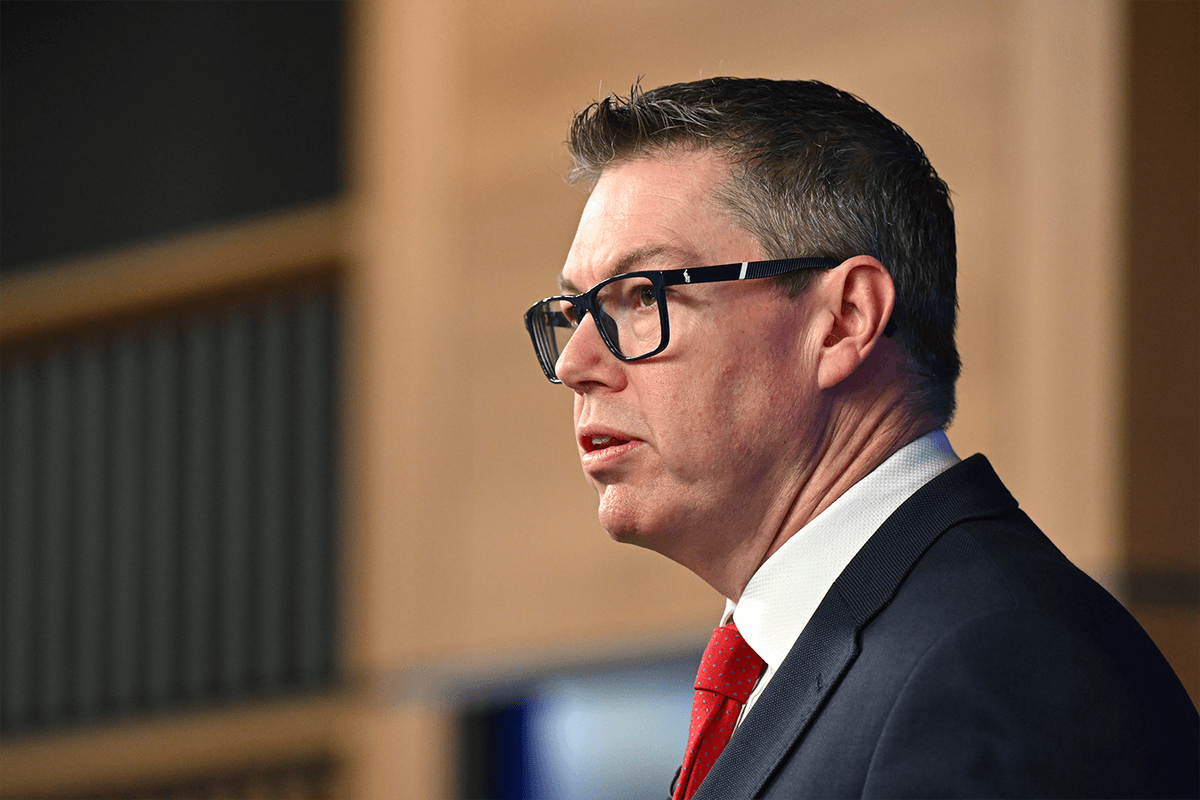
This is where it gets interesting, as Pat Conroy’s interview began to demonstrate. Ferguson’s deft interrogation revealed the tension between Australia’s non-proliferation obligations under the Treaty of Rarotonga and the stationing or “rotation” of US nuclear weapons in or through Australia on new variants of the Virginia-class submarine. This rotation is called the Submarine Rotation Force (SURF) West. Who says that Defence lacks a sense of humour?
How did the Minister resolve the tension? Appropriately, and quite unusually in the strange world of AUKUS, Conroy put in a courageous attempt at squaring the circle. He declared that SURF would end in 2032 after a five-year period, just as Australia’s first (non-nuclear weapon capable) Virginia-class submarine arrives in WA.
In the interview, Conroy mentioned the Treaty of Rarotonga three times. He directly linked the Treaty with the American practice of neither confirming nor denying, thereby revealing why the SURF’s up just as Australia’s first boat arrives. He implicitly acknowledged — as Ferguson’s artfully raised eyebrow confirmed — that Australia’s Treaty obligations cannot accommodate this new USN Virginia-class variant.
In any event, the transfer of older Virginia-class SSNs will not happen: there are too many out-of-service Virginias in the US awaiting maintenance and repair for any US President to release an operational boat to Australia, or anyone else. The first priority for the President, as for the USN, is to preserve the nuclear deterrence roles of the submarine part of the US triad. And the construction drum-beat is not sufficient to make up the shortfall. So, at face value, the Minister implicitly told us that the game’s up — no SURF after 2032 and no RAN Virginias.
The immediate aftermath of the Minister’s remarks, themselves consistent with long-standing Labor policy, was predictable. A “clarification” was issued noting that, of course, USN submarines would continue operating out of WA after 2032 and that, of course, Australia would get its Virginias. But, to mix metaphors (a venerable practice in the world of political communication), when the cat’s out of the bag there’s little point in closing the stable door.
Australian governments have, however, dealt with this problem before. Fifty years ago, for instance, the Fraser government had to reconcile Australia’s Nuclear Non-Proliferation Treaty (NPT) obligations with that same American practice of neither confirming nor denying the presence of nuclear weapons – in this case, relating to the “possible” carriage of nuclear weapons on B-52s transiting through Darwin.
It did so by accepting the general American position while requiring all B-52s to undertake low-level (500 feet) navigation training while flying over Australia en route to Darwin. The Australian government knew that the US Air Force did not allow the carriage of nuclear weapons during low-level training flights under its “Broken Arrows” protocols, established to prevent the accidental loss of nuclear bombs in the event of a mishap. Problem solved, though perhaps a bit deviously.
The Hawke government faced a similar issue in late 1983, when the British carrier HMS Invincible developed propeller shaft problems and sought to use the dry dock in Sydney to undertake repairs. Hilarious casuistry ensued. Defence pundits deliberated on whether a dry dock was sea or land. Lawyers agonised over whether the British neither confirm nor deny policy would implicitly turn a blind eye to nuclear weapons storage on Australian territory by ignoring Australian policy imperatives. It was all too hard, especially if the maritime unions were to take a bolshie position and refuse to release the ship from the dry dock.
So, then Defence Minister Gordon Scholes denied access to Garden Island in Sydney, and Invincible limped off to Singapore for repairs. The outcome was clear. British need did not take priority over Treaty obligations.
Many of the uncertainties surrounding the initial 2021 AUKUS announcement are coming home to roost. As the government is now beginning to understand, the rotation of new US nuclear powered guided missile submarines after 2032 and the rotation and/or stationing of American strategic bombers in northern Australia precipitate a confrontation between our self-imposed strategic dependence on the US and our opposition to nuclear weapons proliferation, specifically our obligations under the Treaty of Rarotonga. And we can’t overlook the weapons-grade nuclear waste management problem.
At this stage, the government finds itself in a cleft stick. Until it can answer these two questions “what are you going to do about nuclear weapons on Australian territory” and “what are you going to do about nuclear waste management” it can’t proceed in good faith. No responsible government could. Like Odysseus, it needs to reimpose order on a very untidy strategic policy household and stick to the Penelope constancy meme by adhering to non-stationing of nuclear weapons on Australian territory.
Allan Behm works in The Australia Institute’s International and Security Affairs Program