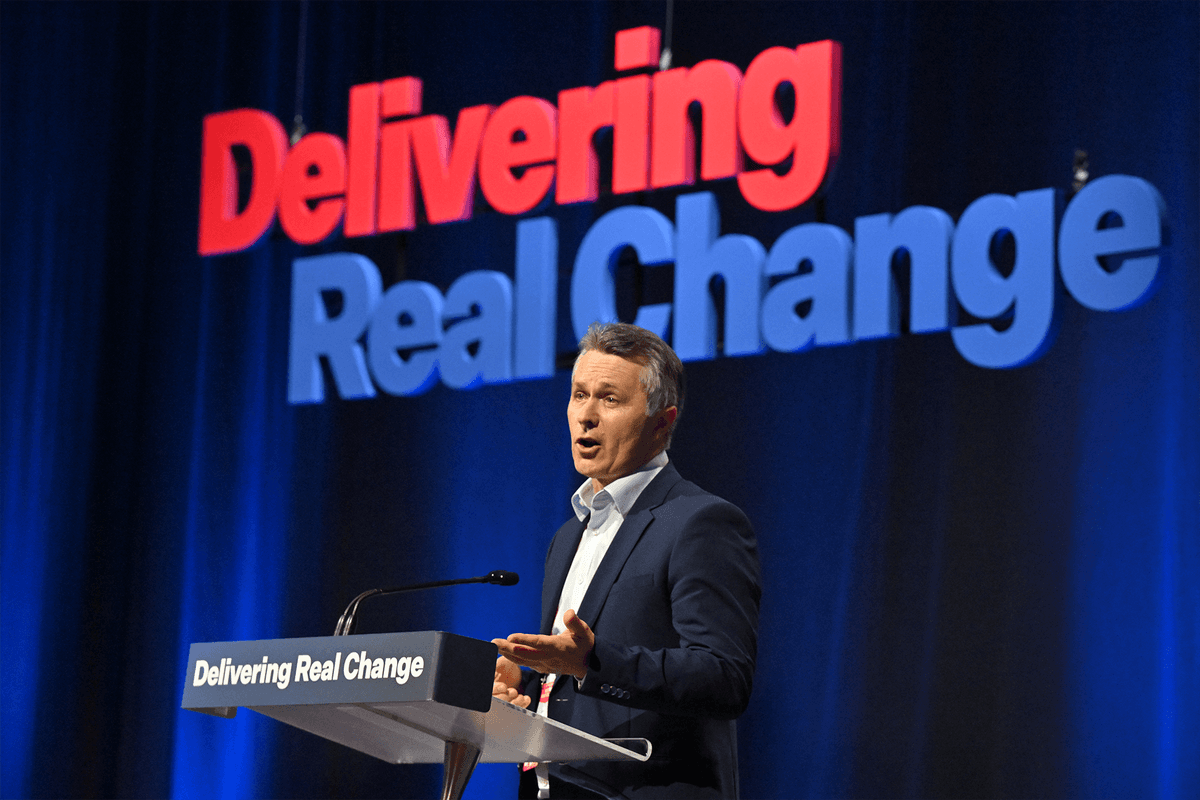
When the Labor faithful gathered in Adelaide for their triennial national conference late last month, the Commonwealth Education Minister Jason Clare appeared Moses-like before them, conjuring up a sweeping vista of the promised land at which, after forty years or more in the wilderness, they had finally arrived.
The Albanese Government had fixed public school funding at long last, he proclaimed. “Something that Gough talked about. That Gonski designed. That no government has ever done. Until now.” And, Clare said, he was “bloody proud of it.”
It was just the latest in a series of increasingly fanciful statements from the Government that, with some honourable exceptions, have gone largely unchallenged. Jason Clare has not fixed public school funding. In the best-case scenario, he has devised a plan for whichever party forms government in two elections time (Labor? The Coalition? One Nation?) to start delivering a partial solution. The greater likelihood is that the Government’s delay and inaction has further entrenched the dysfunction and inequality that bedevils Australian schooling.
The plain fact is that the Albanese Government will deliver almost no additional funding to public schools this decade. Recall that the goal is to fund public schools at the minimum level required for most kids to achieve at adequate levels, as defined by independent experts 15 years ago. That requires an additional $16 billion from both levels of government. In reality, the Albanese Government has committed to increase funding to public schools by just $407 million over the next four years. $16 billion required, just $407 million (or 2.5 percent) promised this decade.
All the while the appalling gap in educational outcomes separating advantaged and disadvantaged young Australians continues to grow. Disappointing perhaps but just wait until the 2030s the government tells us. Then the floodgates will open and an extra $7.2 billion will flow to public schools.
The trouble is that we have seen this movie before, and it was a dud the first time. In 2012, the Gillard Government announced a six-year plan to fully fund schools, with the lion’s share backloaded to 2018 and 2019 — and here we are, still waiting, hoping the funding will arrive by 2036. The problem with promises to do things next decade is that things happen in the meantime.
The Government has successfully promoted the notion that the funding increases are locked in by law. That is incorrect. The legislation requires that: “the Commonwealth share for a government school for a year is either maintained or adjusted upwards.” So a future government would need to amend the legislation to cut funding; it is not obliged to continue increasing it, or otherwise to make good on aspirations espoused by their political opponents in 2026. If Labor were to lose Government the election after next, the only thing likely to be locked in is the measly $400 million increase it has actually delivered in the meantime, but that is all.
Then there is the other half of the extra funding required to lift public schools to the minimum resource standard, the part the states are responsible for delivering. Once again, the timeline extends out to the mid-2030s. While some jurisdictions are ahead of the game, others – like Victoria – have been going backwards. Ben Carroll’s recent promise to do as premier what he could not do as education minister, months out from an election Labor has every chance of losing, only underscores how precarious the whole exercise is.
And then there is an even more fundamental problem. Even if we imagine that the Better and Fairer Schools Agreement is eventually implemented on time and to the letter, public schools will still be underfunded to the tune of many billions of dollars. This is because Morrison-era loopholes will continue to allow states to count spending on school transport, teacher registration bodies, assessment and curriculum organisations and even capital depreciation. All important expenditures to be sure, but they fall outside of the Schooling Resource Standard’s definition of the investment desperately needed inside the school gates. Predictably perhaps these items are excluded from calculations of private school funding.
At this point the Government’s defenders might concede that Labor hasn’t produced a plan to fully fund public schools, but funding is increasing. These immediate increases may be marginal, but small changes can establish a basis for more ambitious action in the future.
But this gets it backwards. To create space for future progress it is first necessary to establish that public school funding is a priority. Instead, Labor has consistently signalled that it can’t or won’t put public school funding first as long as it means putting something else second. When it comes to funding public schools adequately, the light on the hill is always far off in the distance, beyond the budget forward estimates and the next election cycle, in a place that resonates with warm feelings but never impinges on reality.
This becomes clear as soon as the lofty rhetoric is set aside and we focus on the Government’s revealed priorities. The Albanese Government has chosen to provide more additional funding to the American submarine industry this decade than to Australian public schools; it has resisted the opportunity to raise more revenue from foreign multi-nationals that export our gas; and it has prioritised tax cuts over essential spending. Every choice the Government has faced, kids in public schools have taken the hit.
If funding public schools was a priority, the Government could review the allocation of Commonwealth spending to government and non-government schools. At the end of the Whitlam Government 65 percent of Commonwealth spending went to public schools. Today the proportion is just 38 percent. Helped by the huge historical boost in federal funding, the private school advantage in total income per student has continued to grow, inevitably fuelling enrolment shifts away from public schools.
Nowhere is the gap between reality and action more evident than in the Government’s response to the independent expert panel it commissioned to review school funding. The experts highlighted the issue of what schools are asked to do in return for the funding they receive, especially who they are required to enrol. Their findings should have shocked anyone interested in a fair, equal and prosperous Australia.
As Minister Clare told ABC radio in the review’s wake: “We have one of the most segregated education systems in the world, not by the colour of your parents’ skin but by the size of their pay packet. That is just a fact.” This sorry feature of Australian education has a direct and profoundly negative impact on student achievement.
The experts’ response was significant but politic. Their recommendations did not carry a big price tag or even require a firm policy commitment. They simply offered two small steps forward: measure and annually report on the scale of the segregation problem; and conduct research into how comparable countries have created much more socially mixed and cohesive schools.
That was almost three years ago, and we are still waiting for the Albanese Government to act.