Things were a touch better by 1996, partially due to the Keating Government’s One Nation and Working Nation economic programs, but unemployment was still over 8%, and the budget now had a $11.1 billion deficit.
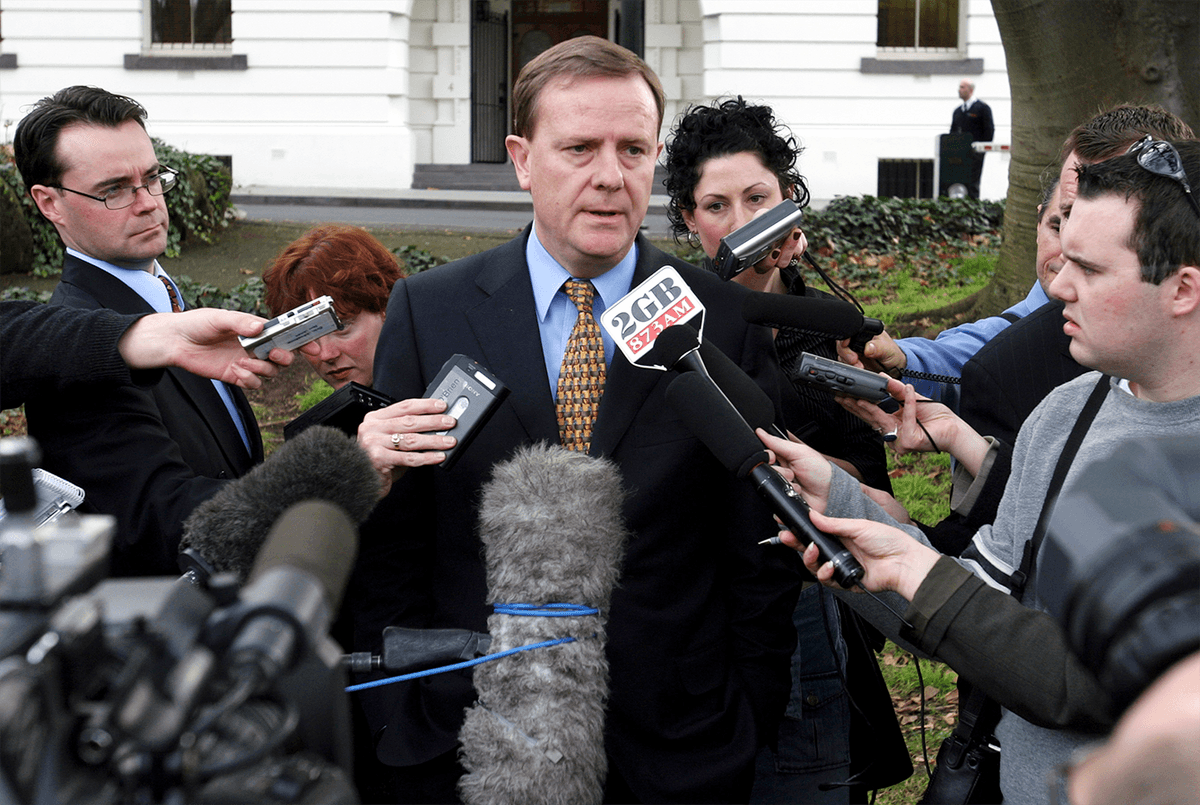
Costello attacked the deficit as the “Beazley black hole” (named after Kim Beazley, Keating’s Treasurer) and used it to justify major cuts to government spending, including welfare, health, universities, and the public service.
Costello knew it would not be a popular budget – as Frank Bongiorno has put it, it created “political pain for the government and economic pain for voters”.
According to Fraser, to try to ease some of the political pain, Costello approached deputy RBA Governor (and soon to be new Governor) Ian Macfarlane to ask him to delay an impending interest rate decision.
Fraser wanted to cut the interest rate from 7.5% to 7%. Costello wanted the RBA to wait a few months until after parliament had passed the budget so he could, in Fraser’s words, claim the budget had “reduced interest rates”.
According to Fraser, during his 12 years on the RBA board, decisions had always been made based on debating the bank’s recommendations and a degree of consensus. Decisions never came down to a vote of board members.
The only time Fraser oversaw a vote was on this 1996 interest rate cut, which Treasurer Costello wanted to delay. This was so rare that Fraser and his staff had to go and check on the formalities of voting arrangements when the vote became necessary.
Fraser believed he had the votes for the rate cut at the crucial meeting, despite the efforts of Costello. Or at least he had the votes before the meeting broke for a half-hour morning tea.
During morning tea, Costello’s board members “got at” an academic board member who had been in favour of a rate cut before morning tea, but suddenly changed his mind after the break.
Now the vote was tied. Fortunately, the RBA voting arrangements gave the casting vote to the board chair, and Fraser was able to “carry the day”.
But it could so easily have gone the other way. After September, Macfarlane replaced Fraser as RBA Governor, who would stay in that role for exactly a decade and adopt a more “hawkish stand” and re-focus the RBA’s activities primarily on inflation targeting.
The message of Fraser’s comments last year was that we cannot take the independence of a central bank for granted. Governments can and do try to intervene in central bank decisions when they think it’s politically viable (just look to US President Donald Trump’s regular attacks on the Federal Reserve for a present-day example). That the Commonwealth respects the RBA’s independence today does not mean we should not remain vigilant about governments of tomorrow.
James Watson is a Postdoctoral Research Fellow at The Australia Institute. A graduate of the Australian National University’s School of History, he has written on the intersections of politics, economics, and social movements for The Guardian, History Australia, and Labour History.