We now often struggle to understand why the far-right is advancing fast – in Australia with One Nation, in Germany with the AfD, in the US with Trump, in Brazil with Bolsonaro and his likes - but if we think about it, neoliberalism has always had an authoritarian face, often masked by the embrace of diversity or cultural “progressiveness”.
Fri 25 Sep 2026 01.00 AEST
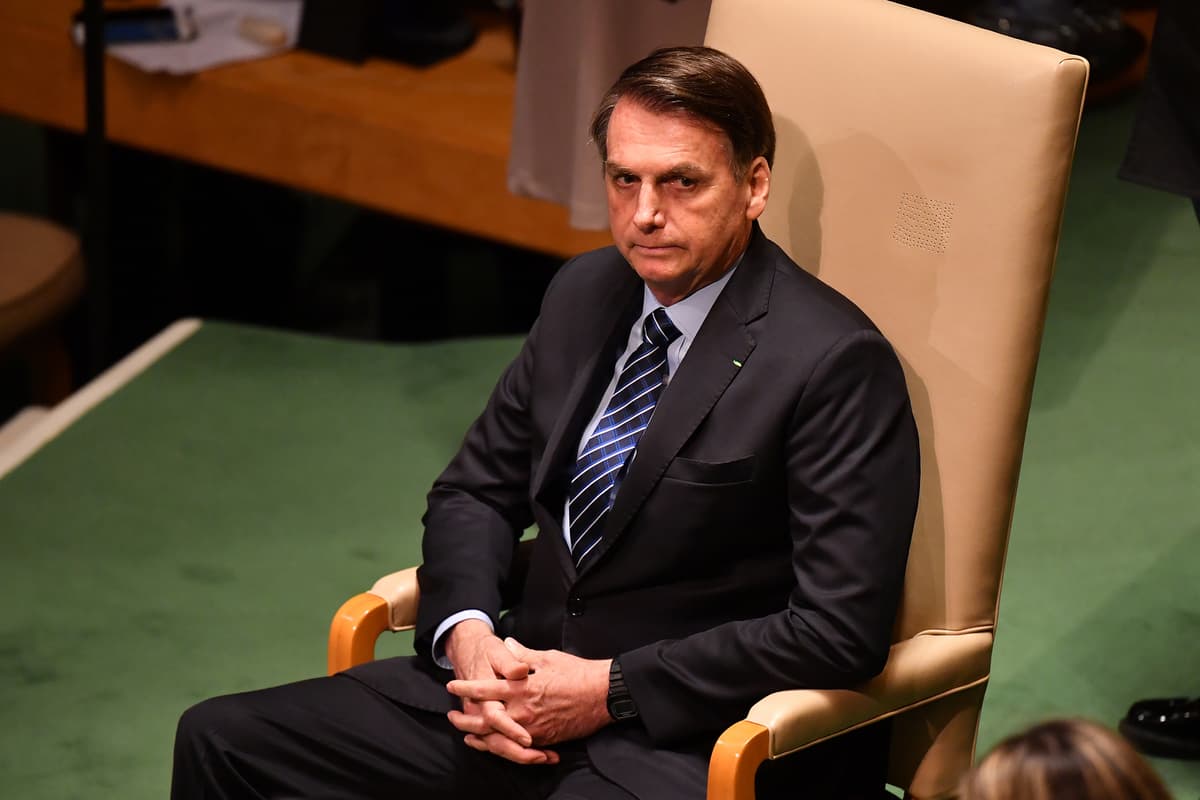
Photo: AAP Image/Mick Tsikas


The Brazilian presidential election is fast approaching, with the first round on 4 October and the second three weeks later. Running neck and neck are the incumbent, Luiz Inácio Lula da Silva (Lula), from the Workers’ Party (PT) and Flávio Bolsonaro (Liberal Party, PL), whose father, former president Jair Bolsonaro, is in prison (currently under house arrest for health reasons) for “doing a Trump”: attempting a military coup to stay in power after losing the 2022 election, spreading claims of fraud without evidence, mobilising supporters against democratic procedures and so on. When Bolsonaro was convicted, Brazil was internationally praised for succeeding “where America failed”. The current situation shows, however, that we need to analyse the whole picture, not personify the issue: the far-right movement is global, and its roots are primarily economic, not political.
As it’s widely known, neoliberal policies over the last decades have sharply altered workers’ everyday lives, with globalisation facilitating production moving mostly to China in search of cheap labour and, consequently, making jobs elsewhere more precarious and short-term, with fragmented labour rights and weaker union movements. At the same time, financialisation infiltrated basic needs and the public sphere, with housing, education, healthcare, retirement and leisure becoming tied to credit markets, leaving people and households heavily indebted and extremely vulnerable to economic shocks, guided by monetary policy. Ideologically, insecurity became framed as individual responsibility and failure, not a structural pattern.
We now often struggle to understand why the far-right is advancing fast – in Australia with One Nation, in Germany with the AfD, in the US with Trump, in Brazil with Bolsonaro and his likes – but if we think about it, neoliberalism has always had an authoritarian face, often masked by the embrace of diversity or cultural “progressiveness”. Chile under Pinochet was famously the “lab” of neoliberalism, with privatisations and an attack on public services implemented as soon as the coup against Allende’s democratic socialism succeeded, one of the many US-backed military coups in Latin America (Brazil’s, in 1964).
During the Cold War, US interventions in the Global South are well documented. With the fall of the Soviet Union, the scenario was blurred. In the Global North, the mainstream Left adhered to neoliberalism. In Latin America, resistance emerged, but it also clashed with upper classes that benefited from globalisation and pushed for “modernisation”, while unions, social movements and leftist parties fought for national sovereignty. Some countries pushed further, such as Venezuela under Chávez and Maduro; others took a hybrid approach, such as Brazil under Lula and Rousseff, focusing on redistribution to lower classes without challenging the system head-on.
It is a difficult life, the one of Latin America, as the “backyard” of the US, ever since the Monroe Doctrine was established in 1823. Trump has inaugurated a new stage of it, the so-called “Trump Corollary” or “Donroe Doctrine”, with the goals of “enlisting regional champions” (doing whatever it takes to guarantee that, imposing tariffs, targeting “drug trafficking”), and “expanding partnerships”, which the 2025 National Security Strategy says will be done “through various means” so that access to critical materials and supply chains is secured.
Some of Trump’s tactics have included an arrangement to have US military and civilian personnel inside Paraguay; backing IMF loans to Argentina, publicly linking the support to far-right Milei’s electoral success; and endorsing far-right candidates in Bolivia, Chile, Honduras, Ecuador, Peru and Colombia (all of whom won, the last three being visited right now by Marco Rubio). Not long after taking office, the new Colombian government signed agreements with the US for civil nuclear and critical minerals cooperation. Leftist governments, on the other hand, have been having the opposite treatment: Maduro was kidnapped, and the US government assumed control of Venezuela’s oil; Trump threatened to take military action in Mexico against drug cartels, and Cuba continues to be strangled as it accused it of being a “national security threat” to the US.
Quality research, analysis, explainers and factchecks from experts you can trust.
As for Brazil, Trump signed an executive order imposing 50% tariffs in response to Bolsonaro’s trial (as a result, Brazil increased its exports to China and other countries), classified the major criminal groups in the country as Foreign Terrorist Organisations (they are not, but the change might facilitate US interventions), targeted the PIX, the free and super-efficient digital payment system created by the Brazilian Central Bank, and is pressuring for access to rare earths reserves, the second largest in the world, with the Pentagon acquiring part of them. On top of that, a movement is pushing to deny Lula’s legitimacy if he is re-elected. In July, two senior US officials had their visas rejected, as they intended to meet electoral authorities in Brazil to cast doubt on the integrity of the voting system.
Recent research shows that in the predictions for the second round of the elections, Flávio Bolsonaro and Lula are technically tied. Lula leads among the poorest, the youngest and Black voters. Bolsonaro’s advantage is with the wealthiest, the Evangelicals, the most educated and the “whitest” Southern regions. This shows that the social base of the far-right in Brazil contrasts with the ones in Australia, Germany and the US, which are mostly composed of lower classes or the less educated.
Returning to the neoliberal parameters described earlier, Workers’ Party governments followed a hybrid form that redistributed, even though it did not holistically disrupt neoliberalism, which helps explain the voting patterns. Given Lula’s past as a union leader, his years in government and particularly his current term, he failed to mobilise the population, which could have catapulted further reform. For example, Brazilians, particularly the lower classes, who are the vast majority, should be on the streets protesting against Trump’s threats. Instead, Bolsonaro supporters (and family) are the ones actually requesting US interference in Brazil.
As it is, Brazil is at a major crossroads: in 2026, deforestation is at its lowest level in a decade, after peaking in 2022 under Bolsonaro, who was and is adored by the agribusiness. During my fieldwork in São Paulo and Rio de Janeiro in 2024, social movement and union leaders, as well as progressive actors and minorities, reported how persecuted they felt while the far-right president was in power, with police repression at its highest. Flávio Bolsonaro’s program will follow suit, promising to build more prisons à la El Salvador and pursue other law-and-order measures. It also aims to reinforce neoliberalism, with privatisations (probably including Petrobras, the oil company), cutting social protection and public services, despite the fact that the failures of this capitalist method have long been acknowledged, with even more dramatic consequences in a deeply unequal country such as Brazil. And if these reasons weren’t enough to show how harmful his government could be, Flávio Bolsonaro is also involved in multiple corruption accusations, the most recent of which is linked to the Banco Master case.
Domestically, Flávio Bolsonaro would be a tragedy for the environment and social inclusion. For the rest of the world, it would solidify the far-right tide in South America, which, no doubt, Donald Trump would qualify as a “big and beautiful” US backyard.
Flávia Soares Julius is a São Paulo–born researcher and teacher in politics and sociology at Macquarie University.

