


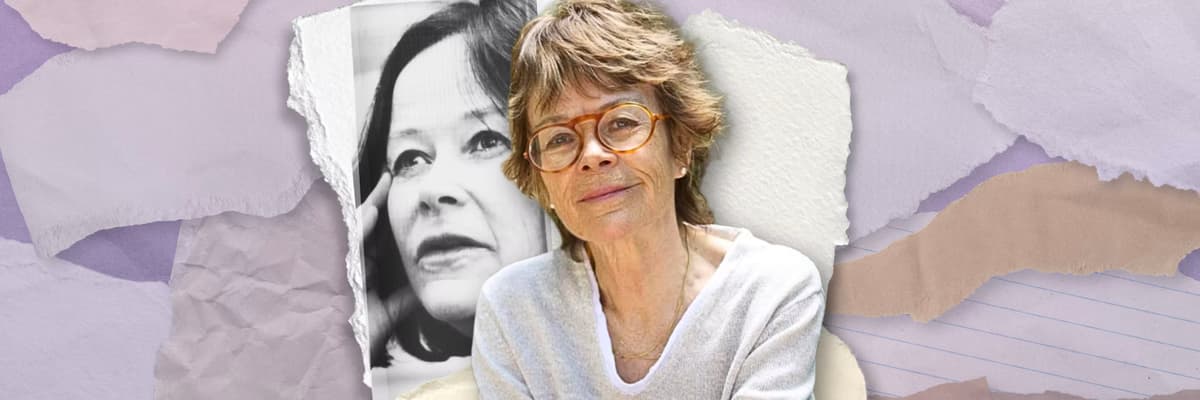


Hilary McPhee, who has died, aged 85, was already a legend when I started working in publishing, nearly two decades ago.
McPhee Gribble, the publishing house she founded with friend Diana Gribble in 1975, was the first home for some of Australia’s beloved authors, including Helen Garner, Gabrielle Carey and Kathy Lette. It also published Tim Winton’s Cloudstreet, voted the nation’s best novel by the Australian Society of Authors in 2003 – the same year it topped a reader poll.
McPhee’s business acumen, creativity and incredible track record made her a titan of the industry. She is survived by three children.
I’ll confess it was with more than frisson that I saw she ordered a copy of the first book I published at Australia Institute Press – I held her in such esteem – and I will always regret the email I didn’t send to say what an inspiration she has been to me and how grateful I am for the books she edited and published.
They included Garner’s debut novel, Monkey Grip, published in 1977, now nearly 50 years old – and enjoying new waves of international acclaim. And Puberty Blues, sent as “a handwritten scrap of manuscript” by 18-year-old best friends Carey and Kathy Lette, who sang to McPhee and her business partner Di Gribble to persuade them to sign them up. Legends she edited included Gerald Murnane, often touted as a potential Nobel Prize winner, with his debut novel, Tamarisk Row.
Beginning at the top
McPhee’s first publishing job was as an editorial assistant at the country’s leading literary journal, Meanjin, working with founding editor Clem Christesen, while she was a student at the University of Melbourne.
After a sojourn overseas, and a stint at the British Council, she was hired at Penguin Australia in 1969, where she was the company’s first editor of “a small list of boomerang-bedecked Australian Penguins”. A stint followed at McKinsey management consulting firm, as their first female writer.
Then, aged 34, in 1975, with four years’ book publishing experience, she started a publishing house with her friend Diana Gribble, whose background was in design and office management. The company started as a rented room in a Victorian house in a South Yarra back street. By 1980, they had an office in Fitzroy with a creche, and editors such as their eventual successor at McPhee Gribble, Sophie Cunningham, and Sue Hines, both now major publishing figures in their own right.
McPhee Gribble subsidised their literary work with a highly popular children’s series, Practical Puffins (which sold three million copies), and a licensing arrangement with Penguin. They also successfully sold rights for Australian books overseas. By maintaining multiple revenue streams and publishing books that found commercial and critical success, the two founders built a business contemporary publishers might envy.

McPhee is one of relatively few editors who have written memoirs — with some famous exceptions. (Accomplished UK publisher Diana Athill’s Stet and Life Class are just marvellous). Her first memoir, Other People’s Words (2001), was published in a 25th anniversary edition this year.
She also published a second memoir, Other People’s Houses (2019), about a writing project in the Middle East following the end of her third marriage, to historian and speechwriter Don Watson.
Defining relationship with Garner
In the pages of Other People’s Words, we meet young authors (many now literary titans), eager, earnest and unedited, ready to find their readers – and McPhee’s frank reflections on the difficulties of running a business and the many and varied demands on editors. She also shares the delights of discovery.
“One day in 1976, Helen Garner arrived at the Jolimont Lane bunker to tell us rather diffidently that she thought she might have written a novel. Would we take a look? And tell her truthfully what we thought,” McPhee remembered. “We each read copies of the manuscript of Monkey Grip overnight. And here was an original voice saying something that hadn’t been said before under skies that were familiar from the opening lines.”
This relationship with Garner was to prove formative for both author and publisher. The trust level was so high, when McPhee and Gribble encouraged Garner to leave one manuscript unpublished, she chose to follow their advice rather than take it elsewhere, wrote Bernadette Brennan in her biography of Garner.
And it was McPhee who suggested Garner insert herself as a kind of character in her own writing, for her first nonfiction book, The First Stone, about sexual assault at a prestigious college at the University of Melbourne. McPhee’s successor at Picador, Nikki Christer, published the book in 1995. The book’s style is now a hallmark of Garner’s nonfiction prose and a mode she carried into subsequent books, including Joe Cinque’s Consolation and This House of Grief.

Darren James/Text Publishing
In this way, McPhee embodied all the qualities authors need in an editor. She was reading the cultural conditions of the time and the market, anticipating the readers’ responses, managing the legal vetting and the personal dynamic with the author – and ultimately collaborating to produce something new.
The First Stone is still in print. And whatever reservations one might have about the book, it will forever be a cultural flashpoint.
Naturally, not all editorial relationships were harmonious, as McPhee describes in Other People’s Words. Of editing Murnane, at Heinemann, she writes:
Overnight he would rework segments and introduce new ones. This was one of those satisfying experiences for an editor that working closely with a fiction writer can be if things go well. My memory is of becoming a kind of sounding board as the novel took its final form and the author’s vision for the novel deepened. Gerald’s memory is entirely the opposite.
First woman to chair the Australia Council
In 1983, McPhee and Gribble entered a “co-publishing” arrangement with Penguin. In 1989, Penguin bought the business, which became an imprint, for a time, and McPhee stayed on a contract for two years. Then she moved to Pan Macmillan, where she ran the Picador imprint until 1994.

Nerida Phelan/MUP
McPhee was headhunted by Paul Keating to become the first female chair of the Australia Council for the Arts from 1994–1997, where she implemented its first complete overhaul since its inception. “People were very hostile to change, but we were trying to fix an uneven system,” she told Kill Your Darlings. “I learned huge things from that period, but god, was it hard. I cried a lot actually.”
She said she was “terribly” embarrassed by the Order of Australia for Services to Literature she received in 2001, when John Howard was prime minister. “When I was at Australia Council, he […] would cut me dead, turn his back to me.”
As well as being a judge on major literary prizes such as the Miles Franklin, Victorian Premier’s Award and Melbourne Prize, she was a director and sometime editor of the online political journal New Matilda.
A living legacy
McPhee’s legacy lives on in the editors she trained and in the standard she set. Earlier this year, she remembered editing her authors in person – they’d “hop on a tram or a bike” – and during long phone conversations with interstate authors like Winton. “There had to be a personal connection. You needed to understand what the author was trying to do.”
I am jealous that no publisher had its own creche when I had my own kid, and that the current conditions for people working in publishing are in some ways worse now. The industry failed to meet the high standards she set. But her words, from Other People’s Words, still echo in my ears when I work:
We learnt to ask questions, make suggestions – and to do the first edit in pencil. This was a useful reminder, for ourselves, that the editorial process was secondary to the act of writing, and, for authors, that the text remained in their charge and that they must in the end seek solutions for themselves.
McPhee will long be remembered by authors and editors alike who admire the panache, sophistication and distinctly Australian publishing that mark her career. Not everyone who cherishes The Children’s Bach or Cloudstreet will know her name – but they have first-hand experience of her publishing.
Correction: An earlier version of this article stated that Hilary McPhee published The First Stone at Picador. The book was acquired by McPhee and published by Nikki Christer in 1995.
Alice Grundy, Managing Editor of Australia Institute Press and Visiting Fellow, School of Literature, Language and Linguistics, Australian National University.
This article is republished from The Conversation under a Creative Commons license. Read the original article.