Mon 9 Nov 2026 12.01 AEDT
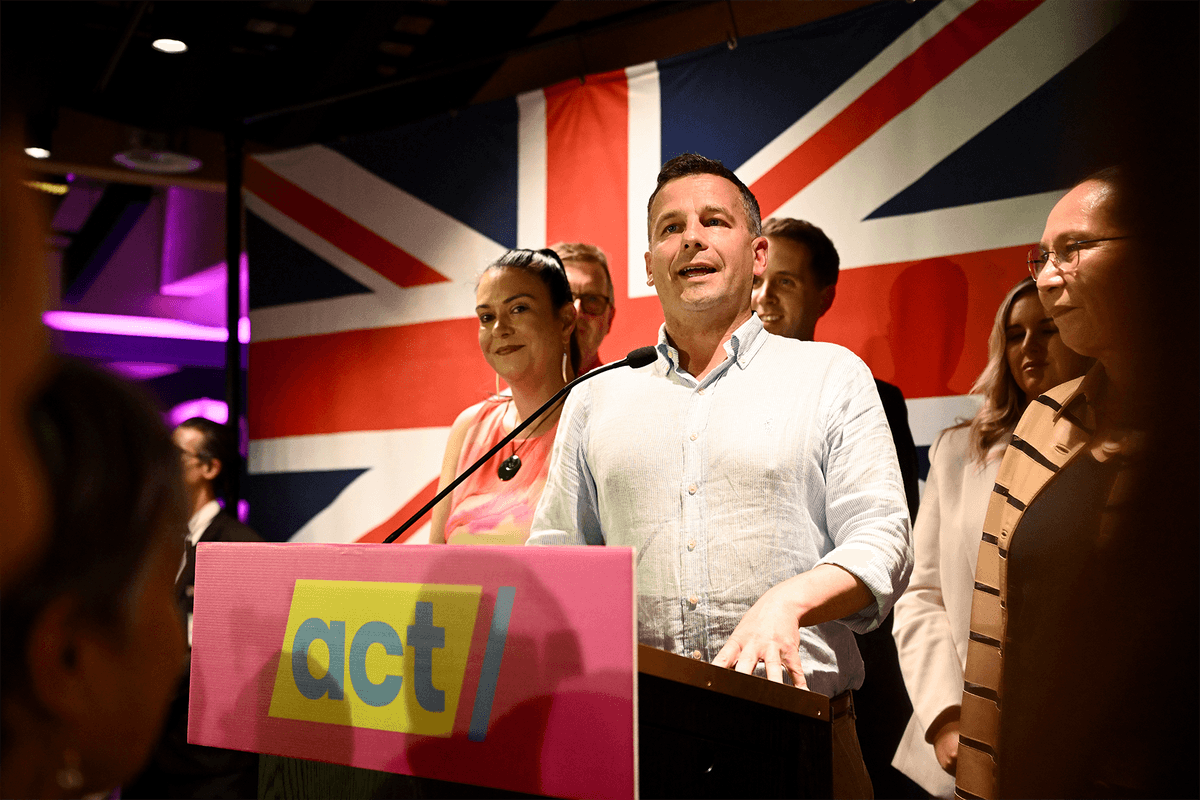
Photo: AAP Image/Bianca De Marchi


In 1976, the chairman of Australian petroleum company Santos, John Bonython, wrote to his wealthy business partner in Texas about a visiting Englishman: Antony Fisher, founder of London’s Institute of Economic Affairs (in 1955), and of the Atlas Economic Research Foundation (in 1981) later rebranded as ‘Atlas Network’. Fisher’s tour had launched the Centre for Independent Studies (CIS), funded without public knowledge by Santos, Shell, Esso, BHP, Rio Tinto, Utah, and Western Mining.
Fisher, Bonython explained, has “a technique of getting academics to say and write under their own names what business cannot say for itself.”
That sentence describes a procedure, and our recent report documents its implementation in New Zealand for half a century. This is a hidden history of crucial importance to the New Zealand election.
Correspondence, workshop agendas and grant reports in the records of the Atlas Network trace a direct line from Fisher’s 1981 letters seeking businessmen interested in a New Zealand thinktank to the office of the Deputy Prime Minister, David Seymour. Elected to high office in the National, ACT and NZ First coalition government that came to power in October 2023, Seymour’s campaign called for a referendum on Aotearoa New Zealand’s constitutional document: Te Tiriti o Waitangi (the 1840 Treaty of Waitangi), claiming it ‘divides us by race’.
That same election day, Australian voters rejected a referendum proposal to recognise Australia’s First Nations in the Constitution, under the influence of a No campaign run across Australia’s Atlas thinktanks and campaign units, which similarly claimed an Indigenous Voice to Parliament would ‘divide us by race’.
Welcomed by US-based AtlasNetwork.org as experiments in a “laboratory”, the record of the present New Zealand government is ‘Trumpian’: slashing social, judicial, environmental and climate protections, and undermining Māori rights to lands, waters and representation guaranteed by the Treaty.
Deployed for decades by hundreds of Atlas think-tanks around the world, the ‘Fisher method’ has three working parts.
The first is recruitment. New Zealand’s free-market turn is memorialised as a local intellectual awakening. Yet for four years, Fisher wrote from abroad, hunting for a local businessman with money and an academic with credentials.
The second: the appearance of independence. In 1985, Greg Lindsay proposed to run the New Zealand operation as a branch of the CIS. Fisher objected: “critics can be that much more effective if they can make any case for the ideas having originated in Australia.” A local letterhead provides an illusion necessary for national influence.
The third is the relay from funder to institute to media to legislature. This is taught as curriculum. The agenda for Atlas’s 1985 Sydney workshop “included Influencing government: persuading; legislators vs bureaucrats” and “The public: mass media; picking the issue; spokesperson; op-ed pieces.” Bonython’s problem, answered by Fisher’s method, was that the public discounts the statements of big business as vested interest. The message is the same, but the messenger becomes a ‘researcher’ perceived as independent by target audiences. Two New Zealanders in that room soon founded the New Zealand Centre for Independent Studies and the New Zealand Business Roundtable, since replaced by the New Zealand Initiative and the New Zealand Taxpayer’s Union.
Quality research, analysis, explainers and factchecks from experts you can trust.
Seymour’s career runs through this system. After university, he went to Canada and joined the Frontier Centre: an Atlas affiliate with ACT founder Roger Douglas on its research advisory board engaging in disputing climate policy and Indigenous rights in oil-rich Alberta. Seymour was among the inaugural 2008 cohort of Atlas’s Think Tank MBA. He then ran a regional spin-off, Frontier Centre Saskatchewan, with Atlas grant funding. A 2009 Atlas report approvingly observed that its policy studies, events and media had already influenced the public and legislators.
Seymour won the MPS Hayek Essay Contest in 2008. His essay cited The Bell Curve, Charles Murray’s book linking race to intelligence. Seymour’s Frontier output included “Why the Eco-Doomsters are Wrong”, and a paper asserting the scientific consensus that “man-made climate change through increased CO2 emissions is a fact” was “not justified by the evidence.” He later worked at another Atlas unit, the Manning Foundation. Returning to New Zealand, he won the seat of Epsom for ACT in 2014.
His party’s Atlas ties predate his own. Credited as a founding ACT funder, Alan Gibbs sat on Atlas’s Business Advisory Council. As the archive records, Gibbs coined the name “Atlas Network.” Douglas took MPS membership in 1998, whilst ACT president. Years later, in an ACT ‘State of the Nation’ speech, Seymour spoke of “my old friends the Atlas Network.”
At Waitangi on 6 February 2024, Mihingarangi Forbes asked him whether ACT had “any links or connections to the Atlas group”. Seymour answered: “No.”
Debbi Gibbs, former Atlas chair, later told Q&A that Seymour “worked at a Canadian think tank and attended Atlas Network events and training.” Readers can weigh that one-word answer against the documents.
Atlas disputes this wider picture. Its CEO complained to the Media Council about “Trick or Treaty?”, Forbes’ Mata Reports investigation that brought the Atlas Network to national attention, asserting that Atlas had no oil-derived funding, nor any role in New Zealand’s politics, including campaigns against the Treaty. The Council did not uphold the complaint of factual inaccuracy but ruled the programme unfair because Atlas was not approached for comment.
The ‘Fisher method’ never intended that the Atlas head office, nor the existence of the Atlas Network as a global infrastructure servicing corporations, would become named, known and discussed in national politics. The US head office arranges seed money, trains recruits in a shared playbook, then allows its institutes to carry on. Aotearoa’s Atlas think-tanks have published on Te Tiriti since 1988, even though fifty years of internal Atlas correspondence about New Zealand never mentions it. Although Seymour’s Treaty Principles Bill has been defeated, he told last month’s TVNZ leaders’ debate that his next big reform would be “one law for all.”
None of this is illegal. Nobody should be barred from advocating for policy reform. But citizens can only weigh an argument properly if they know where it came from. Corporate donors to ‘not for profit’ organisations seeking to shape public policy should be disclosed, since the charitable status of Atlas thinktanks disguises for-profit messaging often harmful to the public interest, e.g. petroleum-funded climate disinformation. Political finance rules should reach the wider campaign units integrated with parties, not the parties alone. Any organisation presenting itself in public as an independent New Zealand research institute should have to declare its foreign funding, training and Atlas Network affiliations.
Fisher’s technique depended on audiences not knowing who stood behind the speaker. So say it under your true name. Tell us who taught you, and who paid you to say it.
Dr Jeremy Walker is a Senior Lecturer at the University of Technology Sydney.

