Australia is facing a defining question: how to finance the trillions required for a sustainable, inclusive and resilient future without overwhelming public budgets. As climate, housing, and environmental pressures intensify, one option that is gaining traction is green, social and sustainability (GSS) bonds.

Tue 10 Nov 2026 14.58 AEDT
Photo: AAP Image/Mick Tsikas


Australia is facing a defining question: how to finance the trillions required for a sustainable, inclusive and resilient future without overwhelming public budgets. As climate, housing, and environmental pressures intensify, one option that is gaining traction is green, social and sustainability (GSS) bonds.
Like other government bonds, a GSS bond is a loan from private investors to governments. Bonds are used by almost all governments to mobilise private capital, at scale, for public purposes.
GSS bonds direct private capital specifically into eligible climate-smart, environmental and social projects, enabling governments to finance priority investments faster and accelerating the delivery of public‑good outcomes. Investors benefit from fixed returns and principal repayment at maturity, while governments take on debt obligations that require prudent fiscal management.
Prudent fiscal management is important here. No one is suggesting that Australia’s challenges can be fixed with debt alone. Use of private debt doesn’t stop the need for governments to spend judiciously, tax appropriately and manage their monetary and credit systems sensibly. GSS bonds do not replace other ways to fund services but can be a powerful tool to use alongside other measures.
GSS bonds can support a wide range of initiatives, from renewable energy and low‑carbon transport infrastructure to social housing and biodiversity conservation. Each issuance is anchored in a clearly defined framework that outlines eligible investments and undergoes independent verification, ensuring transparency and giving investors – and taxpayers – confidence that proceeds deliver measurable environmental and social outcomes.
What began as a niche instrument is now reshaping how Australia funds some of its most urgent priorities. At the federal level, Australia entered the sovereign green‑bond market in June 2024, raising $7 billion through its inaugural issuance. A centrepiece of the Sustainable Finance Strategy, the first bond aims to support projects in renewable energy, clean transport and community batteries, alongside programs to restore native ecosystems and strengthen the resilience of the Great Barrier Reef. Investor demand was strong, with the deal more than three times oversubscribed, and the issuance was later recognised as Environmental Finance’s 2025 sovereign green bond of the year.
Yet, the real trailblazers of labelled government debt in Australia have been the states. Victoria set the pace in 2016, issuing the country’s first GSS bond and becoming the world’s first state‑level issuer to earn Climate Bonds Certification. Its move opened the door for others: New South Wales, Queensland, South Australia and Western Australia have since built active GSS programs of their own (see Figure 1). Victoria, New South Wales and Queensland have each surpassed at least $11 billion in cumulative issuances, and to date the states together have raised close to $50 billion – an impressive build‑out in just a decade. Notable projects include Sydney Metro Northwest, Parramatta Light Rail, and Queensland’s Sunshine Coast Solar Farm.
Quality research, analysis, explainers and factchecks from experts you can trust.
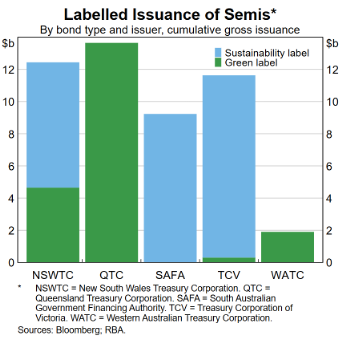
Figure 1 – Labelled issuance of semi-government bonds, by bond type and state issuer (cumulative gross issuance) (Adapted from: Alexander & Jayawardhana, 2025)
Beyond Australia, the global GSS bond market is thriving. The Climate Bonds Initiative – founded and led by Australian Sean Kidney – reports that global GSS+ bond issuance exceeded US$1 trillion in 2025 for the third consecutive year, pushing cumulative volumes past US$ 8 trillion by the end of 2025. This rapid and sustained expansion highlights both the momentum behind labelled debt and the depth of investor demand for credible climate and sustainability investments. Kidney observes, “Despite prevailing geopolitical headwinds, the global outlook for GSS bonds remains robust and positive. Many global investors are prioritizing GSS criteria. Australia has already taken important steps, yet vast opportunities exist to increase funding and accelerate environmental and social outcomes.”
As Australia prepares to preside over the COP31 climate negotiations this month, it steps into a defining role on the global sustainable development stage. At home, the growing GSS bond market offers a promising narrative of momentum and fiscal discipline, tempered by a realistic acknowledgment of the remaining work ahead.
Ultimately, channelling capital into Australia’s most urgent environmental and social priorities is a fundamental investment in long-term resilience and prosperity. While not a silver bullet, GSS bonds offer a proven vehicle to mobilise private finance at scale, helping tackle the critical, underfunded public-good challenges that will define our collective future.
Dr Brad Hiller is a Lead Climate Change Specialist at a multilateral development bank and recently contributed to a €500 million issuance on the London Stock Exchange.
Rod Campbell is the Research Director at The Australia Institute.

