

To get a gun licence in Australia, an applicant must have a “genuine reason” to use a gun. You can’t just have a gun because you want one -- firearm ownership is a privilege in Australia, not the sort of right that United States gun owners never tire of talking about.
Tue 17 Mar 2026 01.00
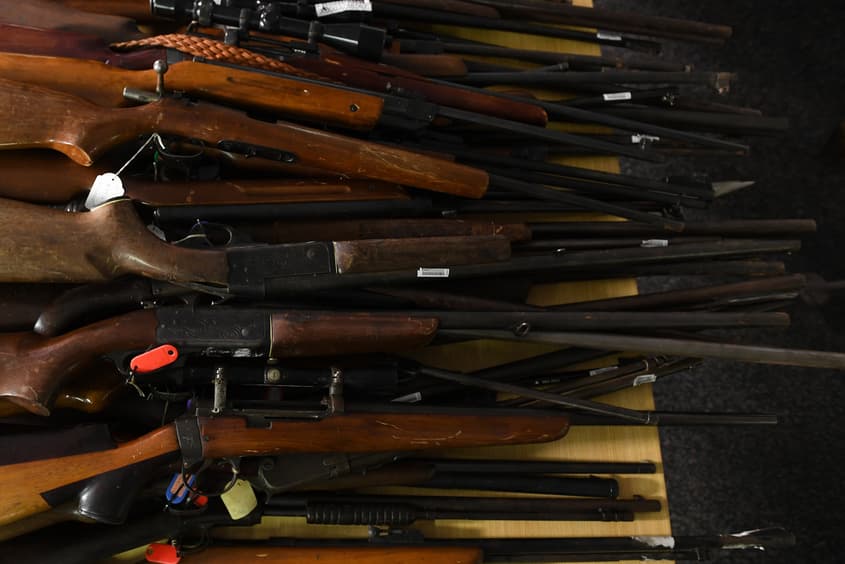
Image: AAP/Dean Lewins


To get a gun licence in Australia, an applicant must have a “genuine reason” to use a gun. You can’t just have a gun because you want one — firearm ownership is a privilege in Australia, not the sort of right that United States gun owners never tire of talking about.
Genuine reasons to have a gun in Australia include working on farms or in security, but do not include the use of weapons for personal protection or to enact violence on others.
However, Australia’s genuine reason requirement has a big loophole that effectively means anyone can pass this test.
Among the genuine reasons to have a gun in Australia are recreational hunting and sports shooting. But most states and territories don’t require applicants to ever actually go hunting or target shooting in order to justify having a gun. You do not need to get muddy hunting ducks or spend deafening days at the shooting range; it can be as simple as filling in a five-minute webform, with no human contact, and paying your membership to a gun club.
In fact, you can show genuine reason to have a gun “from the comfort of your home” just by joining the Queensland branch of the Sporting Shooters Association of Australia (SSAA). According to the SSAA, “It’s as simple as that”:

This means that an applicant can join a gun association and claim a genuine need for a gun with no intention of ever shooting a rabbit or a clay pigeon. Financial membership of a shooting club is all that’s needed. Genuine reason requirement met, for a modest payment.
Only NSW and WA require licencees claiming to be hunters or target shooters to actually participate in these sports. In NSW, a shooter should either go hunting twice per year or go target shooting four times. A WA target shooter needs six trips to the range. It is unclear how, or if, these requirements are enforced.
The size of this problem most easily demonstrated by comparing official statistics on how many people participate in recreational shooting with the number of who claim these activities as their genuine reason for having a gun licence. Unfortunately, the relevant data is only available for NSW as it is the only state to publish data on the number of licences issued under each genuine reason.
According to the Australian Sports Commission, at most 36,000 people in NSW participated in recreational hunting or sports shooting in 2024-25. By contrast, there are up to 253,000 people with gun licences in NSW that list sports shooting and/or hunting as their genuine reason, as shown in the chart below:
The chart shows a startling gap of over 200,000 individuals who own a firearm for the stated purpose of sports shooting or hunting, but are not active participants in either. Given the NSW requirements around participation, it appears that large numbers of people with gun licences in NSW are in breach of their licence conditions.
A similar disparity likely exists in other states and territories, but they do not publish data on licences by genuine reason. This breaks the spirit, if not the letter, of Australia’s gun laws and National Firearms Agreement.
Any reform must ensure “genuine reasons” fit with community expectations. Some politicians and advocates have proposed eliminating the hunting category entirely. This would be a significant step forward in strengthening genuine reason requirements.
Another possibility is for all states and territories to require participation. If participation requirements were enforced nationwide, it would be more difficult to fake a genuine reason to acquire a firearm.
Ever since the Port Arthur massacre, Australia has been united behind the principle that strict firearm controls are important for public safety. The thin evidence needed to fulfil the genuine reason requirement for a firearm licence is not in the spirit of that principle, and represents an erosion of Australia’s gun control regime.
Advertisement
An investigation into the illegal Robodebt scheme has found two senior public officials engaged in corrupt conduct, but the Greens say the political and bureaucratic “architects” have “walked away scot-free”.

In recent weeks, economists have argued that a certain level unemployment is a necessary condition for the economy to function. They have argued that the Reserve Bank of Australia may need to raise interest rates higher, to increase unemployment, which is currently too low, in order to bring inflation under control.

AI deepfakes used in online fraud are a global problem. In Australia, Hong Kong, Taiwan, the United States, the EU, and Southeast Asia, scammers often use deepfake images of public figures to trick people into handing over money. But Australia has been at the forefront of many of the regulation discussions.
