There is a surprising similarity between Australia and the Academy Awards (hint: it isn’t Jacob Elordi).
The Oscars uses preferential voting, or a ranked-choice ballot, to determine category winners – the same method Australia uses to decide elections.
As the name suggests, under preferential voting voters rank nominees in order of preference. If a person’s first choice cannot win, then their vote passes to the person’s second choice, and so on until a nominee has a majority (50% +1) of votes.
To illustrate, I’ll use this year’s Oscar nominees for “Actress in a Leading Role”:
- Jessie Buckley – Hamnet
- Rose Byrne – If I Had Legs I’d Kick You
- Kate Hudson – Song Sung Blue
- Renate Reinsve – Sentimental Value
- Emma Stone – Bugonia
Of course, we already know that Jessie won, so we can imagine what the Academy’s voting might have looked like.
The voting process
If I had voted, my vote card for Leading Actress might have looked something like this:
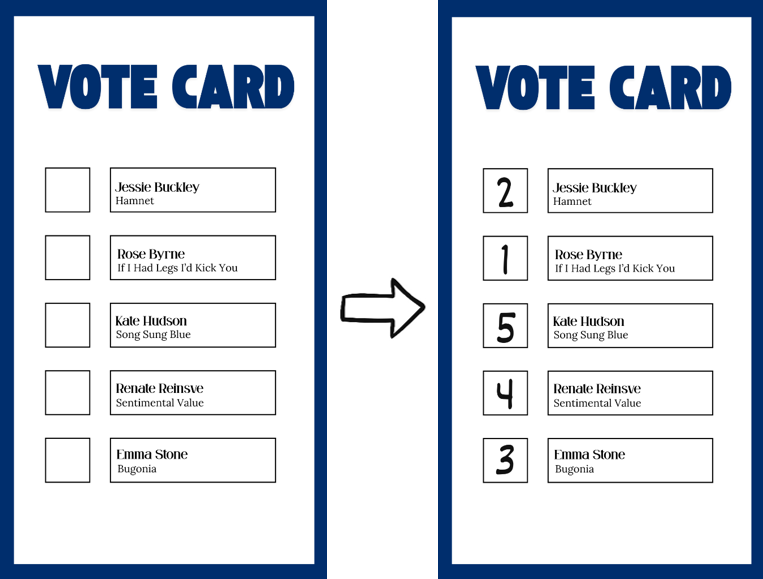
I’ve chosen Rose as my first preference, Jessie as my second, Emma as my third, Renate as my fourth, and Kate as my fifth.
But my vote card is only 1 of many – let’s imagine there were 100, and see what happens as preferences are distributed.
The process begins with first preference votes. These are the ones where a #1 is marked next to a name.
In this scenario, Rose gets 10 first preference votes (10%), Kate gets 16, Renate gets 23, Jessie 24 and Emma 27.
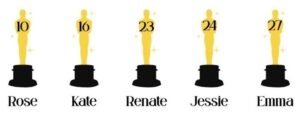
At this first stage, Emma has the highest “first preference vote”, but it isn’t enough to win – she needs a majority, in this case at least 51 votes total.
None of these nominees have reached the benchmark, so vote cards of the person with the least first preference nominations get redistributed to their second preferences – those marked #2 on the vote card.
Since my first preference, Rose, is out of the running, my vote moves to my second choice, Jessie. Mine is one of four votes that goes to Jessie. Two each go to Kate, Renate and Emma.
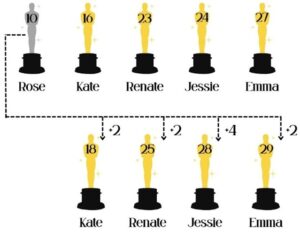
That still isn’t enough for anyone to win, so the vote cards for the trailing person continue to be redistributed to their preferred candidate until there is a final winner.
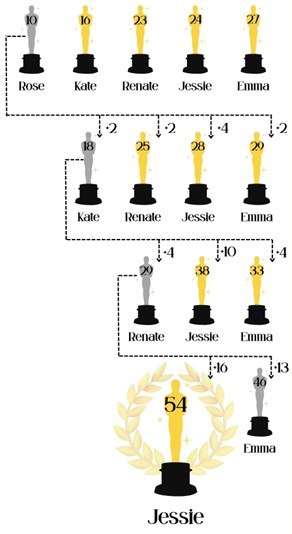
At the final distribution, Jessie crosses over the 50% mark and wins! Her performance in Hamnet was preferred to Emma Stone in Bugonia by 54 of the 100 voters, meaning that Jessie takes home the Academy Award for Actress in a Leading Role.
To put it another way, if the 100 voters were given a choice only between Jessie and Emma, 54 would choose Jessie and only 46 would choose Emma.
If the winner were based only on first preference votes, when Emma was in the lead with 27, then the final winner would have been someone most people did not prefer.
What do the Oscars teach us?
Like Australian elections, the Oscars use a fair voting system. It considers not just the first preference of voters (who voters like the most), but the overall favourability of each candidate (who voters prefer out of the final two candidates).
This means that you can’t waste your vote.
The full distribution of preferences confirms that – between the last two remaining nominees – the majority of voters prefer the ultimate winner. So, in both Australian elections and at the Academy Awards, the winner can be confident that they are preferred over the alternative by the majority of voters, even if they started with a lower first preference vote (just like Jessie did here).
And the best part about preferential voting is that votes are entirely up to each and every voter. That’s a vital part of our democracy.