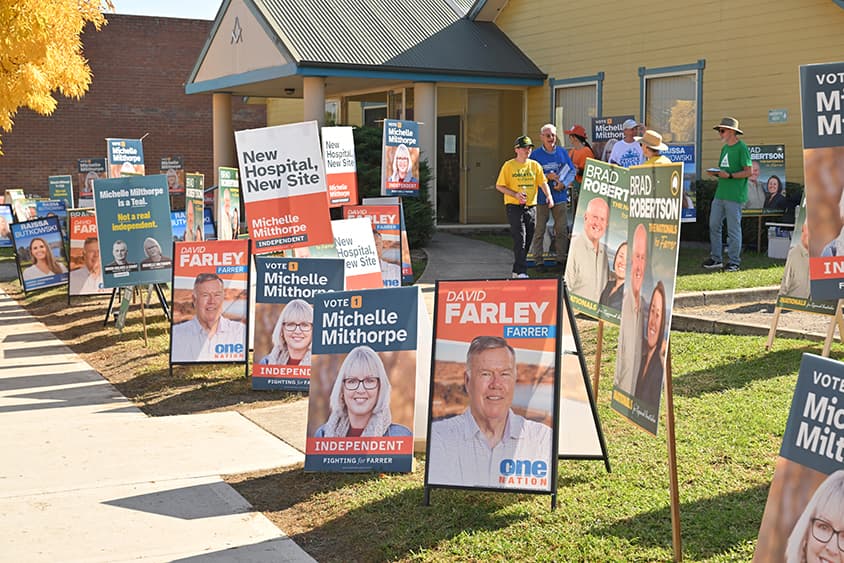
Of the 124,000 Australians enrolled to vote in Farrer, one in five have already cast their ballots.
In an election with the potential for huge ramifications in Australian politics, depending on whether the Independent, One Nation, or Liberal candidate wins, are these 25,000 people really seeing the whole picture when they go to vote?
If you rocked up to cast your ballot on polling day last year, you may have noticed it was a bit quieter than it used to be. More and more Australians are forgoing their democracy sausage to vote before the final days of the election campaign. In fact, only 45% of Australians voted on election day in 2025, a record low.
Despite the shortest pre-poll period in living memory, with booths opening only 11 days out from the election (over a week later than in 2019), Australians set pre-poll records several times during that campaign.
Now, the voters of Farrer are set to outpace even that record, having cast over 18,000 pre-poll and 6,000 postal ballots by the end of last week.
Voting early might be convenient, but it also means missing out on the final days of an election campaign, and all of the information and announcements that might be revealed in them.
In Farrer, early voters would have had just one day to absorb the news that One Nation’s candidate David Farley sought Labor pre-selection in 2022 and supported Independent Michelle Milthorpe’s campaign in 2025.
And, in an electorate where over two thirds of voters support a 25% tax on gas exports, they would have missed out on a growing national debate on implementing such a policy.
A key aspect of an election campaign is hearing the parties’ full list of policies, seeing how their leaders perform under the stresses of a campaign, and then coming together as a country to make a choice about who should represent Australians in the next parliament. As more and more Australians vote early, are they really coming together?
Early voting can have real political consequences when issues surface late in an election cycle.
At last year’s Queensland election, Labor lost government with a 7.0% swing against them – taking only 46.2% of the two-party-preferred vote. However, Labor narrowly won votes cast on election day with 50.6% two-party-preferred. To some extent, this reflects that early voters tend to be more conservative than the electorate as a whole. However, it is also the case that those who vote on the day see more of the election campaign than early voters – particularly on the issue of abortion rights in the case of the recent Queensland election.
When voters go to the ballot box, it’s important that the choice they make is informed as much as possible by the knowledge of what the different candidates, parties, and leaders are offering. Tens of thousands of Farrer voters are missing out on the twists, turns and policy announcements of the final weeks of an election campaign.
How can they make a fully informed choice about who they want to represent them if they’re don’t see those critical final days?