Advanced search
The Point - home
DonateSubscribe
HomeWhat's NewOpinionOff the ChartsExplainersFactcheckAbout Us
The Point — home
DonateSubscribe
The Point — home
Advanced search
  • Home
  • What's New
  • Opinion
  • Off the Charts
  • Explainers
  • Factcheck
  • About Us
DonateSubscribe
Subscribe
  • Home
  • What's New
  • Opinion
  • Off the Charts
  • Explainers
  • Factcheck
  • About Us
The Point - home
Privacy PolicySitemapComplaints & CorrectionsNewsletter

The Point recognises the ancestral connections and custodianship of Traditional Owners throughout Australia. We pay respect to Aboriginal and Torres Strait Islander cultures and to Elders past and present.

©2025–2026 The Point, an initiative of The Australia Institute

EXPLAINER

Who spent big in Canberra’s last election – and how proposed changes would hurt newcomers

Could big spending explain the success of the independents at the ACT election? New data from the ACT Electoral Commission shows this isn't the case.

By Bill Browne

Wed 30 Sep 2026 14.48 AEST
Democracy & Accountability
Who spent big in Canberra’s last election – and how proposed changes would hurt newcomers

Photo: AAP Image/Mick Tsikas

Republish this article

This article is licensed under Creative Commons — Attribution-NoDerivatives 4.0 International (CC BY-ND 4.0).

Republishing guidelines

  • You must credit the author(s) and The Point.
  • You must link back to the original article.
  • You may not edit or modify the article content.
  • Images may be subject to separate copyright and are not included in this licence.

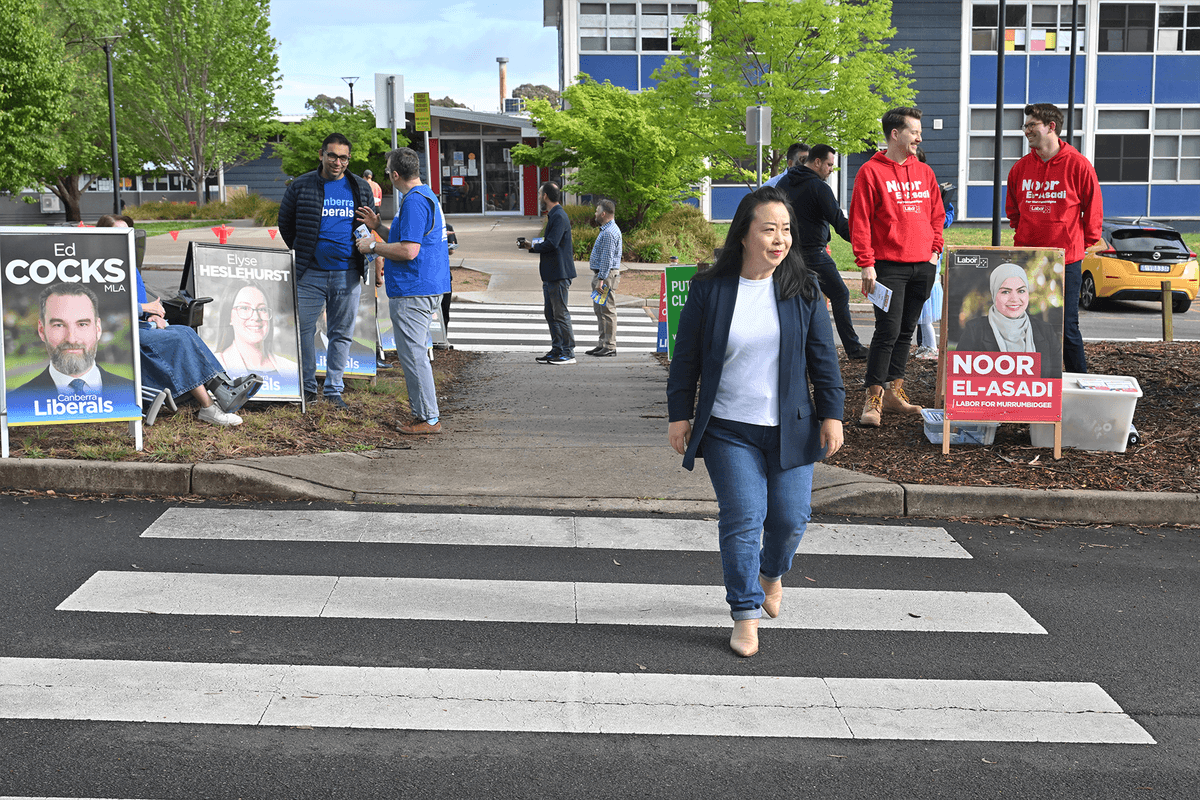
At the 2024 territory election, the Barr Labor Government was re-elected with little change in seat count or vote share. The Greens lost two seats but held onto the balance of power, and two independents – Thomas Emerson of Independents for Canberra and Fiona Carrick – won seats.

There has been a prevailing narrative from both Labor and Liberal politicians that community independents (the so-called “teals”) can attribute their success to big spending campaigns.

The Australia Institute has already shown that this is not true for the federal election.

But could big spending explain the success of the independents at the ACT election?

New data from the ACT Electoral Commission shows the opposite. At last year’s election, the successful independents spent between $2.47 per vote (Fiona Carrick’s group) and $6.18 per vote (Thomas Emerson’s Independents for Canberra group).

By contrast, the major parties were the biggest spenders: $12.78 per vote for Labor and $10.56 for Liberal, followed by Family First and the Greens.

Established political parties can afford to spend big because they receive generous public funding, $10.16 per vote. That works out to $951,000 for Labor, $931,000 for Liberal, $339,000 for Greens, $237,000 for Independents for Canberra and $74,000 for Fiona Carrick.

Get our newsletter

Quality research, analysis, explainers and factchecks from experts you can trust.

Perversely, this money is only paid after the election. New independent candidates were wholly dependent on private funding, while party candidates could spend public funding from previous elections.

The ACT Electoral Commission has proposed a major change to public funding in the ACT: moving to a “reimbursement” model.

Instead of receiving $10.16 per vote, a party or candidate would receive less money if they spent less money to win that vote. Because Labor and Liberal spent a lot, they would get the full $10.16 per vote. But because Independents for Canberra only spent $6.18 per vote, that’s how much they would get “from” each voter. And spare a thought for Fiona Carrick voters, whose votes would only be worth $2.47 each.

As The Australia Institute explained in its parliamentary submission, this is deeply unfair. It will hurt a party or candidate in three circumstances:

  1. They are growing in popularity over time,
  2. They run a lean campaign that is nonetheless appealing to voters, or
  3. Their supporters are numerous but are too poor to donate large sums.

Why should these parties and candidates receive less public funding than a wealthy party or candidate who spends a lot of money per vote received?

The reimbursement model has not attracted widespread support from ACT parliamentarians to date. A parliamentary committee looking into the 2024 ACT election recommended only that the ACT Government “give further consideration” to the proposal.

A reimbursement model would hinder a breakout success from consolidating at subsequent elections and stop a growing party from raising funds at one election to spend against the next. The ACT Government has a lot of other business to get through; this is one proposal that can be safely dismissed.


Related Articles

OPINION

As nation loses its way on AI-generated deepfakes, NSW debates a better way forward

By Bill Browne

Today, the NSW Parliament will debate the case for truth in political advertising laws. It’s the culmination of a months-long petition in which over 31,000 NSW residents lent their names to the call for a ban on misleading ads.

Democracy & Accountability
As nation loses its way on AI-generated deepfakes, NSW debates a better way forward

OPINION

Quiet but sweeping defence changes are yet another blow to our public trust

By Amy Remeikis

The Coalition and Labor will most likely be in lockstep on the latest defence changes, a bill that sailed through the last House sitting while attention was mostly on estimates. It changes 14 different acts of legislation, while giving public servants ministerial powers to override state, territory and, in some cases, federal, laws if an area has been declared necessary for “defence capabilities”.

Democracy & Accountability
Quiet but sweeping defence changes are yet another blow to our public trust

OPINION

AI has been a flimsy excuse for government laziness, underfunding and secrecy

By Bill Browne

A lot of attention has been paid to the mischief done by “agentic” large language models (LLMs) on their own initiative. But the more immediate and commonplace danger is that AI will multiply and indulge existing human weaknesses. AI does not have to be super intelligent to provide an excuse for secretive and poor-quality government decision-making.

Democracy & AccountabilityArtificial Intelligence
AI has been a flimsy excuse for government laziness, underfunding and secrecy

OPINION

A curious bird is the kiwi: reflections on NZ's election

By Allan Behm

A curious bird is the kiwi. Doomed to pedestrianism, it never gets to soar. And its voice is a natural coagulant. One’s blood freezes. Altogether unfortunate, it has turned its politics into a facsimile of itself. The New Zealand election last Saturday saw both the major political coalitions claim indecision as success, and confusion as deliberation. A curious bird is the kiwi. 

Democracy & Accountability
A curious bird is the kiwi: reflections on NZ's election