

A "25% tax on gas exports would make “17 billion dollars a year”, and, as ARIA-award-winning musician Montaigne claims, “if even a fraction of [that money] was directed to music and the arts, it could change the game”. They're right — if less than one fiftieth of the potential annual revenue from the 25% gas exports tax went to arts funding, that alone could be transformative.
Wed 1 Apr 2026 00.00

Missy Higgins during the 2025 ARIA Awards. (AAP Image/Sitthixay Ditthavong)


On Tuesday morning, around 150 Australian artists, musicians and organisations added their voices to the growing chorus of Australians calling on the Albanese Government to introduce a 25 per cent tax on gas exports.
Signatories to the open letter currently include Amyl and the Sniffers, Midnight Oil, Missy Higgins, Montaigne, Teen Jesus and the Jean Teasers, and King Stingray, who were number 1 on Albanese’s Spotify Wrapped last year.
Accompanying the open letter is a short video addressed to the PM, where the artists call on Albanese to commit to the levy, saying “it’s time to make polluters and profiteers pay their fair share”.
One part of the video sticks out: that a 25% tax on gas exports would make “17 billion dollars a year”, and, as ARIA-award-winning musician Montaigne claims, “if even a fraction of [that money] was directed to music and the arts, it could change the game”.
Are they right?
How much would a 25% tax on gas exports raise?
Since the Albanese Government took office in 2022, $255.3 billion in natural gas has been exported from Australia.
Much of that is due to large spikes in price. Natural gas prices tend to follow crude oil prices because the two fossil fuels often come from the same drilling platforms. One can be substituted for the other in many cases, including for heating and generating electricity.
Before Russia – one of the world’s largest oil and gas producers – invaded Ukraine in 2022, the average price of natural gas exported from Australia was $530 per tonne. But by the latter half of 2022-23, when Albanese started his time as PM, that had spiked to $848 per tonne, prices skyrocketed further to $1,311 a tonne the next year.
Those price surges helped major gas companies make windfall profits of almost $100 billion between 2022 and 2024, but only a small portion of that revenue was captured for the public as tax.
According to research from the Australia Institute, if the Albanese Government had implemented a 25% tax on gas exports upon taking office in 2022, it would have raised $63.8 billion a year in revenue in the last three and a half years.
The report found that, in 2023-24 alone, the tax would have raised $17 billion, just as the open letter claims.
Would even a small fraction “change the game” for music and the arts?
Australian governments, including the Commonwealth, play a vital role in funding and supporting Australia’s arts and culture. That’s especially true after the sector was hit hard by COVID and the cost-of-living crisis, taking three times as long to recover as the rest of the economy.
But, adjusted for inflation, combined public funding for the arts is at its lowest point in most of a decade; Australia has the seventh-lowest level of arts funding in the developed world (OECD).
Australian arts are so underfunded that just to fund at the OECD average, governments would need to increase funding by over $5 billion per year – less than a third of the revenue from a potential 25% gas exports tax.
Even smaller amounts could be transformative. For example, doubling the funding for Creative Australia, the flagship federal arts program, would cost just $318 million, or less than one fiftieth of the potential annual revenue.
Montaigne is right: even a fraction of a 25% gas exports tax could mean direly needed funding for the arts, changing the game for musicians and artists across the country.
Verdict: True
Economists and other inflation watchers are claiming that the cut in the fuel excise will be inflationary. This is not true, as this claim ignores everything else that is happening in the economy right now.
Advertisement

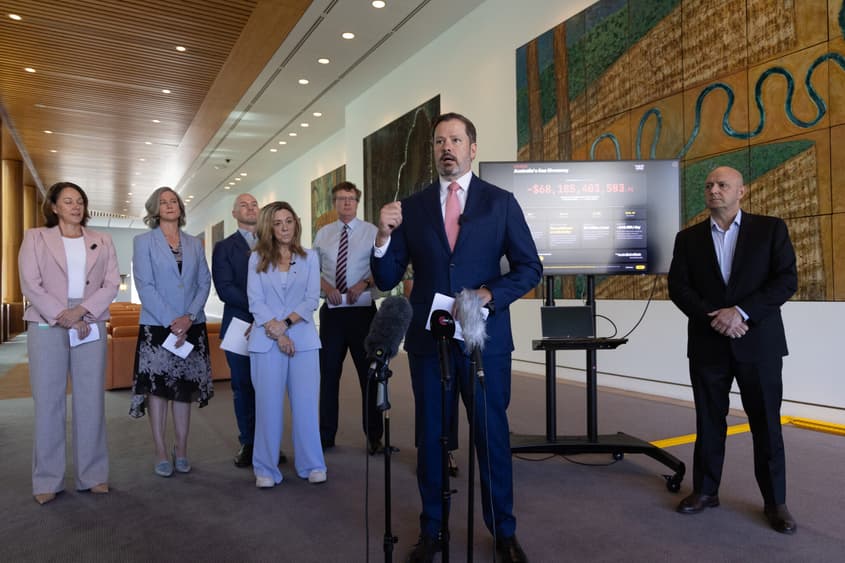
Pressure is mounting on the Albanese Government to introduce a 25 per cent gas export tax, with new figures revealing Australia misses out on almost $350 million in revenue every week.
In a new ad campaign, a mining lobby group claims that mining companies pay “enough tax to fund Medicare.” This is not true. Over the past ten years, the total cost of Medicare was $322 billion, while the mining industry paid $228 billion in tax, a gap of some $94 billion.

