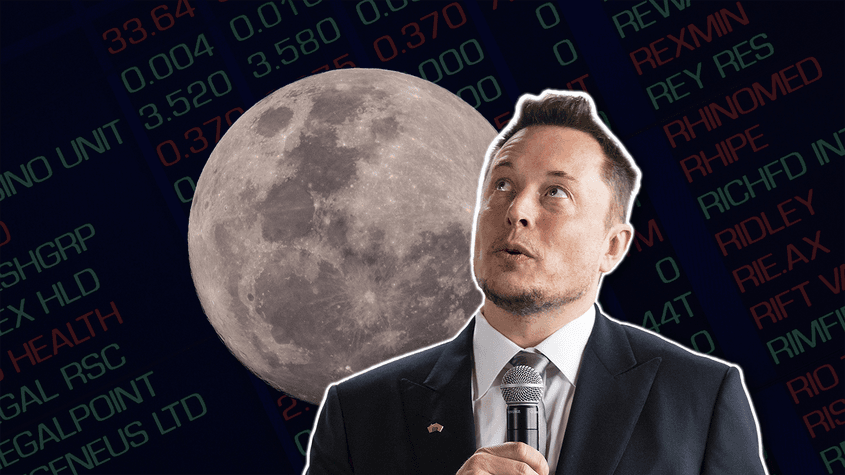
You have probably read that Elon Musk is the world’s first trillionaire. With SpaceX’s shares selling at US$135 at its initial public offering (IPO), Musk’s net wealth has jumped to US$1.3 trillion.
This makes him the richest person in the world. But, does it also make him richer than most nations?
Some parts of the Australian media seem to think it does. The ABC recently reported that:
Musk now has more money than Taiwan’s entire GDP, which sits at $976 billion. The same is true for Belgium, Ireland, Greece…
The Sydney Morning Herald wrote that if “he were a nation, Musk would command a seat at the G20”.
And news.com.au stated:
If Mr Musk were a country, he would be the 20th richest equalling the economy of Poland and bigger than nations such as Ireland, Sweden, Norway, the United Arab Emirates and about double his native South Africa.
This game of pretending Musk is a nation has been going on for years, and a quick Google search will return countless world maps titled “Elon Musk is Richer Than These Countries”.
But is this true? If Musk were a country, would he be the 20th richest country in the world?
Short answer: No. Not even close.
Let’s take Sweden as an example. While its GDP sits at US$760.5 billion, Sweden’s national wealth is estimated at US$3.2 trillion (or 30.2 trillion Swedish krona).
Musk’s net wealth, therefore, is roughly 40% of Sweden’s national wealth. Not bad for just one person, but nowhere near eclipsing Sweden’s.
So why are so many outlets saying Musk is now “richer than nations”?
The reason is a category problem. They’re comparing Musk’s net wealth with national GDP figures, as opposed to national wealth.
This is comparing apples with oranges.
Net wealth is a snapshot of everything an individual possesses such as the value of the property and shares they own, their debts, and what they’ve got in the bank at a particular moment in time. It is what economists call a measure of a stock.
National wealth is a snapshot of the value of a nation’s financial and non-financial assets (minus liabilities) held in its public and private sectors. Like net wealth, it is a measure of a stock.
GDP, on the other hand, is a measure of the value of the goods and services produced and consumed in a country over a period of time (often either a quarter or a year). It is what economists call a measure of a flow.
It’s a bit like comparing the rate at which water flows out of a tap with the size of the bucket. They’re measuring two completely different activities – all they have in common is water.
If we wanted to, we could compare Sweden’s GDP with Musk’s economic activity over the past year – the Tesla Cybertrucks he has bought to prop up his own sales figures, the hush money he has offered to women, and his minimal childcare support payments for his 14 children, and even the income he earned.
If this totalled more than US$760.5 billion per year, then we could say Musk is bigger than Sweden.
But in reality, he would not even be close. Argentina has the smallest GDP in the G20 with US$688 billion per year. Musk is not generating anywhere near that level of income or personal production. There are more than enough economic-literate journalists within the Australian media to know their comparisons are junk.
National governments across the world are richer and more powerful than private capital, and are better suited to solving big problems than amoral trillionaires – and one way they could better solve them is by taxing the wealth of individuals like Musk.
You just wouldn’t know this from most of the reporting on Musk. Even the more left and progressive among them can’t help but fetishise the wealth of an individual over the wealth of an entire nation.