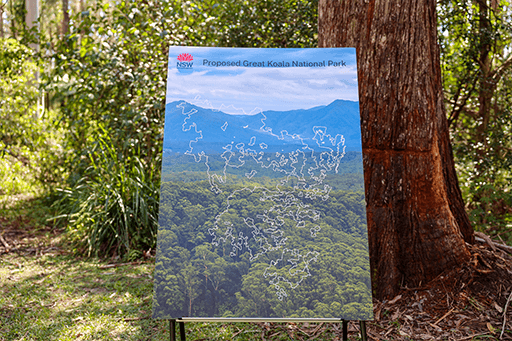
For over a decade, NSW Labor promised to establish a Great Koala National Park in the state’s northeast, to protect significant populations of one of Australia’s best loved creatures.
In late 2025, this long held promise became “dependent” on the NSW Government being able to sell carbon offsets relating to the founding of the park. The NSW government is “exploring the potential benefits of carbon revenue”.
But is this money necessary to create the park?
No. The money to create the park has already been allocated and at least partly spent. As the NSW Government itself says:
The NSW Government committed $80 million in the 2023–24 State Budget to support the development of the Great Koala National Park. An additional $60 million in funding has also been announced for the NSW National Parks and Wildlife Service to support the establishment of the park.
The NSW Budget Papers published in 2023 explicitly include a line item of “Great Koala National Park” with the note “$80.0 million investment to create the Great Koala National Park to preserve large tracts of koala habitat on the Mid-North Coast of New South Wales.” (page 2-14)
Get our newsletter
Quality research, analysis, explainers and factchecks from experts you can trust.
The budget papers also include funding to compensate Forestry Corporation NSW for not being able to log this area.
This wasn’t a one-off. The same line item has appeared in each budget since then and the latest budget papers from 2026 include discussion of a special appropriation of $140.5 million that “has largely been related to the Great Koala National Park.” (page D-4)
This spending on the Great Koala National Park does not have a significant impact on the NSW budget, which is almost 1,000 times bigger – over $130 billion per year (page 4-2). There is clearly no financial need to sell carbon offsets in order to establish this national park and to protect koalas.
The ability of the NSW Government to protect koalas without carbon offsets is further demonstrated by the establishment of the Georges River Koala National Park, south of Sydney. This koala park was declared open in 2025, having been budgeted in 2023 (page A5-8). These koalas were protected without any mention of budget constraints or carbon offsets.
How much money could be raised by selling offsets related to the Great Koala National Park is unclear, but it is not significant in the context of the state budget. Importantly, ending native forest logging would bring other financial benefits – the hardwood division of the NSW Forestry Corporation loses tens of millions of dollars each year, with a $32 million loss expected in 2025 (page 47). Simply ending native forest logging would reduce this annual cost to taxpayers, and potentially funding koala conservation.
Ultimately, protecting koalas and their habitat is a choice for the NSW Government, one that is not dependent on any particular revenue stream or cost.