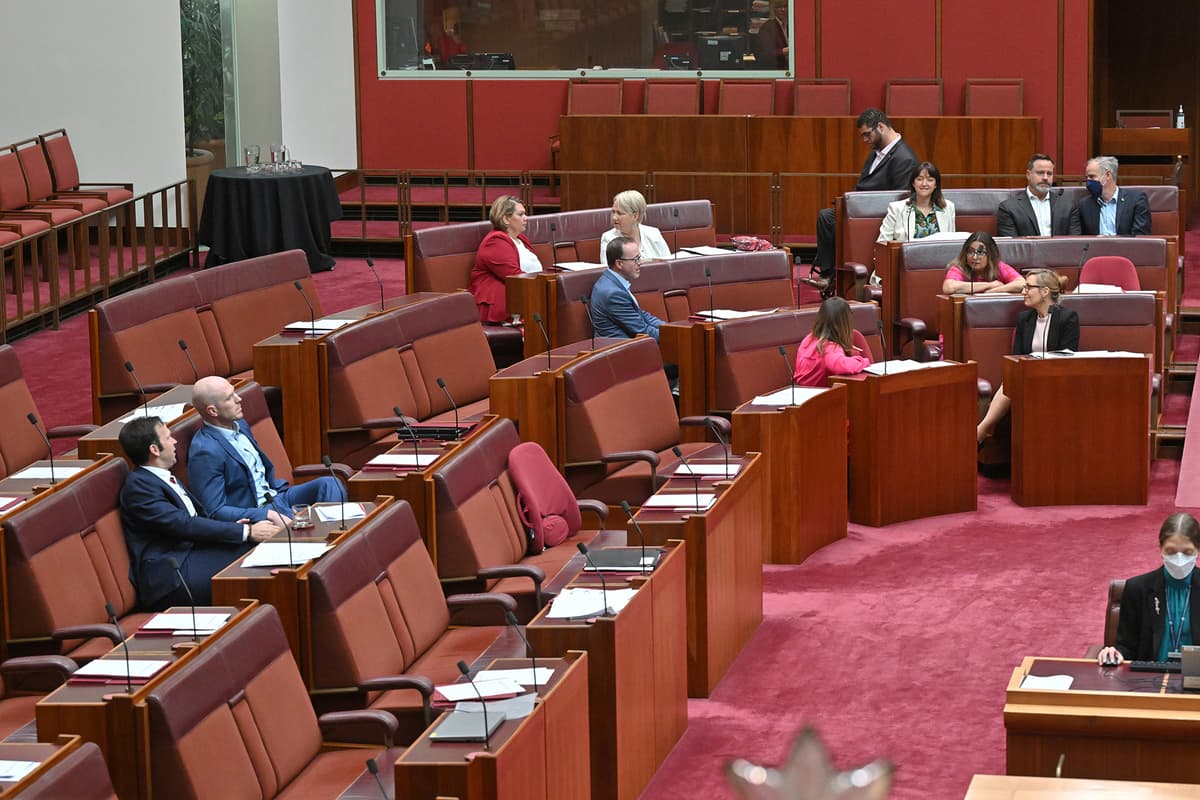
In the coming weeks in the federal Senate, the Australian Greens will hold the balance of power vote on a small disallowance motion with big repercussions for climate policy in Australia.
The Coalition has moved to disallow the Albanese Government’s proposed new carbon credits method, the Improved Native Forest Management (INFM) Method.
The Nationals want it disallowed because as leader, Matt Canavan doesn’t care about climate change and fears it might incentivise governments to reduce native timber harvesting rather than actively manage public forests.
The Greens hold very different views on climate change and are clearly committed to ending native forest logging all together.
But while the Greens and Nationals clearly disagree on some goals, if they both believe the new INFM is flawed then they should obviously both vote against it.
Just as two people might avoid the same restaurant for entirely different reasons, two political parties may both agree that the country would be better off without some new rules even if they disagree on why. What matters most in Parliament is what you vote for and against, not who is sitting next to you when you do so.
The INFM method would, for the first time, allow large emitters to buy carbon credits from publicly owned native forests to claim they have ‘offset’ their emissions. The first public forests to enter the carbon market would be in New South Wales, but NSW forests would not be the last.
If approved by the Greens, the new offset framework (or ‘method’ as it is technically referred to) would become available to states and territories that still have active native forest logging industries, including Tasmania and Queensland.
Privatising the protection of nature is problematic. Australian governments have a mixed report card for delivering public services. But for corporations there is no grey area – they have only ever failed.
Opposing the privatisation of our native forests is not an ideological one; it’s based on a history of the market failing nature even more appallingly than out governments have.
The Murray–Darling Basin is a stark example of what happens when nature is turned into a market; the big corporations profit while the environment suffers.
On top of the historical failures, the proposed ‘method’ itself creates a deeply concerning precedent.
Unlike all other ‘methods’ for making carbon credits, the proposed INFM Method does not require the carbon credits to come from activity that is ‘additional’ to what was already likely to occur.
Put simply, the NSW Government would be given carbon credits for saving some trees that it has repeatedly promised to save since 2015. But the INFM Method does not require State Government proposals like the Great Koala National Park to be ‘additional’ to what was already likely to the case.
The INFM Method would allow state governments to generate carbon credits for carbon stored in trees that they were never going to log.
Other normal rules of both democratic governance and the free market don’t apply.
Under the INFM, as former NSW Environment Minister Bob Debus has pointed out “governments are simultaneously the method designer (albeit through a contractor); the largest eligible landholder; the project proponent; the primary financial beneficiary; and a jurisdiction whose largest industrial facilities can use those ACCUs to comply with the Federal Safeguard Mechanism.”
Talk about conflicts of interest, foxes and hen houses.
Both the NSW and Federal Government have a direct interest in making optimistic assumptions that maximise carbon credit (ACCUs) volumes and, in turn, revenue. They also have a direct interest in giving state-based polluters like the Tomago aluminium smelter a cheap, and potentially free, pool of NSW cash.
When new methods for generating dodgy carbon credits are approved, “everybody wins” – that is, except for the climate and those of us who rely on it.
Even the environmentalists that support the proposed INFM agree that it’s not as good a solution as the Government simply legislating to stop native forest logging, like they have already promised to do.
Tired forest defenders who for decades have watched the destruction of their local forests, now believe this is the only opportunity to stop the ecological devastation. But it clearly is not the only option. The NSW Premier could simply do what he promised to do at the last election,.
Ending native forest logging depends on political will. It is political nonsense to suggest that the only way to stop logging is through market mechanisms. They are unnecessary, set a dangerous precedent, and are easy for governments to manipulate.
The majority of the environment movement, especially those with direct accountability to their members, are against this new way of monetising Australia’s public native forests.
That some tired, predominantly volunteer activists see this as ‘their only hope’ is understandable. The same cannot be said for a professional political party, founded on protecting the environment.
For the Greens to accept ‘what they can get’ is to admit they have limited power in the Parliament and display their lack of faith in the people of Australia to mobilise and protect the environment.
While the disallowance motion seems small, the implications are enormous.
As of today, it is unclear how the party will use the power given to them by the 1.88 million people who voted for them at the last election. Votes given overwhelmingly for action on climate and the protection of our environment.
Whilst it may be uncomfortable to sit with the Nationals and Pauline Hanson to disallow the motion, standing in front of the public explaining why the party of the environment is happy to monetise it would be even harder, and for longer.
And at the end of the day, after the chip wrapping has been thrown away, it is the substance of the legislation that MPs vote for and against that matters, not the symbolism of those who shared your conclusion, if not your motivations.
Leanne Minshull is co-CEO of the Australia Institute