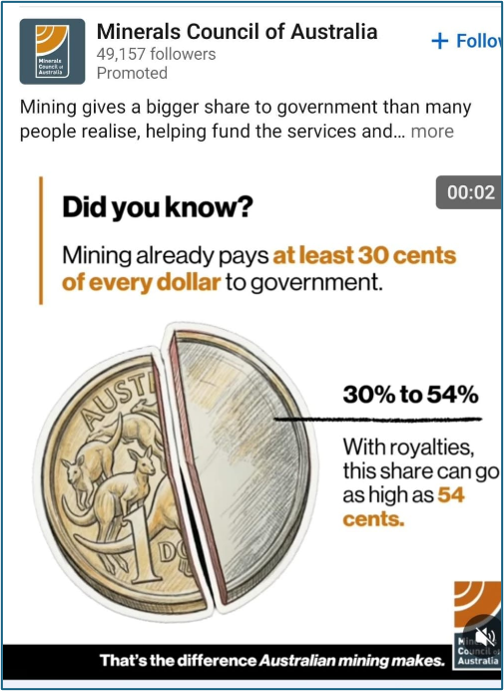
The Minerals Council of Australia is advertising that mining companies pay “at least 30 cents of every dollar to government”, rising to as much as 54 cents “once royalties are included”. Except, this is not correct.
Tue 1 Sep 2026 01.00 AEST
Photo: AAP Image/Mellen Burns


The Minerals Council of Australia is advertising that mining companies pay “at least 30 cents of every dollar to government”, rising to as much as 54 cents “once royalties are included”.
This is not correct.
According to the Australian Government’s official figures, $385 billion worth of minerals, oil and gas was exported from Australia in 2024-25. That year, the Minerals Council claims that its members paid $28.7 billion in company tax.
That works out to 7 cents in every dollar. Taking out the oil and gas exports that aren’t from Minerals Council members, that still only gets us to 9 cents in the dollar.
Royalties shouldn’t be added to this, because royalties are payments for the right to extract and sell finite resources owned by the public. Just as a baker pays for the flour they use and a bricklayer pays for bricks, a mining company pays for the minerals they dig up – minerals that belong to all of us.
But let’s play the Mineral Council’s game and add in royalties. They claim that their members paid $20.2 billion in 2024-25, for a total of $48.9 billion in taxes and royalties. This is still only 16 cents in every dollar of minerals exported. (Note that this is on exports rather than production, which would be lower still, but those figures aren’t as readily available.)
The 30 cents in the dollar figure refers to the tax rates on profits, not on “every dollar” received by mining companies. After mining companies have deducted all their costs on machinery, fuel, workers’ wages, interest payments, royalties and any number of other expenses, they pay a 30% tax rate on profits.
This is not special to the mining industry. This is simply the ordinary rate of company tax that applies to the profits of all large companies operating in Australia.
Quality research, analysis, explainers and factchecks from experts you can trust.
To get up to 54 cents, the Minerals Council add in royalties, which, as explained above, is like a builder claiming payment for bricks is “tax”.
You can see this from their figures. The Minerals Council members paid $28.7 billion in company tax in 2024-25, meaning they made profits of $96 billion. $48.9 billion in taxes and royalties in a year with $96 billion in profits gives a little under the claimed 54 cents in the dollar.
The silliness of this calculation becomes clear quickly when you look at other years in the Minerals Council’s own data.
In 2015-16, its members claimed to pay $5 billion in company tax and $8 billion in royalties. This implies that they made $17 billion in profit, while paying $13 billion in taxes and royalties – 76 cents in every dollar!
How do they survive?
Imagine a year in which the mining industry makes just $1 billion profit, pays $0.3 billion in company tax but still had to pay $3 billion in royalties. Suddenly, the mining industry pays tax of 330 cents in every dollar! Impossible!
Silly calculations lead to plainly wrong claims like mining companies paying tax of 54 cents in every dollar.
Australia is host to many very profitable mining companies. Their tax payments make up a significant share of overall company tax. The Minerals Council are right to make this point. But including an input cost as “tax” and resulting claims of paying “54 cents in every dollar” are wrong and designed to mislead the public. Yet again.
Verdict: Not True

