A Fortescue executive has called for a major overhaul of Australia’s $11 billion fuel tax credit scheme, arguing it undermines the nation’s climate goals by making diesel “artificially cheap”.
By Tegan George
Fri 31 Oct 2025 21.49 AEDT
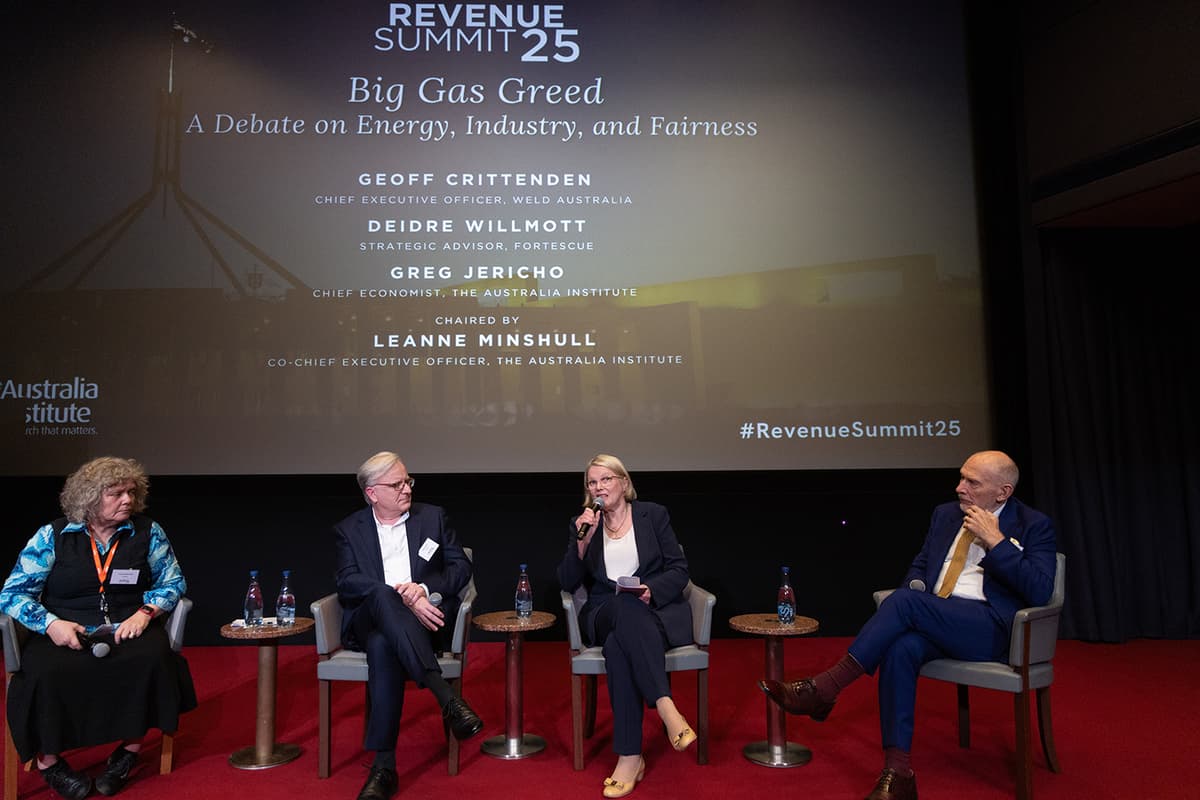
Photo: Mike Bowers


Deidre Willmott, Strategic Advisor at Fortescue Metals Group, said Australia needs a policy that supports decarbonisation and “not one that continues to incentivise burning fossil fuels.”
“A major policy lever, the diesel fuel tax credit, is not aligned with Australia’s stated climate goals.”
The scheme allows companies that rely on diesel to reclaim billions in fuel tax rebates.
Ms Willmott called for action at the Australia Institute’s Revenue Summit where she took part in a panel on “Big Gas Greed: A Debate on Energy, Industry, and Fairness”.
She said Fortescue is “focussed on tackling the greatest challenge of our generation, climate change’.
“We don’t shy away from the fact that we are ourselves are a heavy emitter. Every year we are emitting 2.7 million tonnes into the atmosphere.
“This is why we have committed to eliminate fossil fuels with a target to achieve real zero terrestrial emissions, scope one and two by 2030 without carbon offsets.”
Ms Willmott said Fortescue backed reforms to the Government’s Fuel Tax Credits scheme, pointing out it was designed before Australia’s current climate commitments.
“Users claim back $11 billion per annum in tax credits … [the scheme] undermines the business case for renewables and electrification.
“When we actually want to decarbonise our economy and reduce our emissions, why are we seeing so much funding still flowing to the burning of fossil fuels? It’s an historical system.
“At the moment, the incentive is to keep burning diesel because it is so cheap.”
The Fortescue executive said right now companies pay about $30 to compensate for every tonne of carbon they release but can then receive around $190 back in tax breaks.
“For the litres of diesel that have generated one tonne of carbon, that’s a five-fold incentive to keep using diesel rather than to switch to a cleaner energy source.”
Ms Willmott supports the “cap and re-invest” plan by Climate Energy Finance which would set a $50 million cap on how much mining companies can claim back in tax breaks. Any additional money would need to be used to help switch over to cleaner, greener technology.
“It we don’t do that the fuel tax credits are just going to keep going up and up.”
The Australia Institute’s Chief Economist Greg Jericho agreed major reform is needed to ensure mining companies start paying their fair share.
“One of the things I always do when we have the annual Federal Budget is I turn to the fuel tax credit page, and they’ve always revised it up.
“There’s always a line pointing out that the payments are forecast to increase because the use of the fuel is forecast increases.
“It’s like, yes. Your fuel tax credit incentive is working.”
Ms Willmott pointed out “it’s the 16th largest expense in the Federal Government Budget. We spend more on paying people to use diesel than we spend on either the Army or the Air Force.”
Mr Jericho also called for an overhaul of the Petroleum Resources Rent Tax (PRRT), noting that despite Australia’s “gas boom”, the public has seen little benefit.
He said gas exports have increased 25-fold increase since 2000, however government revenue from the PRRT has fallen by 25 percent.
“Western Australian drivers pay more in rego than gas companies do in royalties in WA.
“Only a very small part of Western Australian LNG projects pay gas because most of them are offshore and if you’re offshore, you’re in Commonwealth waters and you don’t pay state royalties.”
He said it’s a similar case in Queensland where it’s the “gamblers and the drivers who are really providing more revenue than the gas companies.
All the while “the price that households are paying for gas has absolutely exploded beyond all everything else we’re paying”.
Mr Jericho said Australia had “basically tied ourselves to what the world is paying for our gas” when governments approved large-scale exporting in 2010.
“There’s a lack of competition that enables them to make a motza out of it.”
Co-chief executive of the Australia Institute and panel chair, Leanne Minshull pointed out there’s been a recent increase in positive mining advertising.
“If you go to the airport or if you listen to even a true crime podcast, there are gas ads everywhere telling us about how much money the gas companies earn for Australia,” she said.
“The only way we, as Australian citizens, get anything from it is if either they’ve paid a royalty for that gas or iron ore … or they pay tax on their earnings and their profits,” said Mr Jericho.
“If they’re a Japanese company that is not paying any royalties, isn’t paying any company taxes and hasn’t paid any PRRT, who cares that they’ve got $30 billion in exports? We didn’t see any of it.”

