Advanced search
The Point - home
DonateSubscribe
HomeWhat's NewOpinionOff the ChartsExplainersFactcheckAbout Us
The Point — home
DonateSubscribe
The Point — home
Advanced search
  • Home
  • What's New
  • Opinion
  • Off the Charts
  • Explainers
  • Factcheck
  • About Us
DonateSubscribe
Subscribe
  • Home
  • What's New
  • Opinion
  • Off the Charts
  • Explainers
  • Factcheck
  • About Us
The Point - home
Privacy PolicySitemapComplaints & CorrectionsNewsletter

The Point recognises the ancestral connections and custodianship of Traditional Owners throughout Australia. We pay respect to Aboriginal and Torres Strait Islander cultures and to Elders past and present.

©2025–2026 The Point, an initiative of The Australia Institute

WHAT'S NEW

Unemployment holds at 4.3%, but weak labour market tells a different story

Unemployment in November remained steady at 4.3% according to the latest figures out today from the Bureau of Statistics.

By Greg Jericho

Fri 12 Dec 2025 00.30 AEDT
Economy
Unemployment holds at 4.3%, but weak labour market tells a different story

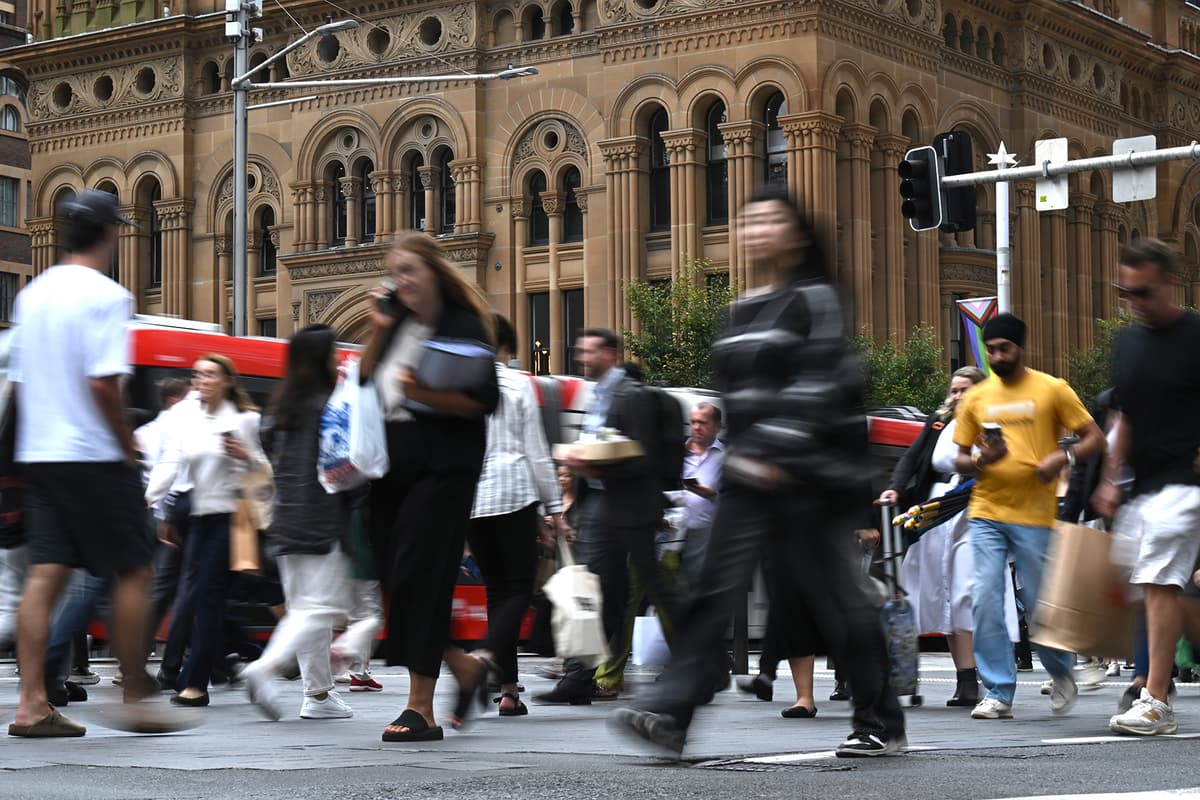
Photo: AAP Image/Dean Lewins

Republish this article

This article is licensed under Creative Commons — Attribution-NoDerivatives 4.0 International (CC BY-ND 4.0).

Republishing guidelines

  • You must credit the author(s) and The Point.
  • You must link back to the original article.
  • You may not edit or modify the article content.
  • Images may be subject to separate copyright and are not included in this licence.

Unemployment in November remained steady at 4.3% according to the latest figures out today from the Bureau of Statistics.

The labour force figures for November provide some good news that suggests the unemployment rate might be stabilising after a period of steady increases throughout 20205:

While the seasonally adjusted figures can bounce around a little, the slight drop in the trend rates – which averages out the figures to provide a more stable picture – suggests that the peak of unemployment might for now have been reached.

However, the good news of the figures is tempered by the fact that in November, employment fell in seasonally adjusted terms and annual employment growth of 1.3% is the lowest (excluding the pandemic lockdowns) since 2017:

The only reason the unemployment rate did not rise is because more people left the labour market than lost jobs. This is less a sign of a healthy labour force than one that is rather weaker than the overall unemployment figure might suggest.

This is highlighted when we look at employment growth across men and women and full-time – in every category the current annual growth is below the pre-COVID average.

Not surprisingly in November there was also a jump in the level of underemployment – up from 5.7% to 6.2% – the highest level since October last year.

Thus, while the overall figure of a steady rate of unemployment at 4.3% will no doubt be viewed as vindication by the Reserve Bank not to further cut rates, and will also be used as an excuse to at least keep them steady in February, the picture is less rosy.

Weak employment growth will inevitably lead to higher unemployment and the risk of unemployment rising back to 4.5% remains, especially given the Reserve Bank has seemingly declared any rise in unemployment will not result in an interest rate cut.

Advertisement

Related Articles

OPINION

Australia’s gender pay gap falls below 20% for the first time

By Gemma Killen

Australia's gender pay gap has fallen to a record low. This year, the pay gap is 19.7%, which means that for every dollar men earn, women earn just over 80 cents. Over a year, this adds up to an average difference of $27,467.

Society & InequalityEconomy
Australia’s gender pay gap falls below 20% for the first time

OPINION

Productivity, New Technologies, Working Time

By Greg Jericho

This is an edited version of a speech delivered by Greg Jericho (Chief Economist at The Australia Institute) at the Academy for Social Science in Australia Annual Symposium. 

Economy
Productivity, New Technologies, Working Time

FACTCHECK

Factcheck: No, a gas export tax would not drive up gas prices for Australians

By Greg Jericho

This morning, Minister for Industry Senator Tim Ayres argued that a gas exports tax would mean higher prices for Australians. Except this is not true. A gas tax would actually lead to lower prices for Australians.

Economy
Not true
Factcheck: No, a gas export tax would not drive up gas prices for Australians

WHAT'S NEW

All gas, no consensus: Albanese bill faces Senate showdown

By Tegan George

The Albanese government is facing renewed calls to introduce a 25 per cent gas export tax as its gas reservation bill comes under pressure from all directions.

Economy
All gas, no consensus: Albanese bill faces Senate showdown

