The Australia Institute’s decision to withdraw its involvement in, and sponsorship of, Adelaide Writers’ Week was easy to make but raises difficult questions. As a research-based think tank, we thrive in the cut and thrust of disagreement, and we regularly participate in events, debates, and conversations with people we disagree with.
Sat 10 Jan 2026 10.06 AEDT
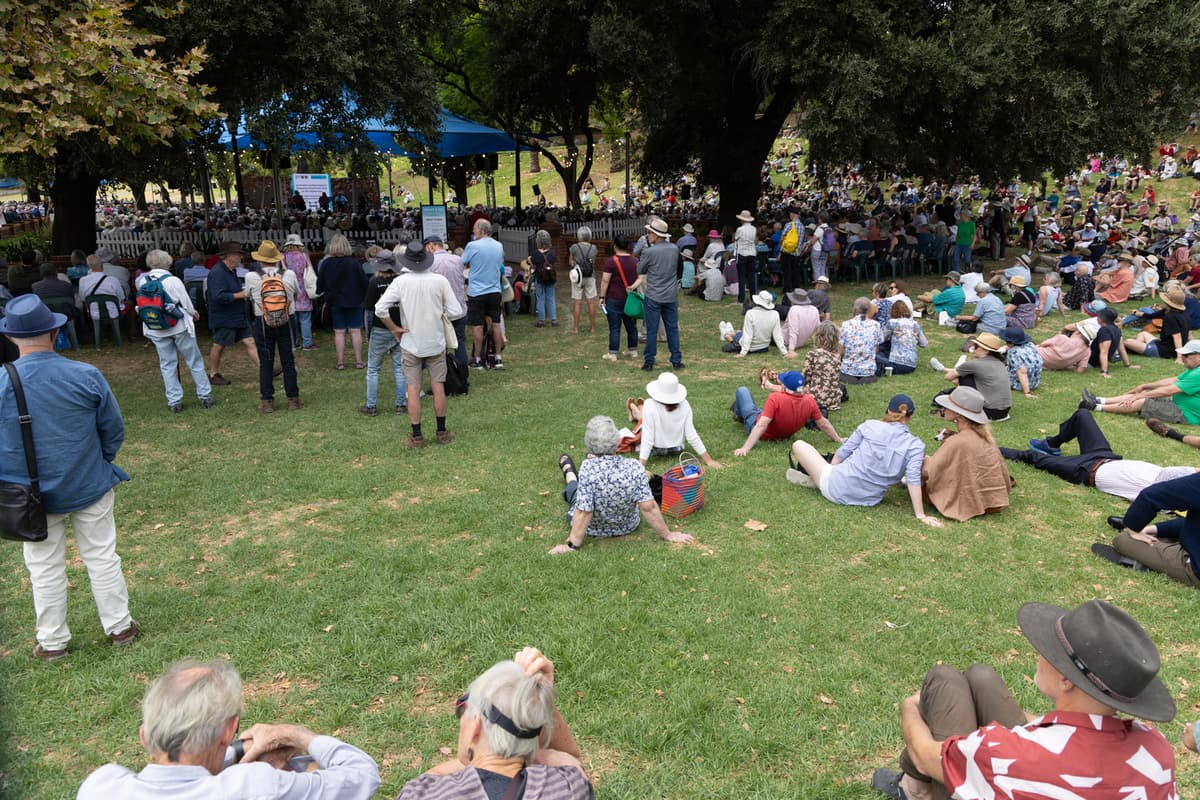
Image: Mike Bowers


The battle of ideas in Australia has always been lopsided, but just as wealth inequality is rapidly getting worse, so too is the ability of diverse voices to be heard. It is not just media ownership that has become more concentrated; the mindset of our media is becoming similarly concentrated as they all chase the same declining demographic of subscribers. Their business model might make sense for them, but the conformity is not good for democracy.
The Australia Institute’s decision to withdraw its involvement in, and sponsorship of, Adelaide Writers’ Week was easy to make but raises difficult questions. As a research-based think tank, we thrive in the cut and thrust of disagreement, and we regularly participate in events, debates, and conversations with people we disagree with.
I’ve been on The Bolt Report with Andrew Bolt, stood on a stage with Alan Jones, and regularly talk to conservative politicians and business leaders. Indeed, despite, or probably because of, my strong views about the Australian mining industry and university sector, I’m speaking at mining and university sector events in the coming months. Engaging with people you disagree with is part of democracy.
But where you spend your time, and your money, also matters in a democracy, which is why the decision to withdraw our involvement was necessary. Adelaide Writers’ Week had become a bastion of debate about big ideas, held in front of big crowds. Its structure was unique in that its events were free of charge and, at any point in the day, there were literally competing stages, with speakers not just competing with other ideas, but competing for a crowd. It was, for me, a highlight of the year to watch Australians move around the beautiful Pioneer Women’s Memorial Gardens, literally following the applause, laughs and sometimes even jeers from the crowds.
But the Board of Adelaide Writers’ Week no longer seems to think attendees can be trusted to make their own minds up about who they want to hear from, and who they want to ignore. The Palestinian Australian author, lawyer and academic Dr Randa Abdel-Fattah had been invited to speak in Adelaide in March this year, but this week the Board wrote to cancel her appearance.
According to the independent Board of Adelaide Writers’ Week, they had:
“Formed the judgment that we do not wish to proceed with her scheduled appearance at next month’s Writers’ Week. Whilst we do not suggest in any way that Dr Randa Abdel-Fattah’s or her writings have any connection with the tragedy at Bondi, given her past statements we have formed the view that it would not be culturally sensitive to continue to program her at this unprecedented time so soon after Bondi.”
To be clear, I have no idea how to define or measure what is “culturally sensitive”, and I respect the fact the Board acknowledged that “we also understand others will undoubtedly form different judgments.” I am one of those people.
But given how “culturally sensitive” it is for any writers’ festival to cancel a writer, I would have thought that the Board might have explained in more detail what it was that they thought was insensitive about a Palestinian woman speaking at an event that the public was free to attend or free to ignore.
While the Board were clear that they did not think Dr Abdel-Fattah or her writings were connected to the horrific massacre of Jewish people in Bondi “in any way”, South Australia Premier Peter Malinauskas seems to suggest something quite different, stating:
“I do not support the inclusion of those who actively undermine the cultural safety of others, who celebrate the death of innocent civilians, or those who doxx other artists simply because of their faith or cultural background.”
Given that no other author has been cancelled by the Board, and that the Board expressed no concern with Dr Abdel-Fattah or her writings, it is not clear why the Premier made reference to the benefits of cancelling speakers who “celebrate the death of innocent civilians”.
But what is clear is that the Board and the Premier both believe adults in Adelaide can’t be trusted to decide for themselves whether to wander over to hear the thoughts of an Australian academic of Palestinian origin, or whether to wander somewhere else.
Antisemitism is real and it is a real threat to many Jewish people’s ability to live in peace. Hopefully, the Royal Commission that so many of the loudest voices in Australia wanted delivers more safety to the Jewish community than the Royal Commission into Aboriginal Deaths in Custody delivered for Indigenous Australians.
But while I do want to hear from the Commissioner how we might better stamp out extremism and hate speech, and I do want to live in a country that can reduce antisemitism and all forms of bigotry and hatred, I know that there is a limit to what laws and tough policing can achieve. If we are to make Australia a safe place for people to live in freedom and safety, we must be very careful about what freedoms we remove in pursuit of safety. History suggests removing the right of diverse voices to be heard does little to ensure safety or freedom of any of us. I think the Board of the Adelaide Festival have made the wrong decision, but I’m glad I live in a country where I’m allowed to say that.
In 2023, while facing down calls to defund the festival over the inclusion of Palestinian-American author Susan Abulhawa for comments critical of Ukraine, Peter Malinauskas admitted it would have been “a politically expedient action for the government to take.
Ultimately, he decided that to do so would lead to “a path to a future where politicians decide what is culturally appropriate” and arts bodies and festivals would be “more concerned with risking the wrath of government” than creating worthy, challenging programs”.
“And at worst, it leads us to a future in which politicians can directly stifle events that are themselves predicated on freedom of speech and the expression of ideas. A path, in fact, that leads us into the territory of Putin’s Russia,” Malinauskas said in 2023.
He was right then and it still stands now. That he now so openly supports a different path speaks to how quickly Australia’s democratic norms are changing. Those of us who feel differently would do well to speak up now, while we still can.
Advertisement