Advanced search
The Point - home
DonateSubscribe
HomeWhat's NewOpinionOff the ChartsExplainersFactcheckAbout Us
The Point — home
DonateSubscribe
The Point — home
Advanced search
  • Home
  • What's New
  • Opinion
  • Off the Charts
  • Explainers
  • Factcheck
  • About Us
DonateSubscribe
Subscribe
  • Home
  • What's New
  • Opinion
  • Off the Charts
  • Explainers
  • Factcheck
  • About Us
The Point - home
Privacy PolicySitemapComplaints & CorrectionsNewsletter

The Point recognises the ancestral connections and custodianship of Traditional Owners throughout Australia. We pay respect to Aboriginal and Torres Strait Islander cultures and to Elders past and present.

©2025–2026 The Point, an initiative of The Australia Institute

WHAT'S NEW

QLD government accused of exploiting summer holiday lull to avoid scrutiny of contentious electoral laws bill

Queensland’s LNP government has been accused of exploiting the summer holiday lull to avoid scrutiny of a contentious bill, which would lift the state’s ban on developer donations to political parties and candidates.

By Tegan George

Fri 16 Jan 2026 12.51 AEDT
Democracy & Accountability
QLD government accused of exploiting summer holiday lull to avoid scrutiny of contentious electoral laws bill

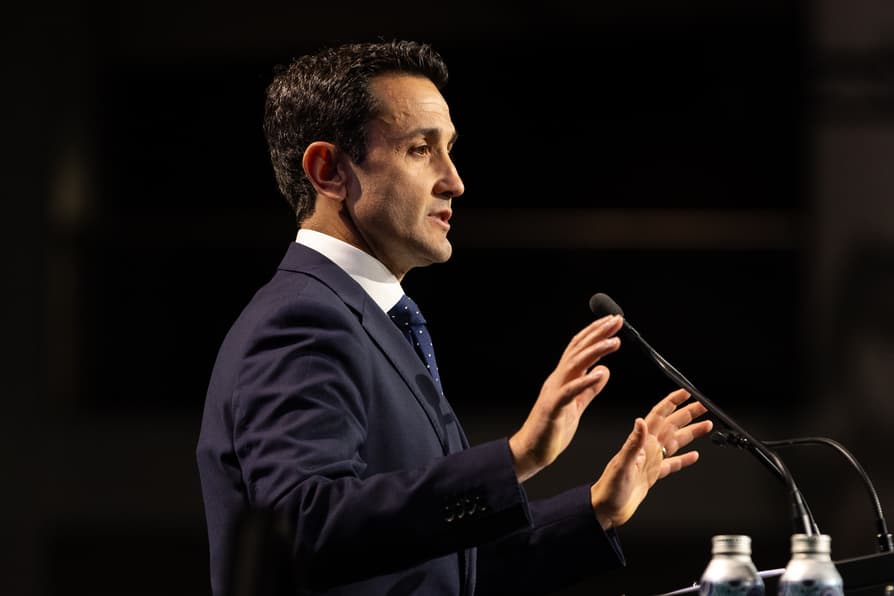
Image: AAP/Russell Freeman

Republish this article

This article is licensed under Creative Commons — Attribution-NoDerivatives 4.0 International (CC BY-ND 4.0).

Republishing guidelines

  • You must credit the author(s) and The Point.
  • You must link back to the original article.
  • You may not edit or modify the article content.
  • Images may be subject to separate copyright and are not included in this licence.

Queensland’s LNP government has been accused of exploiting the summer holiday lull to avoid scrutiny of a contentious bill, which would lift the state’s ban on developer donations to political parties and candidates. 

The Justice, Integrity and Community Safety committee has until early February to report back to the Queensland parliament on the Crisafulli Government’s proposed Electoral Laws (Restoring Electoral Fairness) Amendment Bill 2025. 

The proposed changes to electoral laws were introduced during the final parliamentary sitting day of last year. 

Speaking at the committee’s first public hearing, Director of the Australia Institute’s Democracy and Accountability Program, Bill Browne said the timing “limits the ability of the committee to investigate the consequences of the bill for Queensland democracy”. 

“That is particularly concerning given that submissions, including from the Crime & Corruption Commission (CCC), have warned that the changes ‘are a significant departure from Queensland’s robust political donations framework’.” 

In its own submission, the CCC raised concerns about “actual or perceived” corruption in the lead up to the 2032 Olympic Games, which Queensland will host. 

The CCC initially proposed that such a ban be applied to local government, but the Palaszczuk Labor government took the proposal further and extended it to the state government. 

Mr Browne called the LNP’s proposed changes a “retrograde step”. He told the committee that, “the ban is targeted, constitutional and based on well-established corruption risks.”  

“Lifting the ban risks ‘clientelism’, where decision-makers put the interests of their patrons above the public interest.” 

Mr Browne also pointed out that established political parties are not short of money. 

“After the last election, the Liberal National Party was entitled to $8.6 million in taxpayer funding, the Labor Party to $6.7 million and the Greens and One Nation to millions of dollars between them.   

“The taxpayer provides this funding to, in part, compensate political parties and candidates for lost revenue – so that they don’t need to take private money that could compromise public trust in decision-making.” 

By shifting from a donation cap based on four-year terms to an annual cap, the proposed changes would also allow political donors to give four times as much as is permitted under today’s rules. 

Mr Browne said that this “only serves to benefit incumbents who operate year-in year-out at the expense of new entrants”.  

“The effect is that major party fundraising vehicles will collect four times as much money in corporate subscriptions, but a new political party or emerging independent candidate will effectively be constrained by the old cap.” 

He told the hearing that a better alternative would be a mega-donor cap, as it would “limit any political donor’s involvement by capping the overall amount they can give, rather than how much they can give per recipient.” 

The committee received 82 submissions on the proposed legislation, including from the Electoral Commission of Queensland, the Property Council of Australia and the  Corruption Prevention Network Queensland Inc.   

Advertisement
Related Articles

OPINION

As nation loses its way on AI-generated deepfakes, NSW debates a better way forward

By Bill Browne

Today, the NSW Parliament will debate the case for truth in political advertising laws. It’s the culmination of a months-long petition in which over 31,000 NSW residents lent their names to the call for a ban on misleading ads.

Democracy & Accountability
As nation loses its way on AI-generated deepfakes, NSW debates a better way forward

OPINION

Quiet but sweeping defence changes are yet another blow to our public trust

By Amy Remeikis

The Coalition and Labor will most likely be in lockstep on the latest defence changes, a bill that sailed through the last House sitting while attention was mostly on estimates. It changes 14 different acts of legislation, while giving public servants ministerial powers to override state, territory and, in some cases, federal, laws if an area has been declared necessary for “defence capabilities”.

Democracy & Accountability
Quiet but sweeping defence changes are yet another blow to our public trust

OPINION

AI has been a flimsy excuse for government laziness, underfunding and secrecy

By Bill Browne

A lot of attention has been paid to the mischief done by “agentic” large language models (LLMs) on their own initiative. But the more immediate and commonplace danger is that AI will multiply and indulge existing human weaknesses. AI does not have to be super intelligent to provide an excuse for secretive and poor-quality government decision-making.

Democracy & AccountabilityArtificial Intelligence
AI has been a flimsy excuse for government laziness, underfunding and secrecy

OPINION

A curious bird is the kiwi: reflections on NZ's election

By Allan Behm

A curious bird is the kiwi. Doomed to pedestrianism, it never gets to soar. And its voice is a natural coagulant. One’s blood freezes. Altogether unfortunate, it has turned its politics into a facsimile of itself. The New Zealand election last Saturday saw both the major political coalitions claim indecision as success, and confusion as deliberation. A curious bird is the kiwi. 

Democracy & Accountability
A curious bird is the kiwi: reflections on NZ's election

