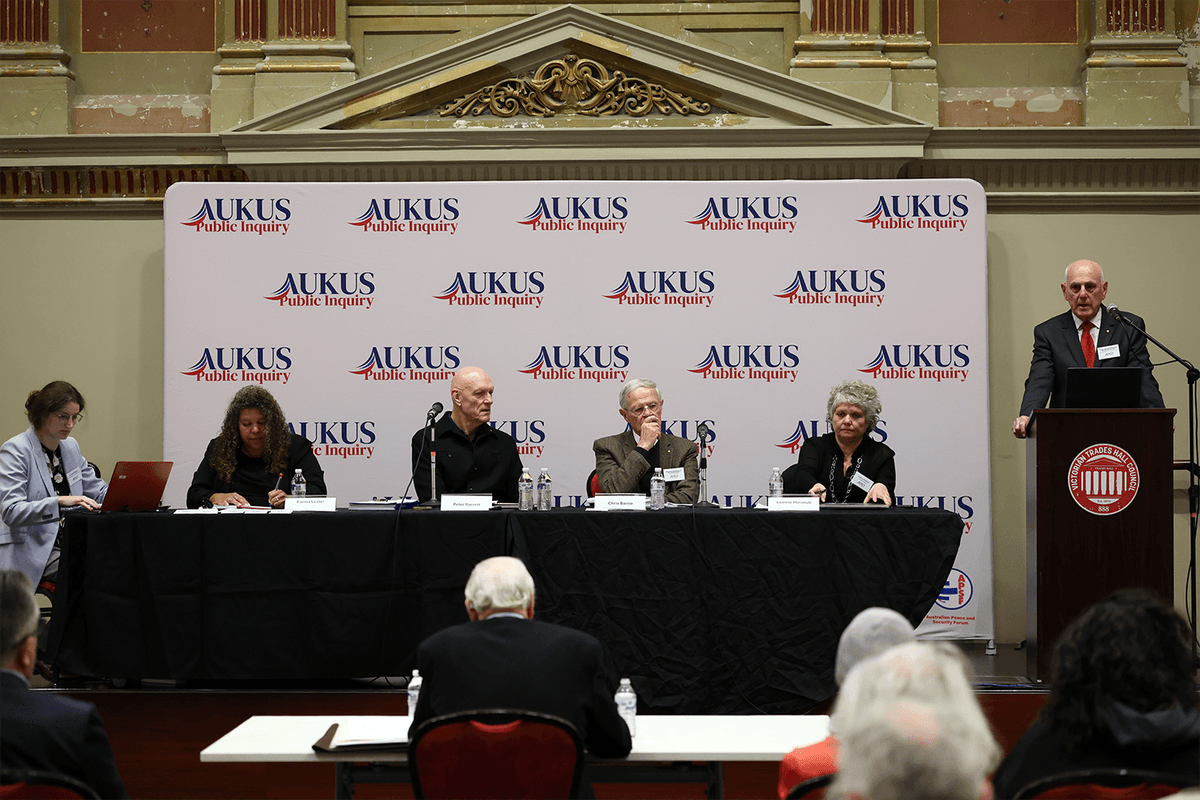
Australia will become a “junior” partner to the United States and lose its strategic independence if it continues to push ahead with the AUKUS nuclear-submarine deal, according to a former Defence Department analyst.
Dr Andrew Gaczol told a public inquiry in Adelaide that Australia remained influenced by an outdated view of its place within Western military alliances.
“We still view ourselves as a junior member of the Anglo Club, with its first loyalty being to the club instead of to itself,” Dr Gaczol said.
“Australian political class and defence policy community still think it’s our melancholy duty to support the military commitments of our great and powerful friends, even if they conflict with Australian interests.”
The former intelligence analyst argued AUKUS would further entrench Australia’s dependence on the US at a time when it should be developing an independent defence capability.
“There is a new world order coming, and Australia needs to position itself for that coming world order, not desperately try to cling to the one that is slipping away,” he said.
“The Europeans and Canadians have gotten the memo. Australia has not.”
“If we got the memo, what would the memo look like?” asked Commissioner Leanne Minshull, co-CEO at the Australia Institute.
“It’s about being as independent as possible with our defence capability,” he replied.
Dr Gaczol, who holds two postgraduate degrees in international relations, warned that relying on a single country for “almost all our military capability” left Australia vulnerable if diplomatic relations soured or supply lines were disrupted.
Earlier in the day, former defence minister Christopher Pyne made a similar point, telling the inquiry Australia needed the capacity to manufacture critical defence equipment if overseas supplies were disrupted.
“If we can’t get them because the Coral Sea is cut off from us, then we have to be able to make them ourselves, and that’s why you’re seeing investments in missiles, vehicles, underwater vessels, and unmanned aerial vessels,” Mr Pyne said.
Dr Gaczol also questioned whether Australia needed “eight or perhaps nine” nuclear-powered submarines with “unlimited endurance” to defend its coastline and keep trade routes open.
“I can’t see how such a small number of boats will be able to keep open all of Australia’s trade routes all of the time,” he said.
“The latest state-of-the-art air-independent propulsion diesel-electric submarines are more suitable as they are smaller, quieter when submerged, and better suited to the relatively shallow waters of the Australian continental shelf, particularly to the north.”
He argued the submarines’ primary purpose was not to defend Australia, but to support the United States in the event of a conflict over Taiwan.
“Given that Australia does not recognise Taiwan as an independent sovereign nation, nor has a security treaty with that island, I find it extraordinary that Australia should commit blood and treasure to such an enterprise,” he said.
Dr Gaczol said AUKUS had been portrayed as the only viable solution to Australia’s defence needs, while opponents were unfairly criticised.
“AUKUS is being presented as a panacea, and opponents are being accused of somehow wanting Australia to be defenceless and that opposition to AUKUS is an act of appeasement,” he said.
“This is quite frankly outrageous.”
Electrical Trades Union (ETU) assistant national secretary Matt Murphy told the inquiry he was concerned taxpayers weren’t being told the full story about AUKUS.
“Much of the talk of deterrence is, in my view, a cover for going to war,” he said.
He warned that a conflict with China “would not resemble any previous war in history”, saying Australia’s experience in Afghanistan would “pale into insignificance” by comparison.
“It would affect the entire region irrevocably,” he said.
“Our neighbours understand this. Indonesia and Malaysia have condemned this arrangement. They are right to do so.”
The union said the trilateral security pact would destroy Australian jobs and “surrender sovereign capability”.
“We are deepening our dependence on the United States at exactly the moment we should be building genuine, sovereign, independent capability here at home,” he argued.
Mr Murphy said the ETU said wasn’t “against defending this country” but had opposed the nuclear industry since the 1950s.
“We are strongly against the deployment of nuclear power and nuclear propulsion in Australia because of the risks associated with uranium mining and extraction, enormous build costs, the deadly consequences to human health and the environment when things go wrong, and its potential to take us down the path of devastating weaponry,” Mr Murphy said.