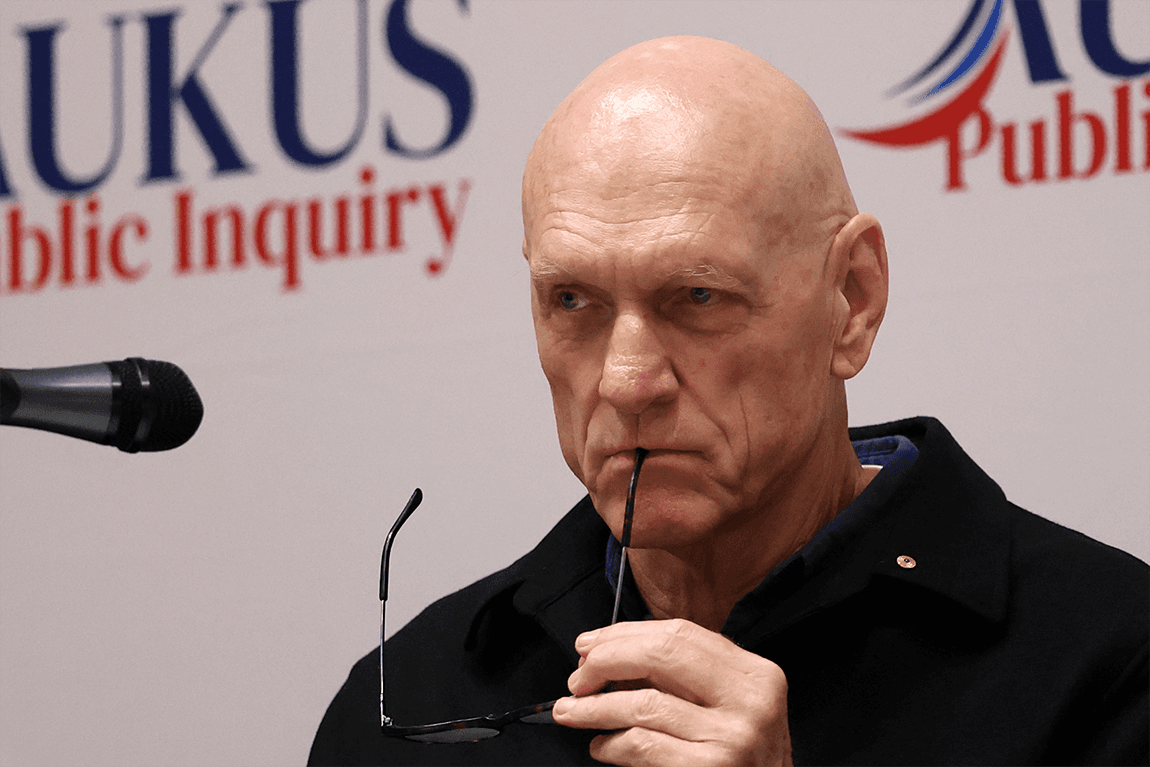
One of Australia’s leading submarine experts, retired Rear Admiral Peter Briggs, has declared that the AUKUS submarine plan is ‘flawed and undeliverable’, arguing a French alternative remains the best option.
Mr Briggs made the comments at the AUKUS public inquiry in Canberra, where demand to give evidence was so strong that hearings were extended to two days.
He told commissioners that Australia’s fleet should “absolutely be nuclear-powered” rather than conventional diesel-electric ‘snorting submarines’, which he argued were slower and more vulnerable to detection.
“They provide an asymmetric, an uneven advantage to us. And if you’re dealing with an elephant, that’s what you need — something that makes it take care,” he said.
“What we’re doing at the moment is not going to get there.”
Mr Briggs, who served 40 years in the Royal Australian Navy, including two submarine commands, criticised the lack of experience among those who drew up the submarine plan between Australia, the US and the UK.
“The so-called optimal pathway, designed, I think, by some political aides in a coffee shop,” he said.
‘No one who understood anything about maintaining submarines had much to do with the plan that’s been developed.’
Mr Briggs echoed numerous concerns heard throughout the inquiry that Australia is unlikely to ever see the three Virginia-class submarines it has been promised.
Under the AUKUS plan, which is projected to cost Australia $368 billion, a future US president must certify that the sale of the boats “will not degrade the United States undersea capabilities”.
Mr Briggs said US shipyards were already failing to meet their own requirements, describing the idea that there will be a “spare” Virginia boat available by 2031 as “fatuous”.
“Their shipyards are full of partly built submarines. Adding more money, there’s no point. They can’t build. They haven’t got the workforce. They haven’t got the supply chains,” he said.
He said the “really annoying thing” was Australia torpedoed a $90 billion submarine contract with France in favour of AUKUS.
“We turned down a perfectly viable and executable, deliverable option in moving from the French program to AUKUS,” he said.
Get our newsletter
Quality research, analysis, explainers and factchecks from experts you can trust.
“That option is, thankfully, still available. There is an alternative.”
Mr Briggs also argued that Australia won’t have the necessary infrastructure at Henderson in WA to meet its maintenance obligations.
The Albanese government is investing up to $8 billion to expand the nearby HMAS Stirling base, while $12 billion has been committed to the Henderson Defence Precinct.
However, Mr Briggs said the issues at Henderson are ‘huge’, and the site is already ‘very confined’.
He said failure to deliver the infrastructure could be enough for the US to refuse to sell Australia the boats.
“This is an impossible proposition. Huge and expensive,” he said.
He also warned against AUKUS submarines using highly enriched uranium, proposing Australia pursue a French design using low-enriched uranium.
“Once it’s active, it’s so toxic that no one can steal it. So, the security there is all about stopping people interfering with it and sabotaging it. It’s a huge burden,” he said.
“It is 24 nuclear weapons sitting in that reactor. You nick it, open it up. You solve your proliferation problem. You’ve created a good problem for someone else.”
The crowd-funded public inquiry has received more than 700 written submissions and has taken the public hearings around Australia.
“My concern around transparency has actually become anxiety over the capability gaps that Australia has got by putting all of our eggs in the AUKUS basket,” said commissioner Leanne Minshull, co-CEO at the Australia Institute.
“I feel by putting all of our eggs in the AUKUS basket, we’ve gone out to buy the latest iPhone, but we haven’t got a SIM card, and the charger’s got an American plug on it.
“What I want to see is the government have an open discussion, and I actually want some grown-ups to talk about what a defence policy for Australia looks like.”