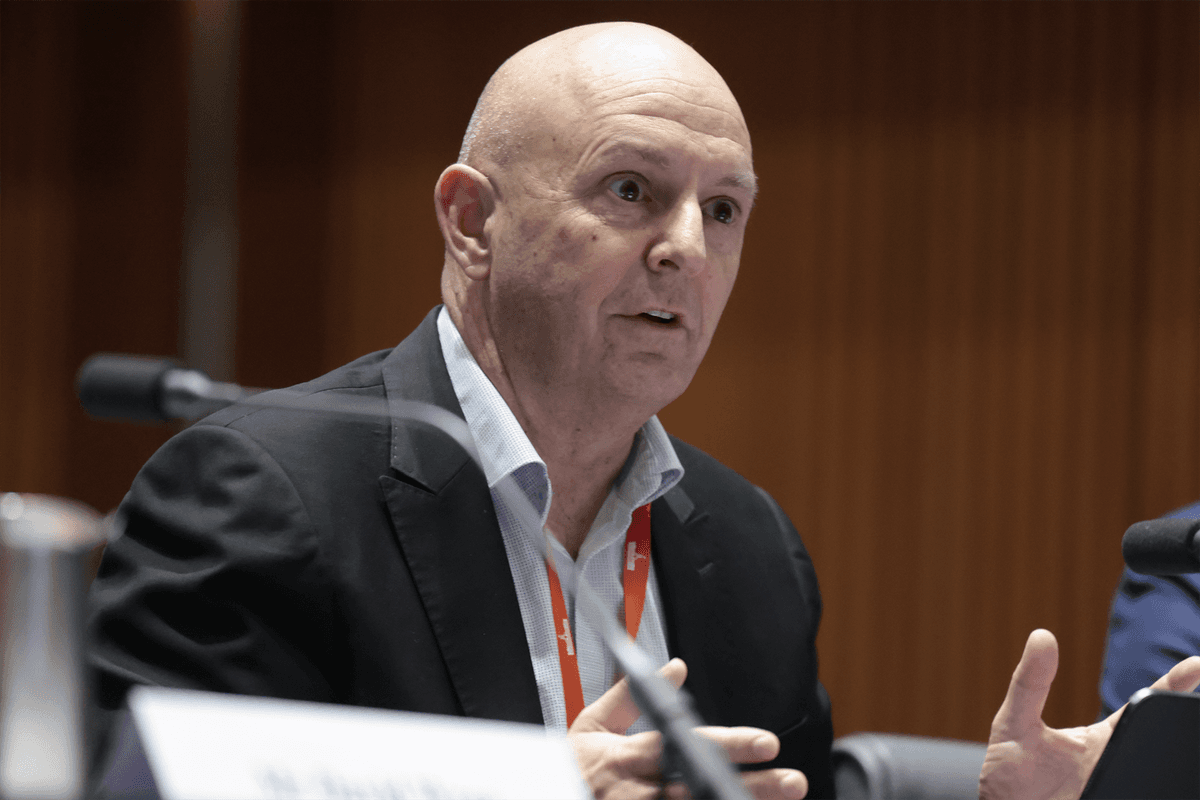
Prominent economist Dr Richard Denniss has warned a parliamentary inquiry that Australia is unprepared for the mass unemployment that AI companies are banking on to drive their profits.
The Australia Institute co-CEO told the Joint Select Committee on Artificial Intelligence that the rush to embrace the technology and build data centres was overshadowing critical questions about jobs and the economy.
“Unlike any technology we’ve ever dealt with, the business model of AI is to generate mass unemployment. That is not an unintended consequence; it is the business model,” he said.
“As an economist, I understand productivity; people lose jobs when technology changes. But the valuations of these AI companies are literally based on the assumption that hundreds of millions of people will lose their jobs and employers will buy AI services instead of labour services.”
Dr Denniss said that while much of the attention was focused on the technology itself, he was more concerned about the broader economic consequences.
“What is the ATO’s plan? What are the state government plans?” he asked the committee.
“Again, all that money that Anthropic is betting on is coming from somewhere, and that’s going to have very real consequences for individuals, for communities, for the economy, for the way Commonwealth budgets are drawn up.”
Dr Denniss also challenged the argument that Australia risked being left behind unless it rapidly embraced AI, warning that national security concerns should not be used to justify an unrestricted rollout.
“This rush, this sort of generalised assertion that if we don’t say yes to everything now we will miss out, is, I would suggest, unprecedented,” he said.
The Australian Strategic Policy Institute (ASPI) stressed the importance of national security, with executive director Justin Bassi arguing the government needed to act quickly on AI.
“We can’t wait for public trust when we’re dealing with something that is a geostrategic issue and is a national security issue,” he said.
“It is the government’s responsibility to build the trust and not wait until the public has that trust.”
But Dr Denniss disagreed, arguing public trust shouldn’t be sacrificed in the rush to embrace AI.
“I do think we do have to wait for public trust. I think to overtly say we can’t afford to wait to build public trust is actually one of the problems, not only on the issue of AI but on so many issues that our democracies face,” he said.
Get our newsletter
Quality research, analysis, explainers and factchecks from experts you can trust.
“From an economic point of view, it’s not even obvious that the frontier models will be generating the economic benefits that we’re so afraid of missing out on.”
ASPI’s head of AI and security, David Wroe, described AI as “the most strategically important technology in human history”.
“There is an important sovereignty discussion here, and that means building as much as we possibly can in Australia whilst recognising we can’t do everything,” he said.
“The fear of missing out is being used, I would suggest, to railroad an important public conversation where trust is key—about where data centres are built and how they’re built and for what,” Dr Denniss countered.
Labor backbencher Ed Husic has also questioned the pace of Australia’s data centre expansion, telling The Conversation’s Michelle Grattan that Australia was “going too fast” and was being “swamped by US tech”.
Tasmanian senator Jacqui Lambie has warned against “rolling out the red carpet” for foreign tech companies, accusing them of using promises of data centre investment to pressure the government over copyright laws.
“I’ve also heard that big tech is pressuring our government to do a deal over our copyright laws, otherwise, we don’t get their data centres,” she told Parliament earlier this year.
Greens Senator Sarah Hanson-Young has called for a moratorium on new data centres until enforceable standards are in place to regulate energy and water use and protect the environment and communities.
“AI is the new extractive industry. If we don’t have the right rules in place, big tech companies will take our resources and leave Australians with little to show for it,” she said.
Foreign Minister Penny Wong said the government wanted to “get it right” when developing standards for AI and data centres.
“Our intention is to ensure that these guardrails and standards enable this technology and this infrastructure to be rolled out safely,” she said.
Dr Denniss said Parliament needed to “get its skates on” and start preparing for the economic consequences of AI.
“If these companies are worth a trillion bucks, it’s because a lot is going to happen really fast,” he said.
“If they’re right, a lot is going to happen really fast, and we’re not ready. If they’re wrong, then we shouldn’t be rushed into doing everything they’re telling us.”