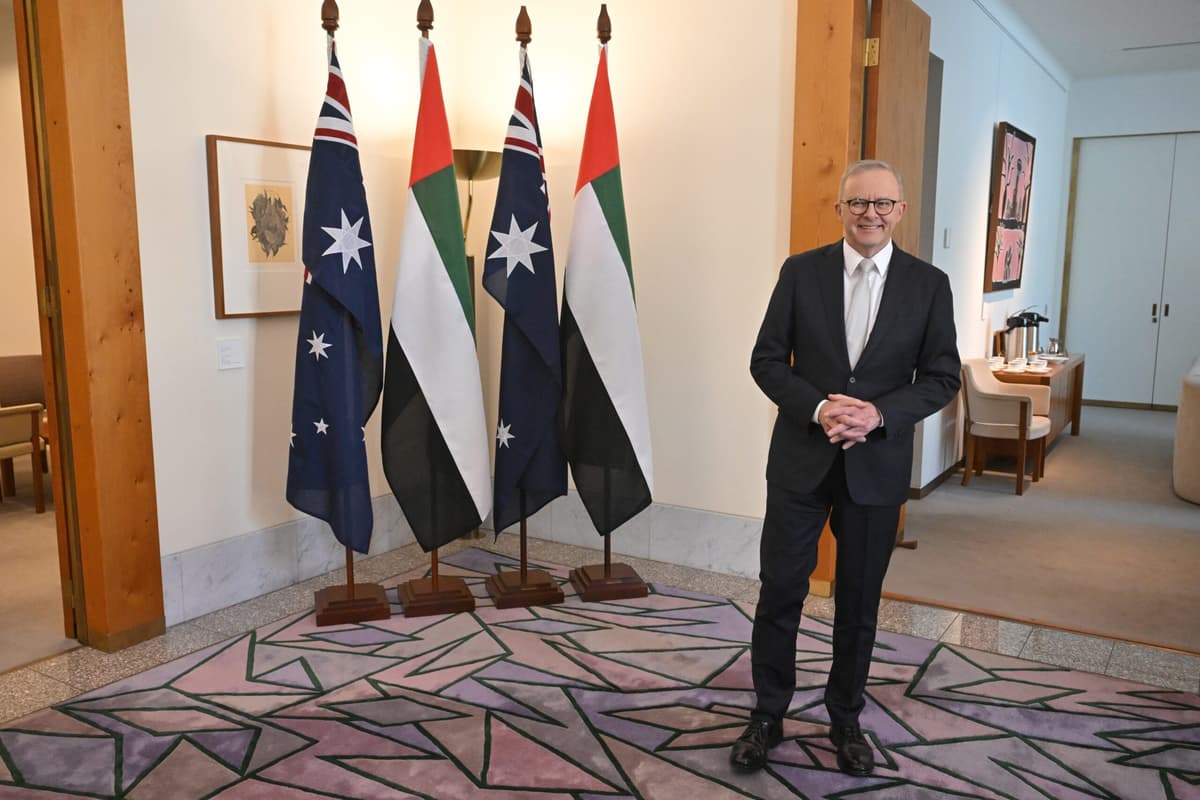
The Prime Minister has urged a prominent Middle Eastern billionaire to bring his global retail empire down under to challenge Australia’s supermarket duopoly.
Anthony Albanese recently finished a 10-day international tour with a stopover in the United Arab Emirates, visiting a Lulu “hypermarket” and extending an invitation to company chairman, M. A. Yusuff Ali, who has been named the most influential expat in the UAE.
“I’ve encouraged him to come to Australia,” he said. “We need more competition in the Australian supermarket sector.”
The retail king presides over the $7.3 billion company which boasts 240 stores across the Middle East and Asia.
“This company is big enough to have direct relations with (Australian) producers, whether they be mango producers, the orange producers, the meat producers that the chairman met in Mudgee that are still providing Halal-certified meat into this market,” Mr Albanese said.
Speaking on the Australia Institute’s Follow The Money podcast, Director of International & Security Affairs, Doctor Emma Shortis pointed out the public plea coincided with the start of Australia’s free-trade agreement with the UAE.
“This is a nice example of how the establishment of effective, deep, diplomatic relationships can have potentially significant impacts on our local economy and how much those relationships matter,” she said.
On Lulu’s own figures, its typical hypermarkets are roughly two to three times as large as Australian supermarkets, Woolworths and Coles and sell everything from groceries and fashion to electronics, appliances and sports equipment.
However, speaking on the Australia Institute’s Dollars & Sense podcast, Chief Economist and co-host, Greg Jericho, warned Aussie shoppers not to get too excited just yet.
“It is going to happen? Probably not,” he said.
“I figured they would have already done it,” said co-host and Senior Content Producer, Elinor Johnston-Leek. “It’s a very cute name but it does feel like a bit of a nothingburger.”
Mr Jericho said Australia is “going to need to get more competition” from foreign companies, supermarkets, department stores to fire up competition again.
“For many people, there really isn’t much of a choice. You can go to Coles or Woolies.”
“They dominate the market so much,” added Ms Johnston-Leek, “they really don’t need to compete in price.”