New data from the Australian Electoral Commission reveals the biggest donors to political parties, and why long-awaited electoral reforms don't go far enough.
Tue 3 Feb 2026 01.00
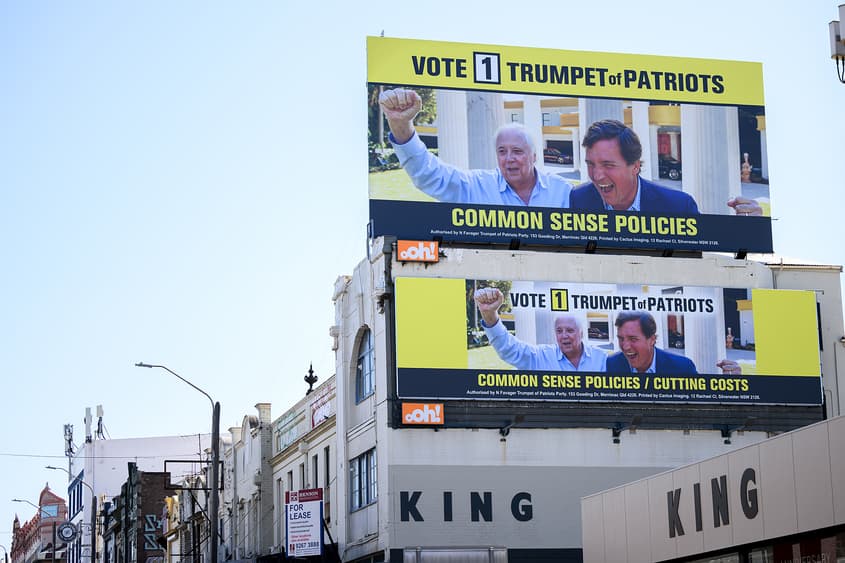
A billboard showing an advertisement for Clive Palmer’s Trumpet of Patriots party is seen in Sydney, New South Wales, Thursday, March 13, 2025. (AAP Image/Bianca De Marchi)


Australia’s biggest political parties raised and spent a record $880 million in the years leading up to the 2025 federal election.
That’s a significant increase on the $704 million spent in the years leading into the 2022 election.
Every February, the Australian Electoral Commission releases a significant amount of data: who made large donations to political parties, how much parties raised and spent, and what the budgets of third-party campaigners looked like.
The AEC calls it the “annual financial disclosure return information from political parties”.
The 2024/25 data, released yesterday, reveals Clive Palmer’s Minerology was the only large donor to his Trumpet of Patriots party, which ran candidates in two thirds of the 150 House of Representatives contests.
Mr Palmer’s company donated $54 million to Mr Palmer’s political party which, like his United Australia Party in 2022, failed to win a single seat.
By far the best funded group was the former Coalition, with the Liberals spending $193 million and the Nationals $19 million.
The Labor Party spent $160 million and the Greens $40 million. These figures include administrative spending and some state/territory election campaigns, but the lion’s share presumably went to the federal election campaign.
Federal Independent candidates are subject to earlier and different reporting requirements, but for the purpose of comparison Independents spent $29 million at the 2025 federal election.
The timing of the data drop means some of the donations happened as long as 19 months ago – a far cry from the real-time disclosure of donations, to which the Albanese Government committed ahead of the 2022 federal election.
Late last year, the Government struck a deal with the then-Coalition opposition to rush through the long-awaited changes to the nation’s election laws, including real-time disclosure of donations over $5,000. (Labor had originally supported the idea of real-time disclosure of donations over $1,000.)
“Waiting up to nineteen months to find out who is funding Australia’s political parties is ridiculous. Fortunately, from the middle of this year stricter donation laws mean Australians will find out about many political donations in real time,” said Bill Browne, Director of the Australia Institute’s Democracy & Accountability Program.
Mr Browne was critical of the “rushed and unfair” electoral reforms, saying they favoured major party incumbents, ensuring they’d have significantly more taxpayer dollars to fund future election campaigns, while making it harder for minor parties and independent candidates to compete.
“Last year, Labor, Liberal and the Nationals voted together to dramatically increase taxpayer funding – to the extent that when the next election comes around, the taxpayer will be funding over half of the cost of major party election campaigns,” he said.
“In Australia, it’s perfectly legal to lie in a political ad. And thanks to taxpayer funding of election campaigns, you could be the one paying for the ad that lies to you.”
“Democracy depends on robust competition and a diversity of voices, but in Australia the playing field is tilted towards incumbents and major parties at the expense of new challengers.”
Mr Browne said the major parties could still raise money through cash-for-access payments where powerful lobby groups, organisations and rich individuals effectively buy access to people like federal ministers – anything from a seat at a fundraising event to one-on-one face time with a politician.
“Even with improved donation disclosure rules, there will be cash-for-access payments that Australians never find out about,” Bill Browne said.
Advertisement