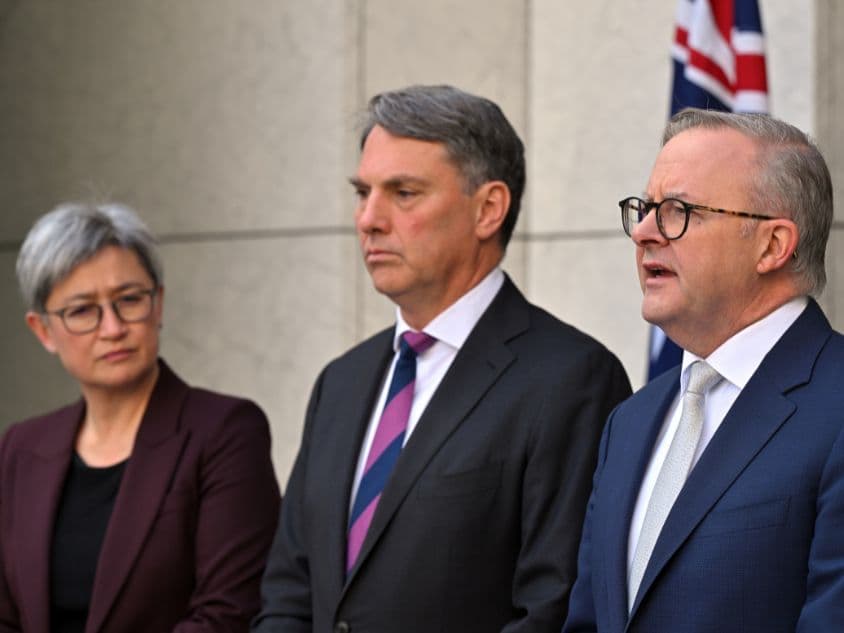
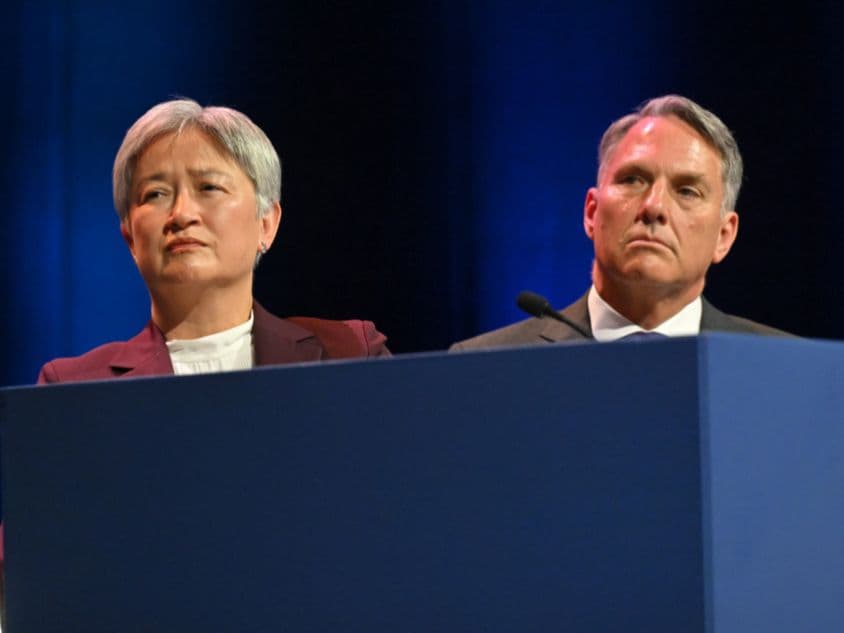
Australia’s AUKUS agreement has dragged the country into the Trump administration’s war on Iran with Prime Minister Anthony Albanese accused of obfuscating the country’s involvement.
After initially refusing to comment, Mr Albanese confirmed that three sailors were on board the US attack submarine that sank an Iranian warship in waters off Sri Lanka, as part of training under the agreement.
“I can confirm also, though, that no Australian personnel have participated in any offensive action against Iran.”
However, international relations expert Dr Emma Shortis dismissed the government’s attempt to draw a distinction between presence and participation.
“The government can dance around it as much as it likes. There are no passengers on nuclear powered submarines,” said the Australia Institute’s Director of International & Security Affairs.
“Not participating is not a thing and this is what AUKUS does.”
Hosting the Australia Institute’s After America podcast, she said the agreement had pulled Australia into the conflict “in all but name” and argued the development was “entirely foreseeable”.
“Australia is part of it, whether we like it or not.”
The Greens defence spokesman, David Shoebridge, said it was an “inevitability” of AUKUS.
“The Albanese Government has been lying to the Australian public about its role in the illegal US and Israeli war in Iran.
“Those lies have consequences and have already implicated Australia in US war crimes.”
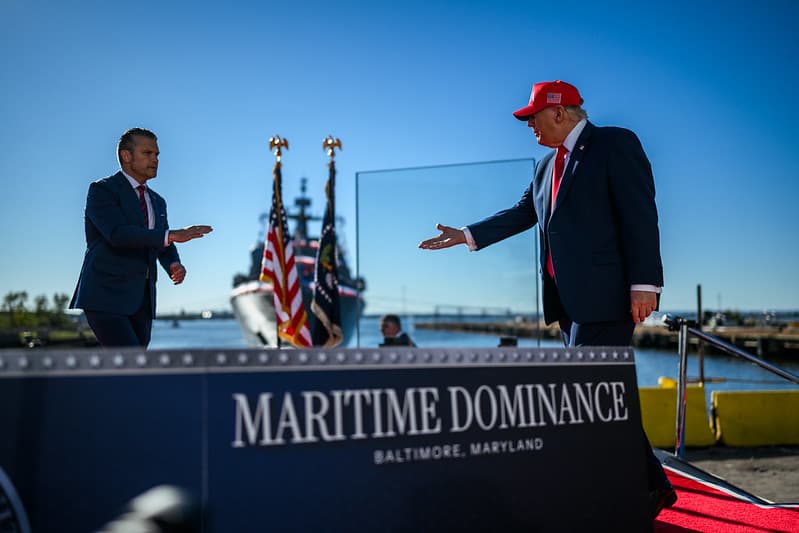
Dr Shortis said the conflict represents a broader pattern in Donald Trump’s leadership.
“There are no neat dividing lines between Trump’s foreign policy and how he behaves domestically.”
The US president most recently used his State of the Union address to declare a new “war on fraud”, claiming Minnesota’s Somali community has “pillaged” an estimated $19 billion.
“He almost seemed to try to pin the entire [budget] deficit on the Somali American community,” said Dr Shortis.
“Trump’s obviously always been appallingly racist, but the brazenness of that, I think, should still be shocking. It’s clearly an effort to redirect the blame away from him.”
Elizabeth Pancotti, from Washington DC-based think tank Groundwork Collaborative told the After America podcast that “when we look at who doesn’t pay their taxes or who cheats on their taxes, it is the wealthy”.
“The vast majority of corruption in our government is not in fact driven by working Americans who are just trying to get by and get a little help.”
The State of the Union address is a major annual speech given by the US President to Congress.
According to Ms Pancotti, previous Presidents have used it to “roll out landmark proposals that they hope to turn into law”, however Donald Trump spent “just a couple of minutes out of the nearly two-hour speech” discussing the economy and affordability – one of the biggest political issues in recent US elections.
“There are actually few real achievements to brag about, so he seems to fudge the numbers or lie or strategically point to things,” she said.
Groundwork Collaborative’s managing director of policy and advocacy said while Donald Trump originally pitched himself “as this populist who is taking on the establishment and taking on the wealthy” people are “starting to see the cracks in his authenticity”.
“I think that his landmark legislative achievement is an extremely unpopular tax bill that primarily cuts taxes for the wealthy,” she said.
“The things he follows through on are kicking millions of people off their healthcare.
“It’s one thing for him to post [he’s] taking on Wall Street, and it’s another for him to invite tech CEOs to his inauguration and give tax handouts to big investors.”
While the Democrats have struggled to respond to Donald Trump’s penchant for contradictions and unpredictability, she said “we have seen some really exciting green shoots in the last few months”.
That includes “realising that they have to do more than just say, ‘No, Trump bad’ – that they have to be for something.”
Using grocery prices as an example, she pointed out it’s not enough anymore to simply increase food stamp benefits.
“That doesn’t bring prices down.
“We are seeing a lot more people really catch on to the idea that they have to take on corporate power and they have to take on massive inequality in our economy and the ramifications it has.
“And I think that’s really important that we’ve made progress there.”
Subscribe to After America on Apple Podcasts, Spotify, Pocket Casts or wherever you get your favourite podcasts.