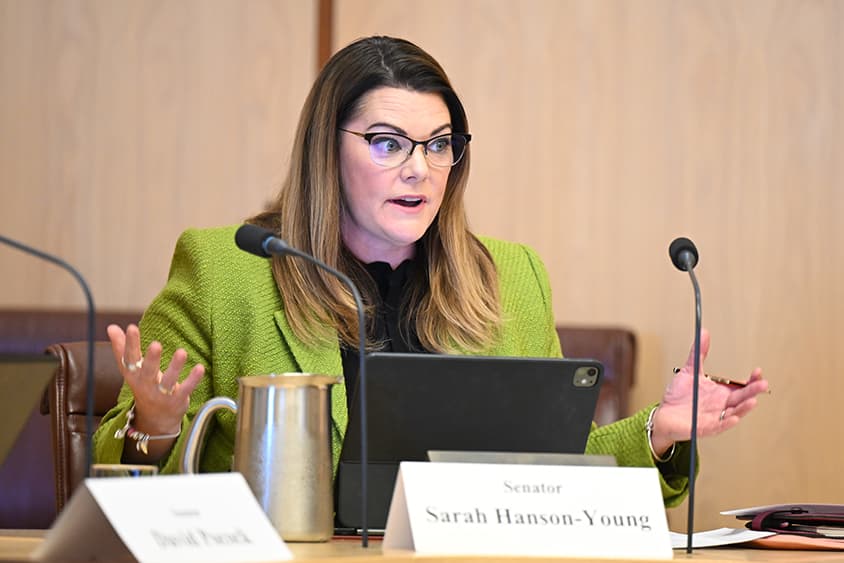
Pressure on the Business Council of Australia (BCA) to reveal which members informed its opposition to a gas export tax sparked a heated exchange on Wednesday, with Senator Sarah Hanson-Young reminding BCA Chief Executive, Bran Black, that he “wasn’t in ASIO”.
Mr Black gave evidence to the Senate inquiry on its second day of public hearings, arguing a levy would be “counterproductive” at a time when Australia needs more investment.
“Energy investors are like butterflies – if they are scared, they fly away,” he said, citing the head of the International Energy Agency (IEA).
The inquiry is examining how the country taxes the gas industry, amid calls for a new 25 per cent export levy.
In its written submission, the BCA argued: “if Australia becomes less competitive for any reason, investment goes elsewhere”.
“Australians are already receiving a fair return,” Mr Black told the committee, warning that a new tax would drive away investment and leave Australians with “less gas, higher energy prices, and a slower path to net zero”.
He said the BCA had encouraged members to “speak their minds” to help form its policy position but refused to disclose their names.
“You’ve put forward a very strong proposition against this policy. I’m wanting to know which members of the BCA you consulted,” said Senator Sarah Hanson-Young.
Mr Black said the association engaged with its members on a confidential basis.
“If I start talking about BCA internal processes, then that undermines the confidence within which I have those conversations,” he said.
Senator Hanson-Young rebuked: “I’m sorry, you’re a business association. You’re not ASIO, you’re not the AFP, and you’re not federal cabinet. I’m asking you, has this been discussed at the board level?”
“I respectfully provide the same answer,” replied Mr Black.
“With respect, you are under the orders of the Senate to answer questions,” shot back Senator Hanson-Young.
“Mr. Black, if we, if we had every, every witness come here and say, we are only going to answer questions based on our own rules, our own processes, we wouldn’t get very far.”
Earlier in the day, Queensland Resources Council CEO Janette Hewson argued that all Australians are “benefiting” from higher gas prices.
“We’re unsure why there is a need to add a new tax,” she said.
“We believe that through the company tax structure, through the Queensland royalty scheme, all Australians are benefiting from higher prices at a time when you do have higher prices.”
Ms Hewson questioned the rationale behind a new tax, saying, “We just don’t understand what the problem is that this is meant to solve. We just see it actually resulting in a decrease in taxation revenue base”.
She warned imposing a “moderate tax increase” sends a signal “that investment is not welcome”.
“I think you won’t be surprised if I say I don’t think there’s ever a good time to impose taxes, but I’m saying it on the basis of this is all about how it’s done.”
The QRC was keen to point out the oil and gas industry is Australia’s second-largest corporate taxpayer, but the claim failed to convince Independent Senator David Pocock.
“The thing I hear from a lot of Australians is that they are growing very tired of hearing from a gas industry that wants to pat itself on the back for paying payroll tax. Every big business pays payroll tax,” he said.
“What we’re talking about here are the raw materials, this finite resource that belongs to all Australians. That a company like Santos can export $47 billion worth of gas and pay $0 in corporate tax.”
Greg Jericho, chief economist at the Australia Institute, said the industry’s claims need to be viewed in context.
“Saying you’re one of the biggest tax-paying industries does not read as great when it essentially means they are one of the most profitable industries,” he said.
“The most recent figures from the ATO show that in 2022-23, when the gas industry was making huge profits off of the Russia Invasion of Ukraine, it was paying less tax relative to its profits than other industries.”