Employment Minister Amanda Rishworth has announced what she described as “once-in-a-generation reforms”, declaring Australia’s “one-size-fits-all” employment services system is failing the country’s 1.1 million jobseekers.
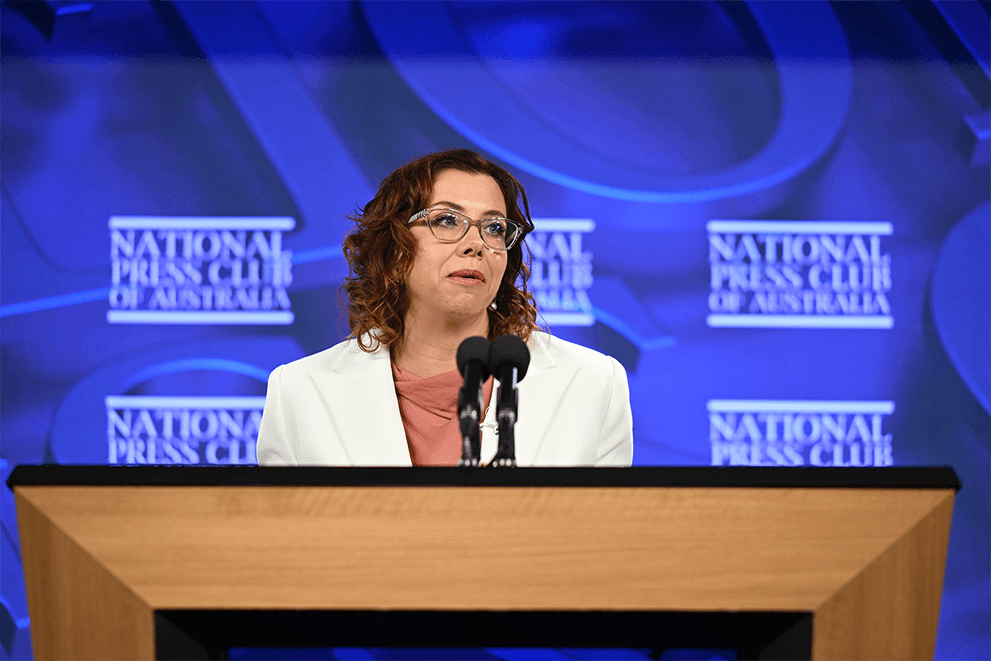
In a speech to the National Press Club, Ms Rishworth said the current system was “letting people fall through the cracks” and a more personalised, streamlined approach was overdue.
“I cannot understate the big job in front of us. This is major complex reform, but it will be worth it,” she said.
“Suitable employment must be the goal for every participant, but the timeframe and pathway for getting there will be different for each individual based on their barriers to employment and their distance from the labour market.”
The new system will provide three streams of support for jobseekers: a digital service for those ready to work, provider-led assistance for people needing to build skills and confidence, and a more intensive stream for people facing complex barriers who require more time.
There will also be changes to mutual obligation requirements: tasks and activities recipients must agree to complete to qualify for financial support while they receive help to find a job.
Dr Gemma Killen, Executive Director of the Working with Women Alliance, cautiously welcomed the reforms, “so long as they do not create further barriers to accessing income support”.
“The system’s underlying assumption – that people will not seek work without the threat of penalty – fails to recognise both the complexity of unemployment and the essential social and economic contributions of unpaid labour, most of which is performed by women,” she said.
“We know that in the current system, women are more likely to be placed in insecure, casualised or short-term work where they routinely face discrimination or harassment,” said Dr Killen.
“Without ongoing or practical support, women are landing in unsafe jobs or being penalised by the mutual obligations system for not accepting or tolerating unsafe or insecure jobs.”
Minister Rishworth said going forward mutual obligations must be “fair, proportionate, and above all effective”.
“I hear from job seekers and employment service providers that many mutual obligations are meaningless: a grab bag of busy activities that simply do not lead to a job,” she said.
Mutual obligations have long been criticised for prioritising compliance measures over tangible employment outcomes.
“Mutual obligation and the Job Services network as a whole has been an utter failure,” said the Australia Institute’s Chief Economist Greg Jericho.
“They have always been about punishment rather than helping people get a job.
“It comes from the Howard belief that being unemployed is a failure of the person and that receiving unemployment benefits is something you should be grateful for and more than that, should have to earn.”
Minister Rishworth said the incentive structure for providers will also be overhauled to focus more on whether jobseekers are being placed in the right roles.
“The incentive structure for providers often means there is not enough regard as to whether the job is suitable, which often leads to poor job fit, and poor job fit often leads to poor outcomes for the participant and for the employer,” she said.
“Basically, job providers get rich by just giving people any job, taking the government’s money and laughing as they bugger off overseas for their holiday while the unemployed person gets the shitty job that is not suited, leaves it and is back with a job provider,” summed up Mr Jericho.
“The government’s own Employment White Paper in 2023 found that Job Services providers failed disadvantaged and low-skilled unemployed and focused on the more profitable highly skilled unemployed who actually did not need any assistance finding a job”.
Minister Rishworth said 20 per cent of the Workforce Australia caseload “has been stuck in the system for over five years”, a figure she described as “just too high”.
The Australia Institute’s Chief Political Analyst Amy Remeikis said the changes need to be accompanied by a rise in the JobSeeker rate.
It currently sits at around 42 per cent below the poverty line, with the 2026-27 budget papers revealing the government plans to reduce spending on the program.
“At the same time as the RBA is raising interest rates to make more people unemployed, in a heavy-handed attempt to tackle potential future inflation, Treasury is revising down expenditure in Jobseeker, claiming there will be a 3.8 per cent drop or saving of $700 million over two years,” she said.
The employment services system has a troubled track record, with multiple investigations uncovering widespread governance failings that have prompted fears it could mirror the unlawful Robodebt scheme.
An August 2025 Commonwealth Ombudsman report found 964 jobseekers had their income support payments unlawfully cancelled between April 2022 and July 2024 due to chronic maladministration.
A subsequent Ombudsman report in December 2025 found the Department of Employment and Workplace Relations (DEWR) had high rates of overturned decisions, inadequate oversight of privatised providers, and misleading communications regarding mutual obligation penalties.
“Stigmatisation of unsuccessful job seekers as people who are reluctant to accept employment may contribute to the limited oversight of providers and possible narrow administration of the program,” noted Commonwealth Ombudsman Iain Anderson.
His second report also criticised private providers for using flawed and sometimes unlawful processes within the Targeted Compliance Framework.
The newly announced reforms will now go through a consultation and design process, and won’t take effect until mid-2028.