Former defence minister Linda Reynolds has warned Australia has been in a ‘hybrid and grey zone war’ with China for years, arguing the country remains unprepared and that no ‘credible Plan B’ to the AUKUS submarine deal has been proposed.
Mon 29 Jun 2026 15.57 AEST
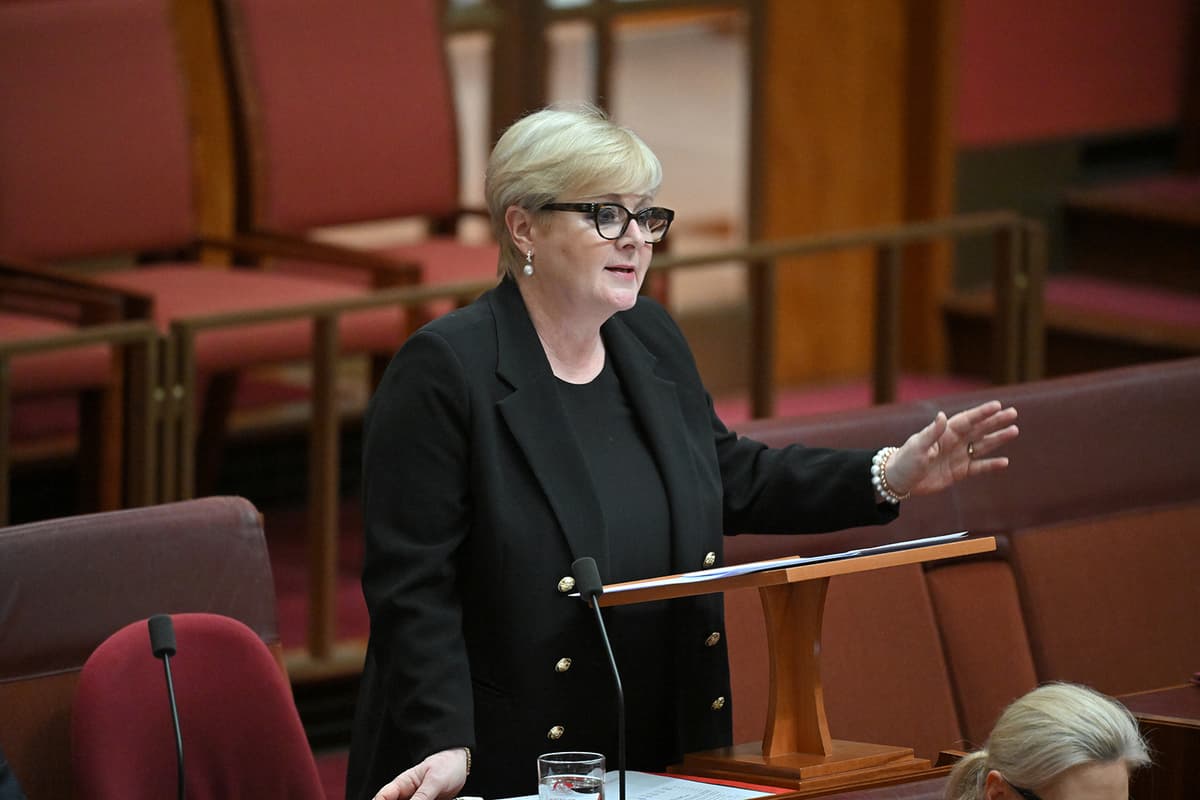
Photo: AAP Image/Mick Tsikas
Former defence minister Linda Reynolds has warned Australia has been in a ‘hybrid and grey zone war’ with China for years, arguing the country remains unprepared and that no ‘credible Plan B’ to the AUKUS submarine deal has been proposed.
Giving evidence to the AUKUS public inquiry in Fremantle on Monday, the former WA senator argued the threat was not limited to conventional military conflict.
“We’ve actually been at war with that bloc, and particularly with China, since before I was minister,” she said.
“Now, that’s not kinetic war … but it is what’s called hybrid and grey zone war.”
Ms Reynolds pointed to warnings by ASIO director-general Mike Burgess that Australia was facing “unprecedented levels of espionage”, including cyberattacks targeting critical infrastructure.
He recently revealed the agency had foiled a plot to access the nuclear submarine program and said the trilateral defence pact was expected to be targeted by foreign countries in the future.
“Not only do they attack to interfere, they also put malware on the software … so that they can work out how to turn the systems off,” Ms Reynolds said.
“If they can turn our power off, they can turn our navigation off, they can interfere, if not destroy our communication satellites, our nation stops,” she said.
“They most likely won’t have to physically invade, you know, storm the beaches of Australia, but they don’t need to anymore to neutralise us.”
Ms Reynolds argued the threat extended beyond China alone, pointing to the growing cooperation between China, Russia, Iran and North Korea.
“These four authoritarian states are pooling their strength, and they are learning very, very quickly from each other’s wars, and they are implementing those lessons very, very quickly,” she told the inquiry commissioners.
“The stark fact is that China is in its largest military buildup of any nation since 1945 – 31 years now and counting.”
Despite the growing cyber threat, Ms Reynolds said Australia remained poorly prepared.
“We have not taken this issue seriously,” she said.
“We still remain very flat-footed in working out what that threat means for us, and what we then have to do to counter it.”
“So those are the attacks that will increase first if we have a war in our region, in the South China Sea and we have no defences against those [attacks] at the moment.”
Ms Reynolds, who served as Minister for Defence from 2019 – 2021, defended the $368 billion AUKUS submarine deal, arguing no credible alternative had been proposed.
“I absolutely believe that AUKUS is strengthening our sovereignty,” she said.
“I have not yet seen anybody put forward a credible Plan B.”
“To abandon AUKUS over a delivery shortfall would be akin to an answer to a leaky roof being to sell the house itself.
“We have to deliver it, but we have to deliver it faster, and we need new priorities.”
She argued Australia’s defence spending had effectively declined and that the country’s immediate capability gaps were more concerning than delays to the submarine program.
“The new AUKUS class of submarine are a generational build,” she said.
“They are not something that can or should be acquired immediately, and they have a much longer and different funding envelope.
“But the near-term weapons, missiles, and the defences against missiles and drones are the things that we now need to deliver, and they’re the very things that the government is not yet adequately funding in the budget.”
Ms Reynolds rejected suggestions AUKUS had made Western Australia a military target in the event of a conflict involving the United States.
“As soon as we built HMAS Stirling, it became a target,” she said.
Asked if she thought Australia was prepared for such an event, she replied, “No. I’ve been very critical for a long time, for 10 years, well before AUKUS.”
However, she said Australia shouldn’t respond to geopolitical tensions by weakening its alliance with the US.
“It is a complete fallacy to say that we can uncouple from the United States in terms of our military capability,” Ms Reynolds said.
“All of our advanced systems, our weapons, our capabilities are all completely seamlessly integrated with the United States. They’re interoperable, is what it’s called.
“So, even if we wanted to, tomorrow we couldn’t, and nor should we want to.”
She said the lessons of history suggested that making concessions to authoritarian states would ultimately fail.
“I think World War Two is probably the best analogy we have at the moment,” she said.
“Appeasing autocrats and dictators does not work, and it inevitably leads to war.”
Advertisement
Spare a thought for Saudi Arabia. Its almost-omnipotent leader Crown Prince Mohammed bin Salman (MBS) notwithstanding, it’s in dire straits — and not just in the Strait of Hormuz and Bab el-Mandeb. Its faith-based security strategy has left it in a diabolical position, with immeasurable consequences for the Middle East as a whole.