A former Western Australian public health chief has warned the AUKUS inquiry that there is a ‘nuclear disaster waiting to happen’, arguing there is no safety plan to protect Perth communities in the event of a major nuclear accident at naval base HMAS Stirling.
Dr Colin Hughes, the former head of Public Health in Perth, told the independent inquiry that governments had failed to adequately prepare for the possibility of a nuclear accident involving visiting or serviced submarines.
“There is actually no nuclear safety plan for Rockingham, Kwinana, or the people of Fremantle and Perth in the case of a major nuclear catastrophe,” he said.
Dr Hughes described a worst-case scenario involving a major incident at a submarine servicing facility, triggering explosions, fires, radiation leaks and mass evacuations across Perth’s southern suburbs.
“Concrete slabs are scattered across access roads, twisted steel hangs from shattered structures,” he said.
“Sections of the reactor building are simply gone. Fires burn in dozens of locations.
He said emergency responders would be confronted by an “invisible threat”.
“Radiation cannot be seen. It has no smell, no colour, no warning.
“Radiation alarms on emergency vehicles begin sounding, and some responders stare at the readings, unsure whether the instruments are malfunctioning.
“Commanders quickly realise this is not a normal fire.”
Dr Hughes said the scenario had been developed with the assistance of ChatGPT and was based on historical nuclear disasters, including Chernobyl and Fukushima.
“The precautionary principle in medicine is always to take the worst-case scenario and to say, ‘we need to be able to plan for it and prevent it’,” he told the inquiry.
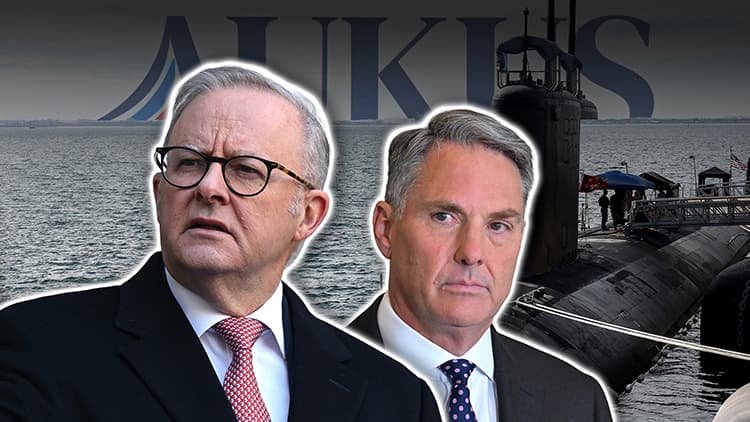
Under the AUKUS agreement, Australia will purchase three second-hand Virginia-class submarines from the United States, with deliveries expected from the early 2030s.
Dr Hughes argued governments needed to answer some fundamental questions before moving ahead with the trilateral security pact.
“Where is the hazard equipment for our first responders to be able to go down there and extract people who have been injured? And where do they go? What are the hospital facilities?” he asked.
“Where’s the map that says this childcare centre, that kindergarten, that school, that aged care centre — how many people are there? Where are they going to go, and how are we going to do it?
“Because that is what we need to know as a population.”
Commissioner Dr Carmen Lawrence, a former WA Premier, said comparisons with overseas nuclear submarine bases highlighted how little information was available to communities living near HMAS Stirling.
“I’ve had a good look at some of the material that exists in the UK and the US, in communities that are home bases for nuclear-powered vessels and, in some cases, nuclear-armed vessels,” she said.
“And I have to say on the basis of that comparison we’re not doing very well at this stage in terms of informing our population, let alone first responders.”
Dr Hughes told the hearing that Western Australia had navigated the COVID-19 pandemic successfully because the state had ‘listened to the science’.
‘We saved over 10,000 lives because government listened to health professionals,’ he said.
“But they’re not listening now. They’re ignoring the fact that we have a nuclear disaster waiting to happen.”
Commissioner Lawrence acknowledged that while the chance of an accident may be ‘low probability’, the consequences would be ‘high impact’.
Dr Hughes also raised concerns about the potential long-term health impacts of radiation exposure, citing studies that showed “people who serve on the submarine are 30 per cent more likely to develop cancers of various kinds.”
He argued governments needed to assess the risks associated with accidents, terrorism and military conflict and ensure communities were prepared.
“My plea is, please, if you are going to continue with this madness, at least tell the people of Rockingham and Kwinana how they are going to escape or protect themselves from a nuclear disaster waiting to happen,” he said.